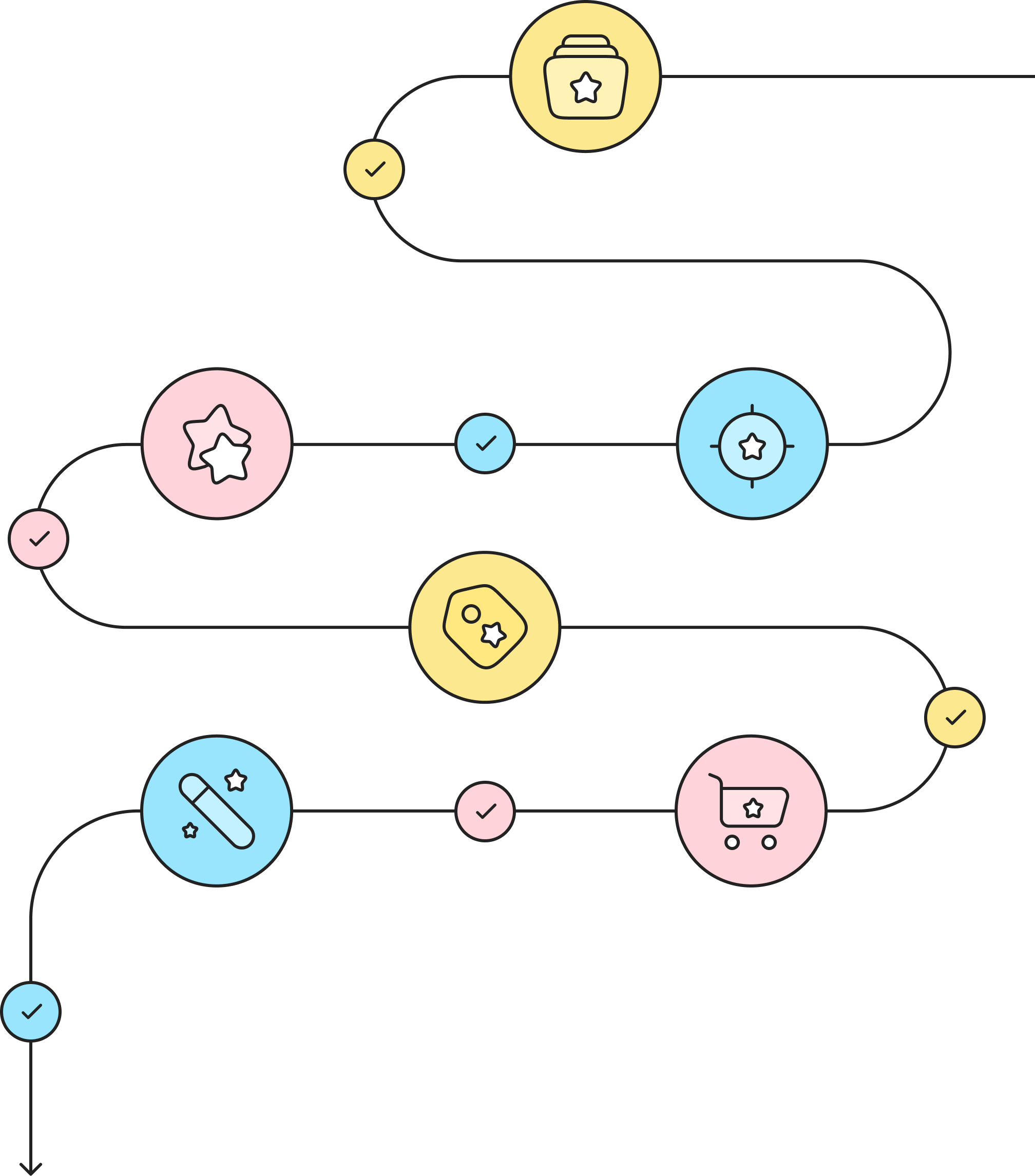
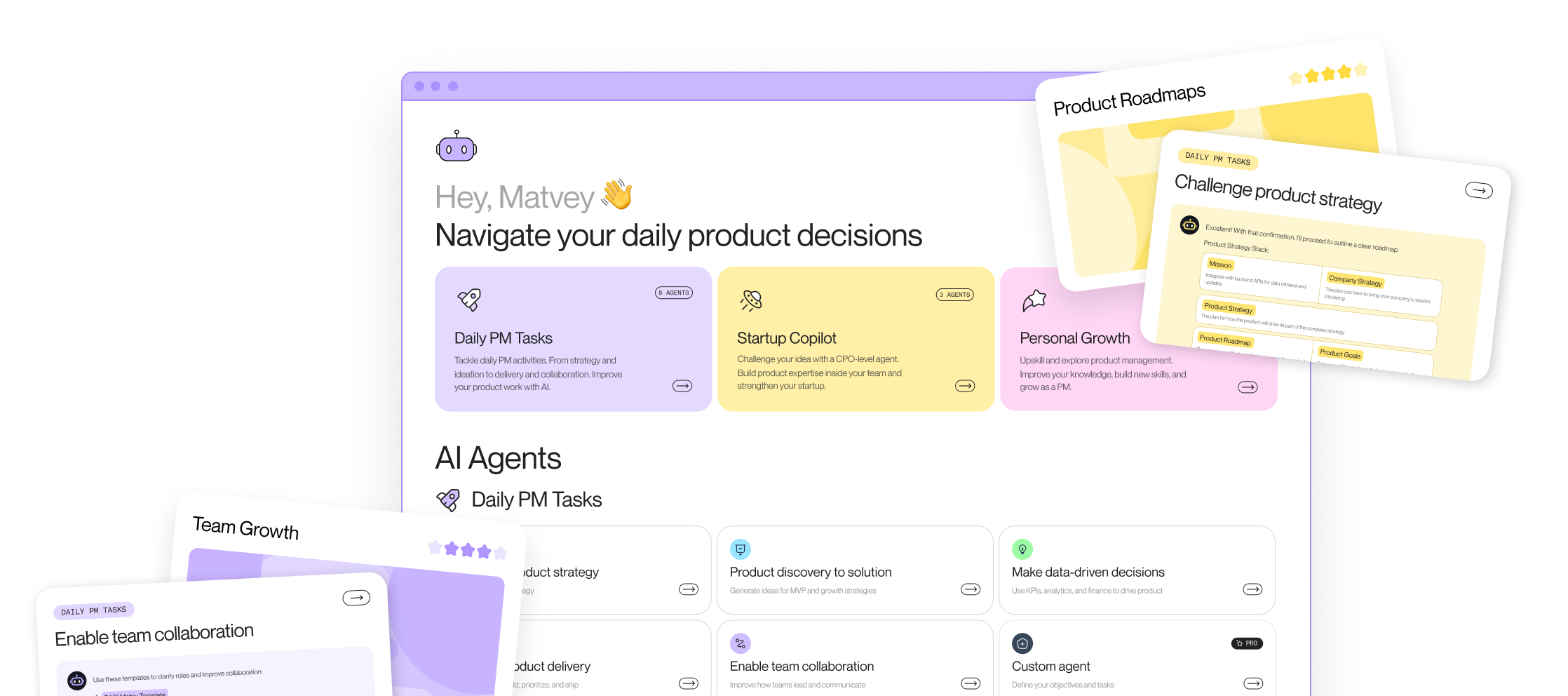
In 1 to 2 weeks of full-time work, you'll launch a product, get your first paying customers, measure unit economics, and prove one channel can convert. Along the way, you'll write about 30 artifacts covering vision, ICP, MVP scope, pricing, and launch metrics. These become your investor material and AI product context.
Research the market and size the realistic opportunity.
competitor-matrix.md
market-sizing.md
Why it matters
Analyst reports can make a market look huge. Your reachable segment may be tiny. Bottom-up numbers and competitor gaps tell you whether the opportunity is worth the effort.
What to do
Replace market opinions with evidence: secondary research for context, bottom-up sizing for scale.
Define what you need to learn
Write 3 to 5 specific questions research must answer. Vague research produces nothing.
Run secondary research
Pull industry reports, pricing pages, and search trends to map the market quickly.
Size the market bottom-up
Estimate TAM, SAM, and SOM from customer counts and realistic revenue. Show assumptions.
Analyze competitors and gaps
Compare 5 to 8 alternatives on positioning, pricing, and target buyer. Identify who they underserve.
Document market constraints
Note regulation, sales cycles, and switching costs that will slow adoption.
Hands-on resources
Review competitors and market shifts with these tools and agents, then look for underserved segments.
Narrow the market to one beachhead segment and describe your ideal customer.
segmentation.md
ICP-CARD.md
Why it matters
You don't have enough time or money to serve everyone. A narrow ideal customer profile raises conversion and retention. Disqualifiers stop bad-fit customers from pulling your roadmap apart.
What to do
Pick one segment you can name, reach, and serve better than anyone, then write its ideal customer profile (ICP).
Pick a segmentation model
Choose one lens: behavioral, benefit-based, ABCDX, or 5W. Do not stack models.
Define 2 to 3 candidate segments
Describe each by shared need and buying behavior, with a rough size and how to reach it.
Choose your beachhead
Pick the segment with the most pain, fastest reach, and budget to pay. Note why you rejected others.
Write the ICP card
Capture firmographics, technographics, pain points, buying triggers, and fit factors.
Define disqualifiers
List the traits that make someone a bad fit. Saying no early protects your churn rate.
Hands-on resources
Read the ICP guide for the model, then draft your segments with the agent.
Interview real users to confirm the problem is frequent, painful, and costly.
interview-plan.md
problem-statements.md
Why it matters
Interviews are the cheapest way to find out you are wrong. Frequency, cost, and existing workarounds are the evidence that a problem is worth paying to solve.
What to do
Run synthetic interviews and talk to 10 to 15 people from your segment about their current behavior, not your idea.
Write a discovery interview plan
Ask about the last time they faced the problem, what they tried, and what it cost.
Synthesize ~100 interviews with AI agents
Generate transcripts for your persona to validate the plan and identify key problems.
Recruit against the ICP
Source participants matching your beachhead. Wrong people produce confident, useless answers.
Run 10+ interviews
Aim for 30 to 45 minutes each. Record and transcribe so you analyze evidence, not memory.
Capture pains, jobs, and workarounds
Log every tool, hack, and spreadsheet. Workarounds are the clearest proof of demand.
Validate frequency and cost
Confirm how often it happens and what it costs. Rare or cheap problems rarely convert.
Hands-on resources
Design your questions with the interview guide, then build the plan with the interview agent. Use Askable to recruit participants and Dovetail to transcribe and synthesize insights.
Scope and develop the first shippable version that solves problems end to end.
mvp-scope.md
user-flow.md
Why it matters
Without a written vision, every later decision gets re-argued from scratch. Naming your riskiest assumptions now is what lets you test them cheaply instead of discovering them after the build.
What to do
Scope the smallest version that solves one problem completely, and write what it excludes.
State the MVP goal as a hypothesis
Name the assumption this build tests and the result that counts as validated.
Define what is in
List the minimum flow from first touch to the core value moment, even if it is a fake-door MVP.
Set a hard timebox
Commit to a ship date of 2 to 6 days. If scope will not fit, cut scope, not the date.
Build a launch-ready prototype
Get the flow working end to end so early users can run it unaided, not a clickable demo.
Check it solves one problem end to end
A half-solved problem produces no retention and no usable signal.
Hands-on resources
Choose your MVP type from the guide, then write a feature spec your coding agent can plan the implementation from.
Craft your positioning and pick one channel to reach the launch audience.
positioning.md
messaging.md
gtm-strategy.md
Why it matters
Good products fail when buyers don't understand them or never hear about them. Running one channel every week teaches you more than running five badly.
What to do
Write your positioning and value proposition, then pick one channel you can measure.
Write the positioning
Define your category, buyer, alternatives, differentiation, and value. Five specific lines.
Draft the value proposition
Connect pain, claim, and gain in one sentence a customer would repeat to a colleague.
Choose one primary channel
Pick the channel your segment already uses to buy. Add a second only after it works.
Map a minimal acquisition flow
Define how a visitor becomes a lead and a lead becomes a customer, then write the process.
Run a test campaign
Bring the first visitors through your one channel and test the flow from click to purchase.
Hands-on resources
Prepare the go-to-market strategy and find your first channels using AI marketing tools and assistants.
Test real demand and find your first committed early adopters.
feedback-repository.csv
early-adopters.csv
Why it matters
Enthusiasm is free, commitment is not. Signals that cost someone time or money separate real demand from politeness before you spend the full build budget.
What to do
Test that people recognize the problem, understand your solution, and commit something real.
Test problem recognition
Show your problem statement and check users describe it back in their own words.
Test solution clarity
Ask what your product does after 30 seconds on the page. If unclear, fix positioning.
Test willingness to pay
Ask what they pay today, then put a real price in front of them and watch the reaction.
Identify 10 to 20 early adopters
Name the people who will use the first version and give feedback weekly.
Hands-on resources
Read why product-market fit alone does not produce growth, then check your price against reachable customers.
Launch to a narrow audience through one channel and monitor activation daily.
launch-plan.md
launch-REPORT.md
Why it matters
Launch is the start of learning, not the finish line. Daily monitoring and personally onboarding early adopters turn the first two weeks into signal you can act on.
What to do
Ship to your narrow audience through one channel and fix activation blockers within days.
Finalize the build
Close the scope defined in step 6. Anything not in it waits until after launch.
Test stability and the core flow
Walk the full flow on desktop and mobile. Verify payments, emails, and error states.
Set up support and feedback capture
Open chat, email, or community support and answer every message personally.
Launch to the initial audience
Release through your one channel to the step 10 audience. Onboard early adopters yourself.
Monitor daily for two weeks
Check activation, drop-offs, and errors daily against your step 11 criteria. Ship fixes fast.
growth stage
Post launch
What's next after the launch
What's next?
You've shipped through the 12 steps: a validated problem, a launched MVP, first customers, and about 30 artifacts of product context. Now the work shifts from launching to learning. Turn real usage into a repeatable loop of feedback, fixes, and focused growth.
What to do
Turn early usage into a repeatable learning loop, then scale only what proves out.
step 1
Collect qualitative feedback
Interview 10 active users and 5 who churned. Churned users explain retention fastest.
step 2
Analyze behavior against expectations
Compare funnel data to the drop-offs you predicted. The gaps are your roadmap.
step 3
Fix the biggest friction first
Rank issues by reach and severity. Fix onboarding and time-to-value before new scope.
step 4
Recheck unit economics with real data
Replace estimates with real CAC and retention. Revisit pricing if LTV:CAC is under 3:1.
step 5
Scale only what works
Double down on the one channel with proven conversion and retention, not on new ones.
Key focuses
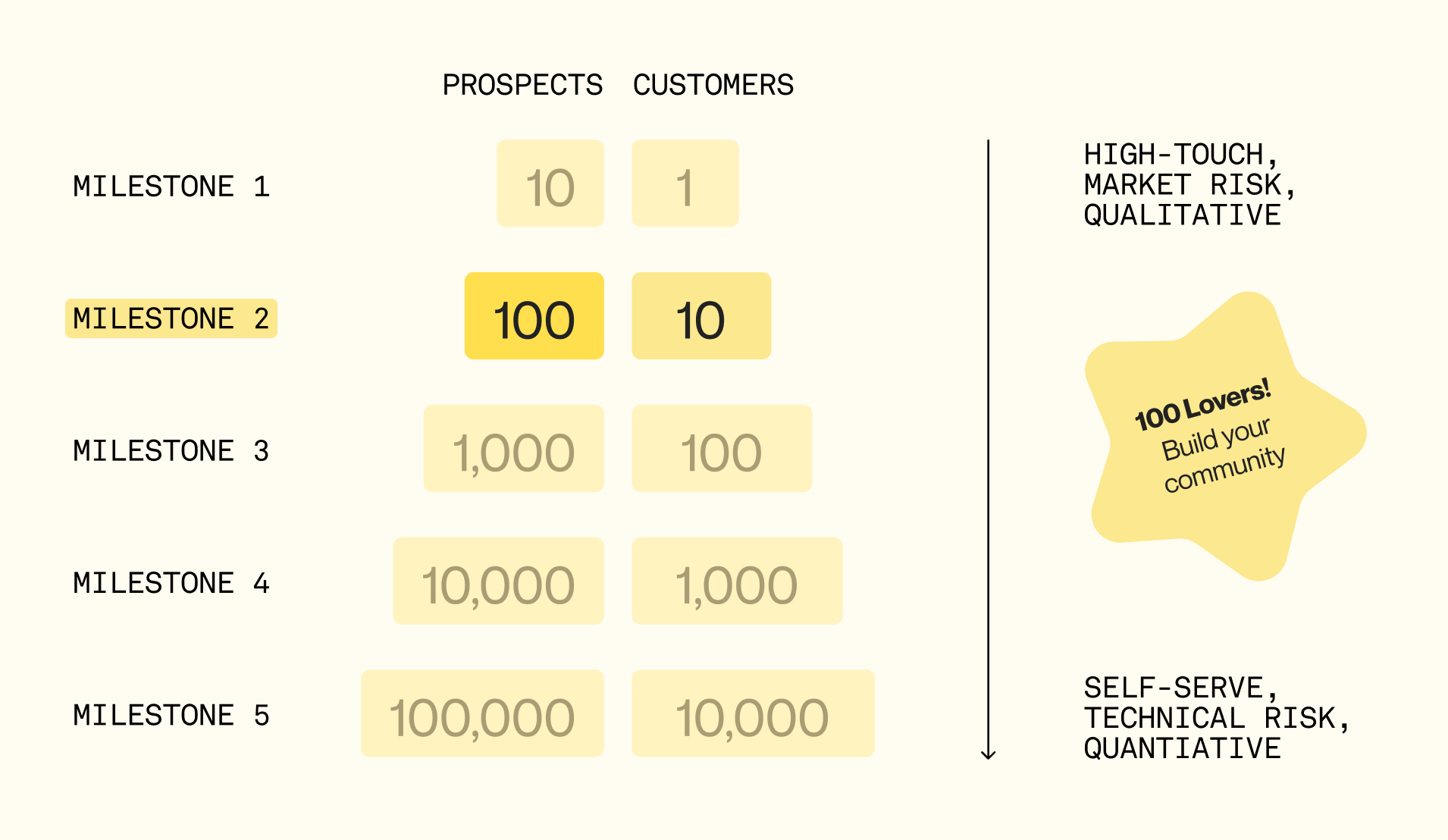
Post-launch success comes down to setting the right goals and hitting target milestones. Define the traction your stage demands, then work backward from it.
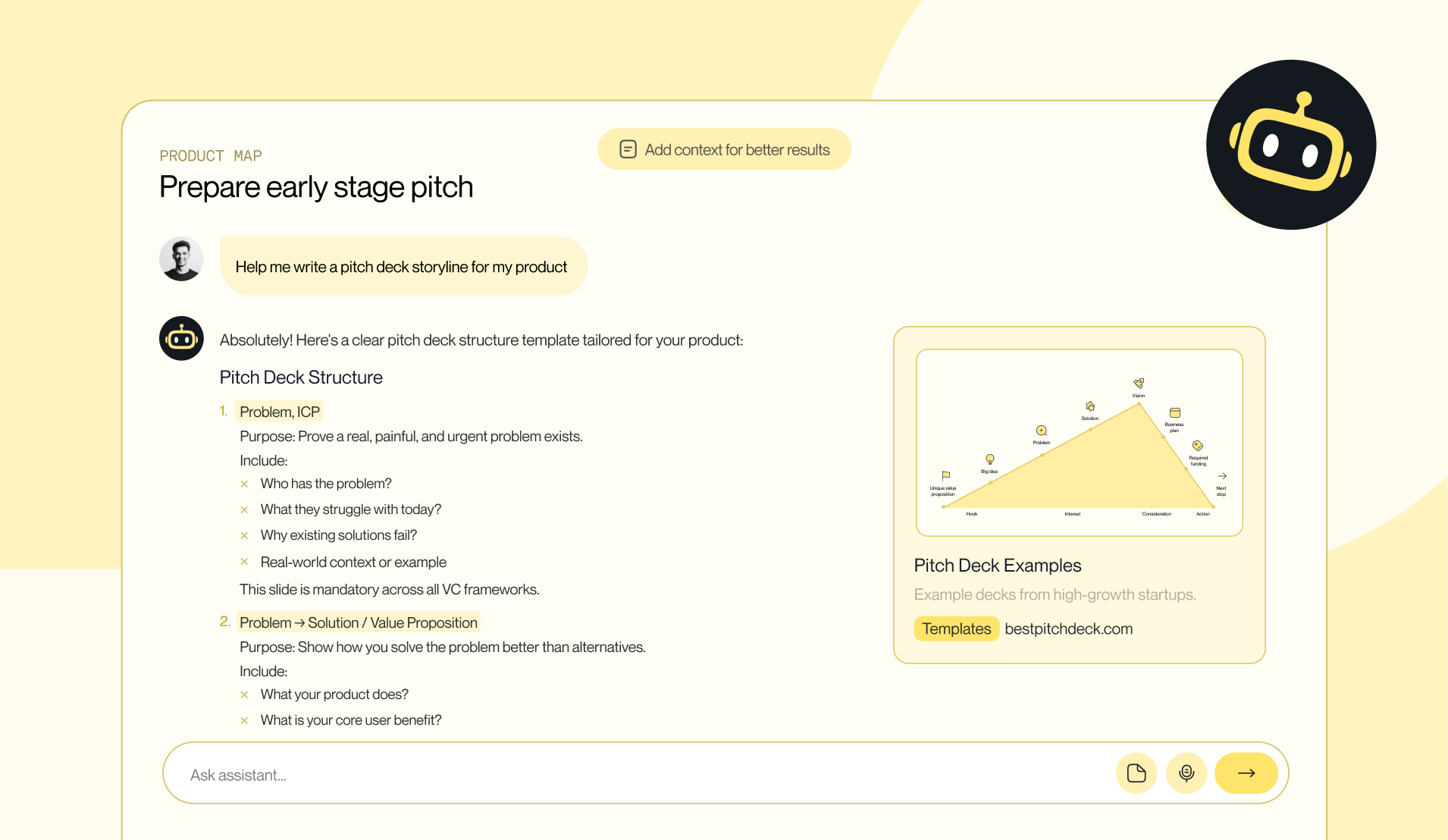
Every artifact you created along the way is exactly the context investors ask for: vision, ICP, interview findings, unit economics, and launch metrics. Feed them to the pitch agent to draft a pre-seed narrative built on real evidence.
Building product context from day one is far easier than assembling it later. Each artifact takes minutes to write while the decision is fresh. Reconstructing the same context months later means digging through old docs, chats, and memory.