AI-native TASK framework

for agentic product management

TASK turns PMs into orchestrators. Agents, grounded in your product context, operate across the entire product lifecycle, so you focus on strategy and make better decisions.

TASK overview
01
Topics
Expert-curated materials and frameworks mapped to every product domain.
02
Agents
Autonomous AI assistants that handle product ops and management tasks.
03
Skills
Human competences that guide agents and set the quality bar for every output.
04
Knowledge
Tangible LLM-friendly artifacts including specs, roadmaps, reports, and more.
About the TASK framework
What is it
TASK is a framework for agentic, AI-native product lifecycle management. It redefines how product work gets done by placing AI agents at the center of execution, not as passive tools, but as active participants operating across the full product lifecycle.
Why it matters
Traditional product management relies on a single PM juggling dozens of responsibilities: research, prioritization, documentation, stakeholder alignment, and delivery tracking. The PM becomes the bottleneck. TASK flips this model. Instead of doing everything themselves, the PM orchestrates a system of intelligent agents that work autonomously within clearly defined domains.
How this 4 pillars enable agentic PM?
How it works
Each iteration gets faster as agents build on accumulated knowledge and PM expertise sharpens the direction.

The underlying principle is that a well-structured context enables autonomous execution. Agents don't need step-by-step instructions because the topic and knowledge layers give them what they need to act independently.

The more precise the context and the richer the knowledge base, the less the PM needs to intervene and the better the outputs become.
TASK explained
A closer look at each pillar and how they work together.
T — Topics
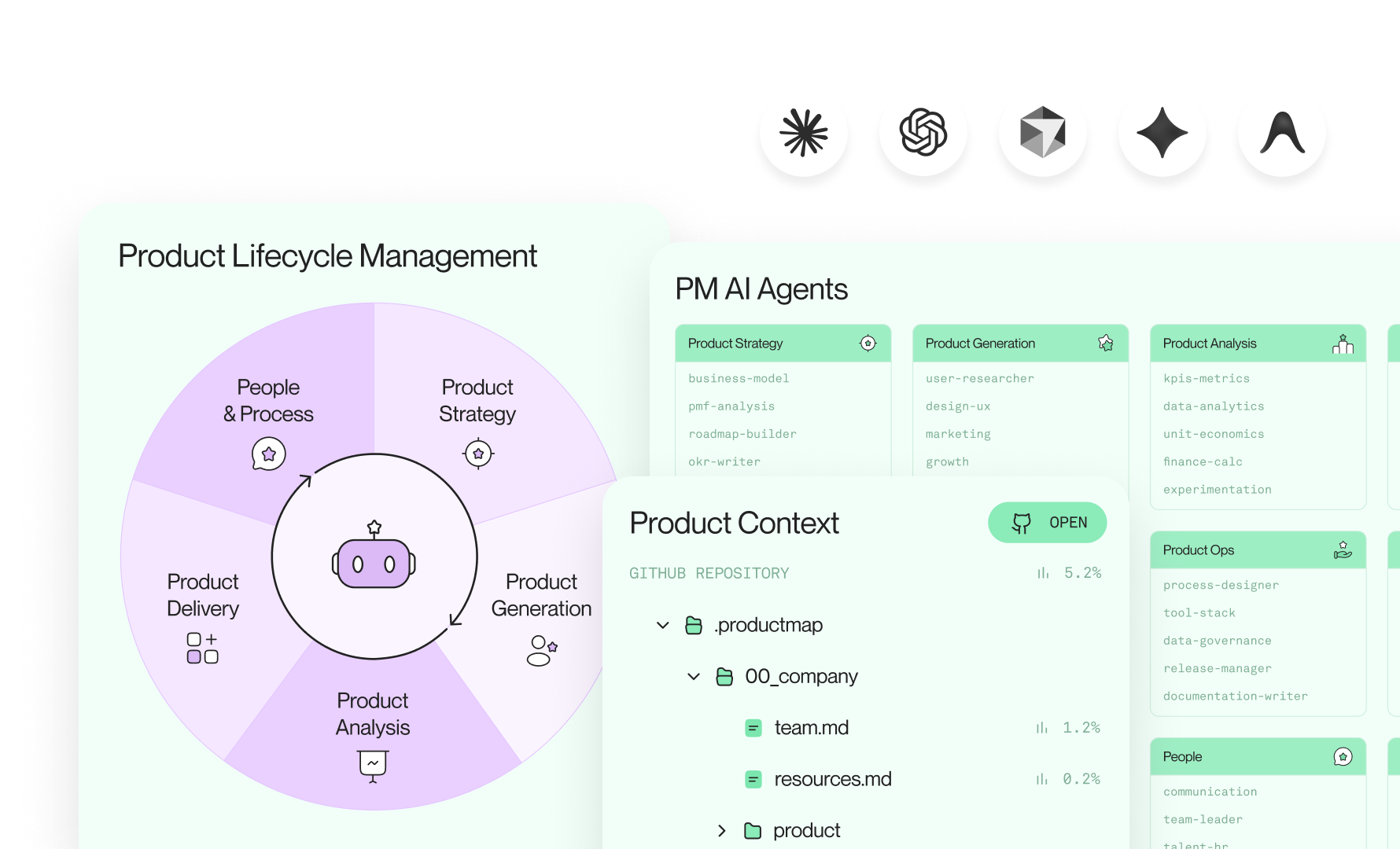
Topics define the operating space for every agent task. Each topic represents a PM domain with curated expert resources, guides, and frameworks mapped to real deliverables across the full product management lifecycle. The product catalog covers 5 key domains:
Product Strategy: Business model, product-market fit, roadmapping, and ICP
Product Generation: User research, design and UX, marketing, growth, and AI
Product Analysis: KPIs and metrics, data analytics, unit economics, and finance
Product Delivery: Backlog management, processes, development, and experiments
People: Facilitation, talent, communication, and negotiation
Topics give agents the domain context they need to understand what good work looks like and apply the right methods without step-by-step instruction.
PM Topic Catalog
60+ topics covering 5 key product management areas
A — Agents
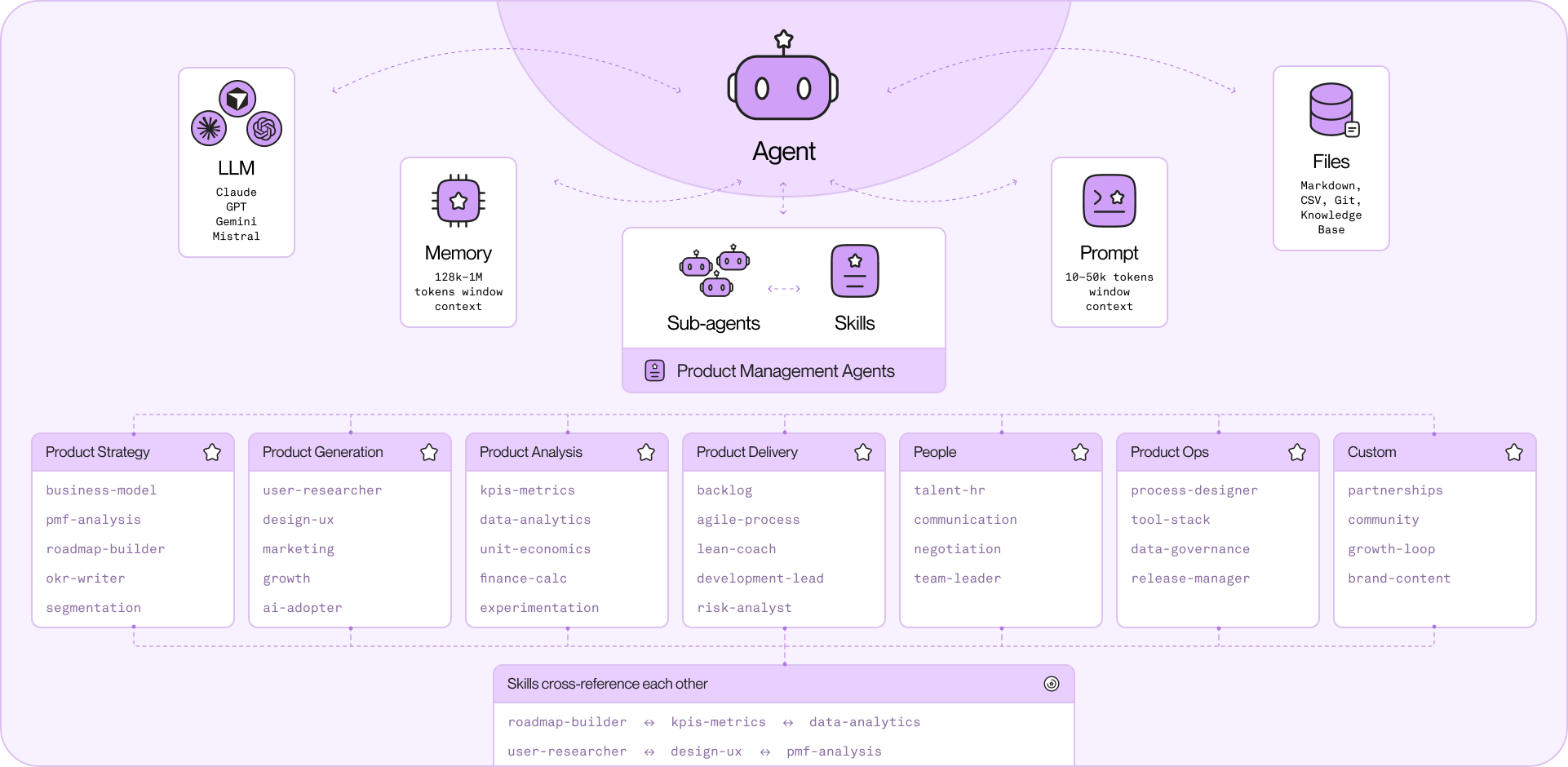
Agents are autonomous AI assistants that execute work within topics. A research agent conducts competitive analysis. A drafting agent produces PRDs. A prioritization agent scores and ranks features. Each one understands its domain, applies the right methods, and delivers outputs independently.
Agentic product management architecture for AI-native teams
The architecture is designed for flexibility and depth. Each agent operates with its own system prompt, memory, and access to relevant knowledge files scoped to a specific topic or job.

Agents can spawn sub-agents for specialized execution and cross-reference outputs to build complex, goal-driven pipelines. Different agents can use different LLMs, allowing the system to match model capabilities to task type: research, drafting, scoring, or synthesis.
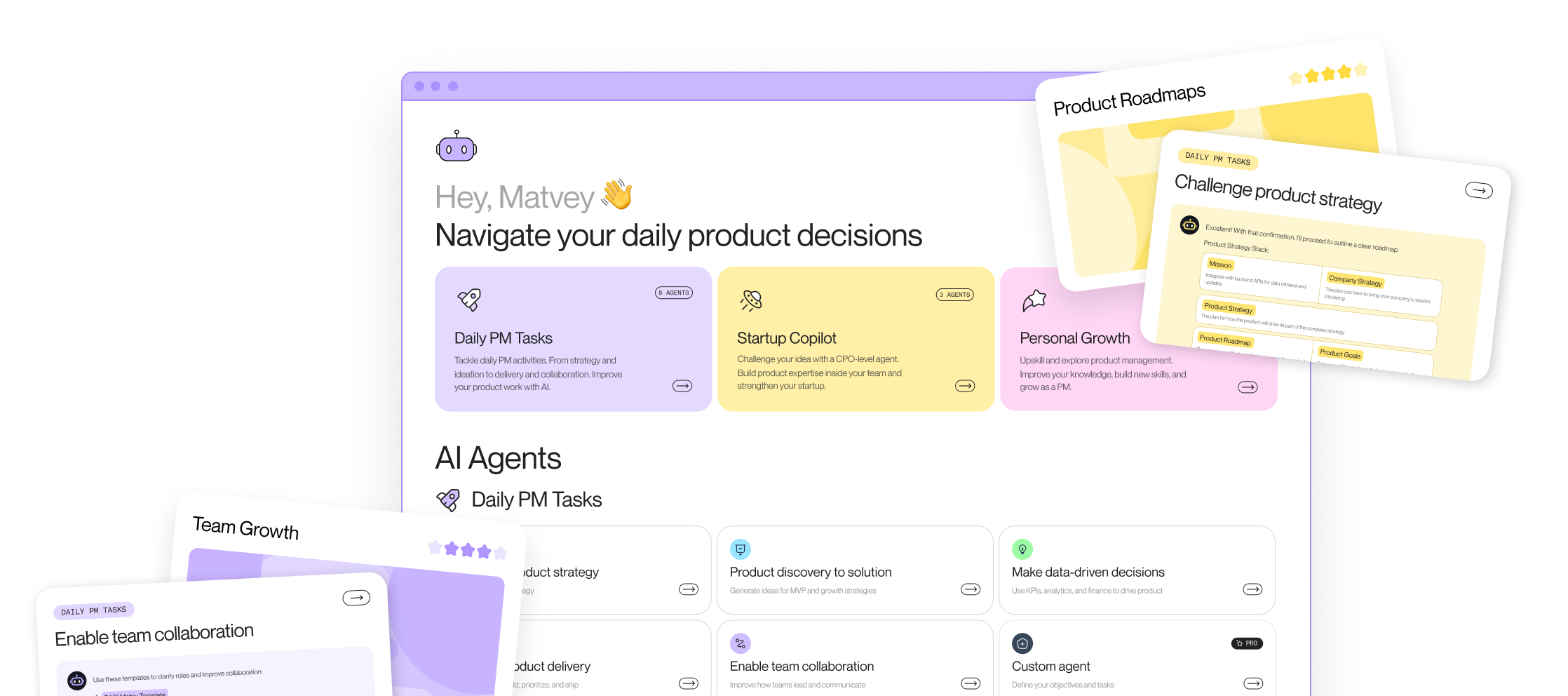
PM Assistants
10+ product management assistants for the entire PM lifecycle
S — Skills
Skills represent the PM's personal competences and the human judgment layer that shapes how agents are directed and what quality bar their outputs must meet. Agents amplify skills, they don't replace them.
Product: Strategic impact, business goals ownership, product discovery
Customer: User experience, voice of customer, product marketing
Analytics: Fluency with data, measuring progress & KPIs, stakeholder management
Process: Product vision & planning, backlog management, software engineering
People: Communication, team leadership, people management
The PM's skill profile determines which tasks get delegated, how agents are directed, and where human judgment steps back in.
PM Skills Guide
An ultimate guide to 15 essential PM skills and assessment
K — Knowledge
Knowledge is the accumulated output of every agent interaction: research reports, roadmaps, specs, decision logs, and more. It compounds over time, making each cycle faster and better informed.
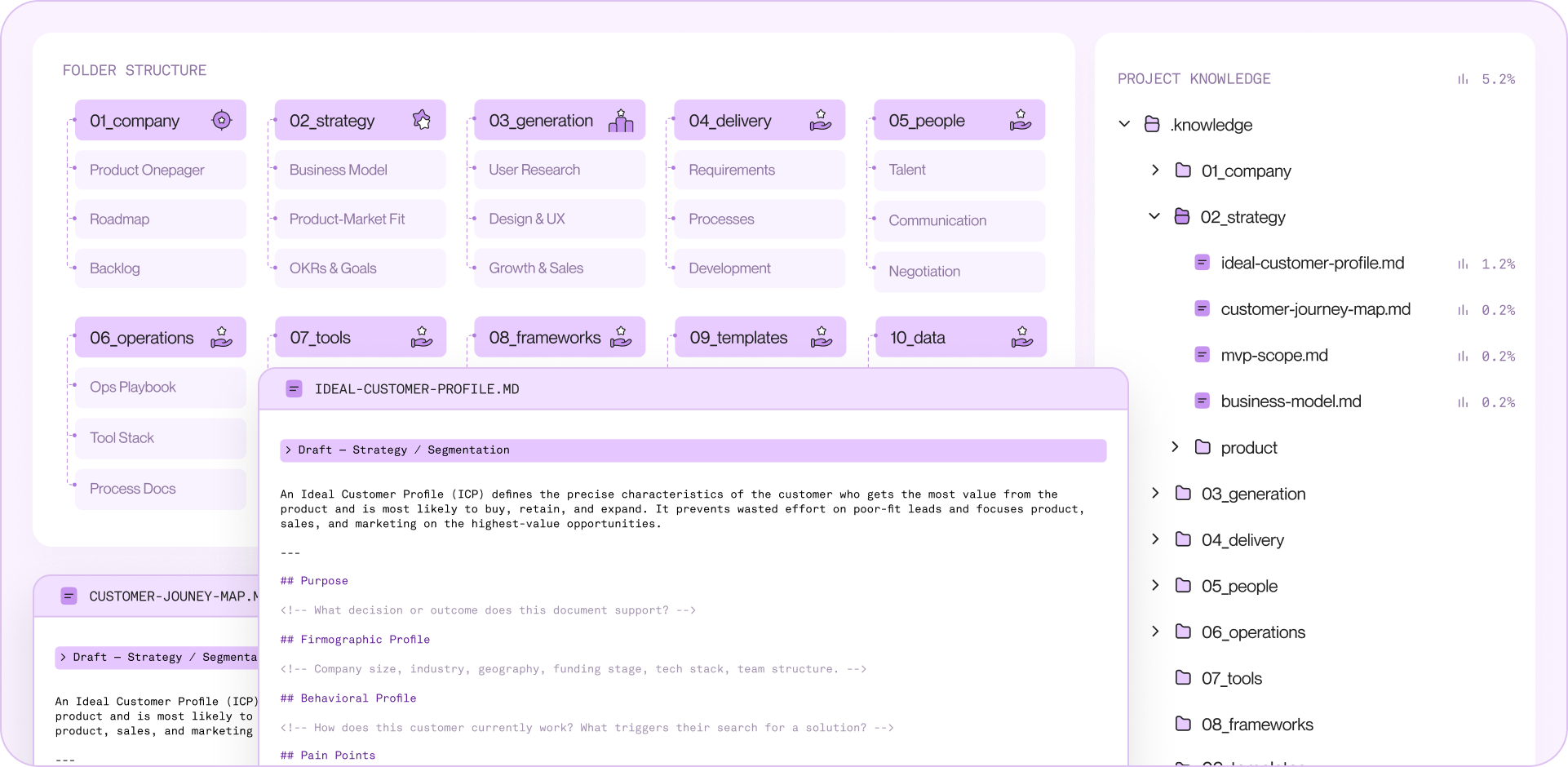
Context engineering for agentic product management with AI
Ideally, product knowledge base is version-controlled using Git, treating PM artifacts the same way engineers treat code. The folder structure should mirror the topic taxonomy: Strategy, Generation, Analysis, Delivery, and People, with additional folders for project-specific contexts such as operations and product data.

Artifacts should be stored in plain text, LLM-friendly formats like Markdown or CSV, so agents can read, reference, and build on them across every cycle.
Context Engineering Guide
By Product Map and AI Maker
How to apply
Start by defining a topic, the product domain or task area you are working in. Assign an agent with the right context and knowledge, then apply your skills to guide and validate the output. The resulting artifact goes back into the knowledge base and feeds the next cycle.
Define topic
Assign agent
Apply skills
Build knowledge
The loop is designed to be lightweight. You do not need to build everything at once. Start with one topic, establish a base of structured knowledge, and expand from there as the system learns from each iteration.
Who it's for
TASK is built for product managers and product teams who want to work at a higher level.

If you spend most of your time producing documents, chasing information, and managing coordination, TASK shifts that work to agents so you can focus on strategy, judgment, and the decisions that move products forward.
TASK framework for agentic product managers and product teams
Get started
Your practical checklist starts with picking a topic, structuring your knowledge base,
setting up version control, configuring your first agent, and running the loop until it compounds.
step 1
Pick one topic
Start with one PM domain you are actively working in.
step 2
Build your knowledge base
Add existing documents to a topic folder in plain text formats like Markdown or CSV.
step 3
Set up version control
Initialize a Git repository and mirror the folder structure to the topic taxonomy.
step 4
Define your first agent
Write a system prompt scoped to your topic with access to the relevant knowledge files and a clear task.
step 5
Run the loop
Assign a task, validate the output with your own judgment, and save the result back into the knowledge base.
AI ADOPTION

TASK applications

What are the product use cases for AI adoption?
WHEN TO APPLY
TASK applies whenever a PM domain has a clear output and a repeatable process. If you can describe the deliverable and point to the context that informs it, an agent can execute the work. That covers most of what PMs produce.

The five product domains below represent the full PM lifecycle. Each one has established methods, standard artifacts, and a defined quality bar. That makes them ideal operating environments for agents.
5 PM domains
Each domain defines the scope for agents and supplies the relevant knowledge.
Product Strategy
Agents handle research and drafting across business models, positioning, roadmaps, and OKRs. The PM synthesizes signals and makes the calls.

Agentic PM use cases:
Generate a Business Model Canvas from a product brief
Run competitive analysis and produce a positioning map
Draft a quarterly OKR set with cascade mapping
Build a Now/Next/Later roadmap from a prioritized backlog
How it applies to TASK:
Product-Market Fit
Topic
Competitor Analysis
Agent
Strategic Impact
Skill
Positioning & ICP
Knowledge
Start with these artefacts:
business-model-canvas.md
competitor-analysis-matrix.md
iCP.md
okr-planning-sheet.md
roadmap-now-next-later.md
Product Generation
The most artifact-dense domain. Agents move from raw input to structured output: research synthesis, GTM plans, experiment backlogs, AI specs.

Agentic PM use cases:
Synthesize interview transcripts into a research report
Draft a go-to-market strategy and launch checklist
Generate a growth experiment backlog with ICE scores
Produce an AI PRD with model requirements and evaluation criteria
How it applies to TASK:
User Research
Topic
Research Synthesis
Agent
Voice of Customer
Skill
Research Report
Knowledge
Start with basic artefacts:
research-synthesis-report.md
CUstomer-journey.md
gtm-strategy.md
growth-experiment-card.md
ai-prd-SPEC.md
Product Analysis
Agents produce the evidence behind decisions: metric definitions, experiment designs, cohort reports, and financial models. The knowledge base must be structured for this to work well.

Agentic PM use cases:
Define a North Star Metric or OMTM and build a KPI tree
Design a funnel analysis test with a hypothesis and success metrics
Produce a unit economics model with LTV and CAC
Generate a quarterly business review with variance analysis
How it applies to TASK:
Product Analytics
Topic
Funnel Analysis
Agent
Fluency with Data
Skill
Experiment Report
Knowledge
Start with these artefacts:
north-star-metric.md
ab-test-design.mD
funnel-analysis-report.md
unit-economics-model.md
kpi-dashboard-spec.md
Product Delivery
High volume, standardized formats. Agents draft requirements, break down epics, and maintain risk logs. The PM validates scope and quality.

Agentic PM use cases:
Draft a requirement from a brief with goals and acceptance criteria
Break down an epic into RICE-scored user stories
Generate a risk register with probability and impact ratings
Produce a technical spec and architecture decision record
How it applies to TASK:
Stakeholder Analysis
Topic
Requirement Draft
Agent
Backlog Management
Skill
PRD Document
Knowledge
Start with these artefacts:
prd-template.md
user-story-map.md
Stakeholder-map.md
rice-scoring-sheet.md
risk-registry.md
People
Agents draft frameworks, communication plans, and structured documentation. The PM applies judgment where relationships and context matter.

Agentic PM use cases:
Build a skills matrix and individual development plan
Draft a stakeholder communication plan with cadence and ownership
Prepare a BATNA analysis for a vendor negotiation
Generate a product ops playbook with workflows and governance
How it applies to TASK:
Negotiation Strategy
Topic
Stakeholder Mapping
Agent
Communication
Skill
Meeting Plan
Knowledge
Start with these artefacts:
skills-matrix.md
stakeholder-map.md
RACI-MATRIX.md
product-ops-playbook.md
individual-development-plan.md
about the authors

Meet the team behind the TASK framework

TASK framework was first published by the Product Map team on 2 April 2026 and continues to evolve as AI adoption in product management matures.

Product Map Team

PM team 1PM team 7PM team 6PM team 7PM team 7PM team 7PM team 7PM team 7

Product Map is a community-driven AI copilot for product managers. It combines a comprehensive PM knowledge base with practical tools and expert resources. Led by Matvey Bryksin

About Product Map AI

Join PM Community

  • 01

    An open space where knowledge, ideas, and product expertise come together

  • 02

    Product knowledge-led PM community for product people
About PM community
about PRODUCT MAP

Product Map is your navigation

for better product decisions

Knowledge-led PM copilot

Tools and resources for the entire product lifecycle. Made for product people to learn, build, and grow.
AI assistants
Product knowledge & context
Learn more
Product Map AI: PM copilot for product managers