




Ask an AI to interview ten of your users and it'll hand you ten clean transcripts in under a minute. The quotes sound real. The pain points line up with your roadmap. The personas have names. None of those people exist, and the model will never tell you that.
This is the quiet failure mode of AI in discovery. It doesn't refuse the work or return an error. It produces a confident, well-structured customer who agrees with whatever you hoped was true. Ship a quarter of decisions on top of that, and you've optimized a product for a person nobody has ever met.
The fix isn't to ban AI from research. It's to be exact about which parts of discovery it speeds up, which parts it quietly fakes, and where a real human still has to be in the room.
Where AI saves real time
The production work in discovery is slow, repetitive, and mostly mechanical. That's where AI earns its place.
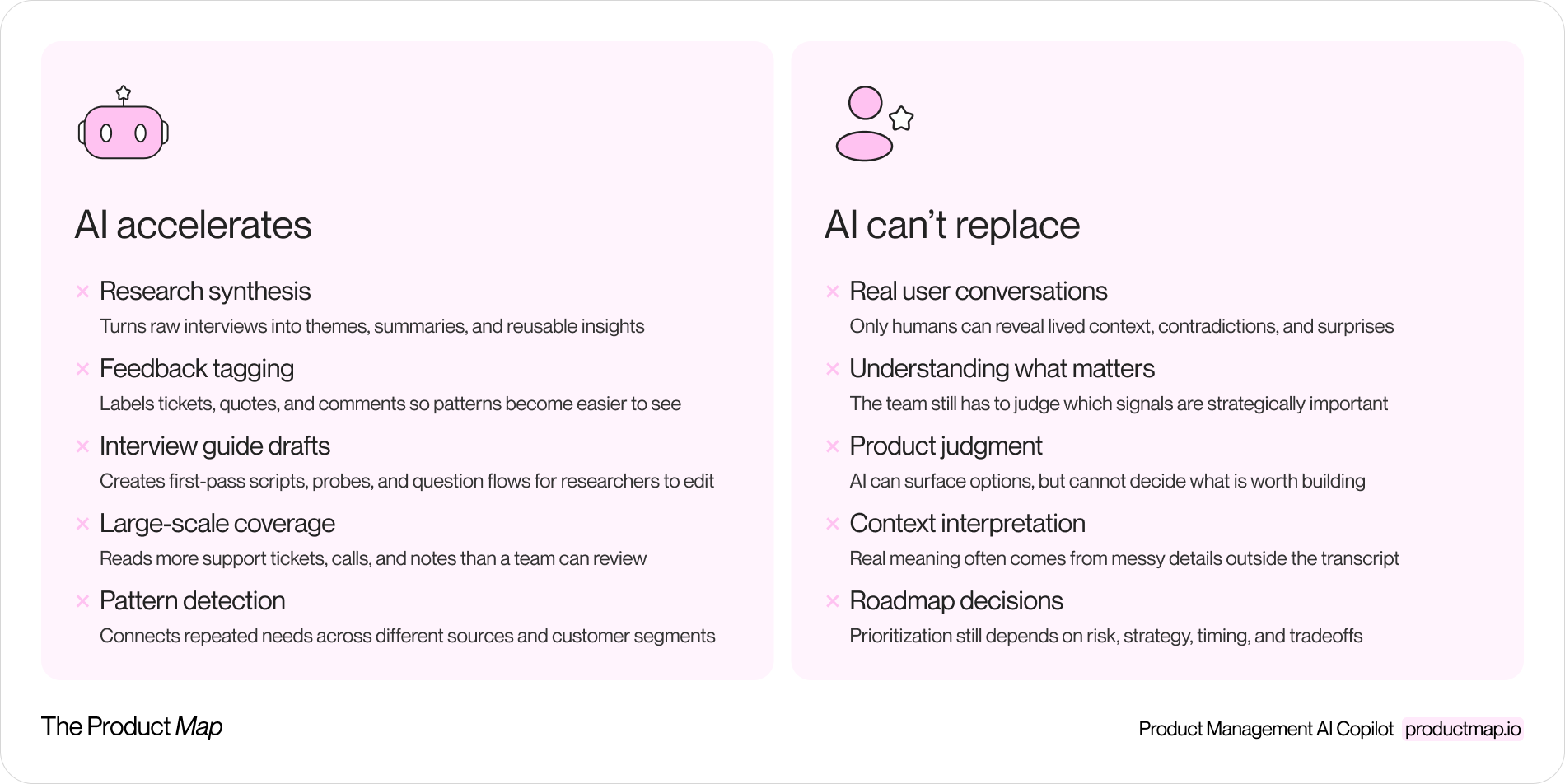
- Synthesis: clustering fifty interview transcripts by theme, tagging feedback, and pulling the five quotes that say the same thing in different words.
- Draft guides: a first-pass interview script for a problem you're exploring, with follow-up probes you can cut or keep.
- Coverage: reading every support ticket from the last quarter instead of the twelve you had time for, then surfacing the pattern you would have missed.
- Speed to a decision: turning a finished round of real interviews into a ranked list of opportunities the same afternoon, not three weeks later.
Each of these starts from evidence you already collected. The model compresses the time between raw signal and a usable read. It doesn't invent the signal. That distinction is the whole game.
When synthetic users mislead
Synthetic users simulate a persona and answer your questions as that persona would. They're useful in a narrow band: pressure-testing an interview guide before you run it, getting a directional read when you have zero access to a segment, or warming up your own thinking on a problem.
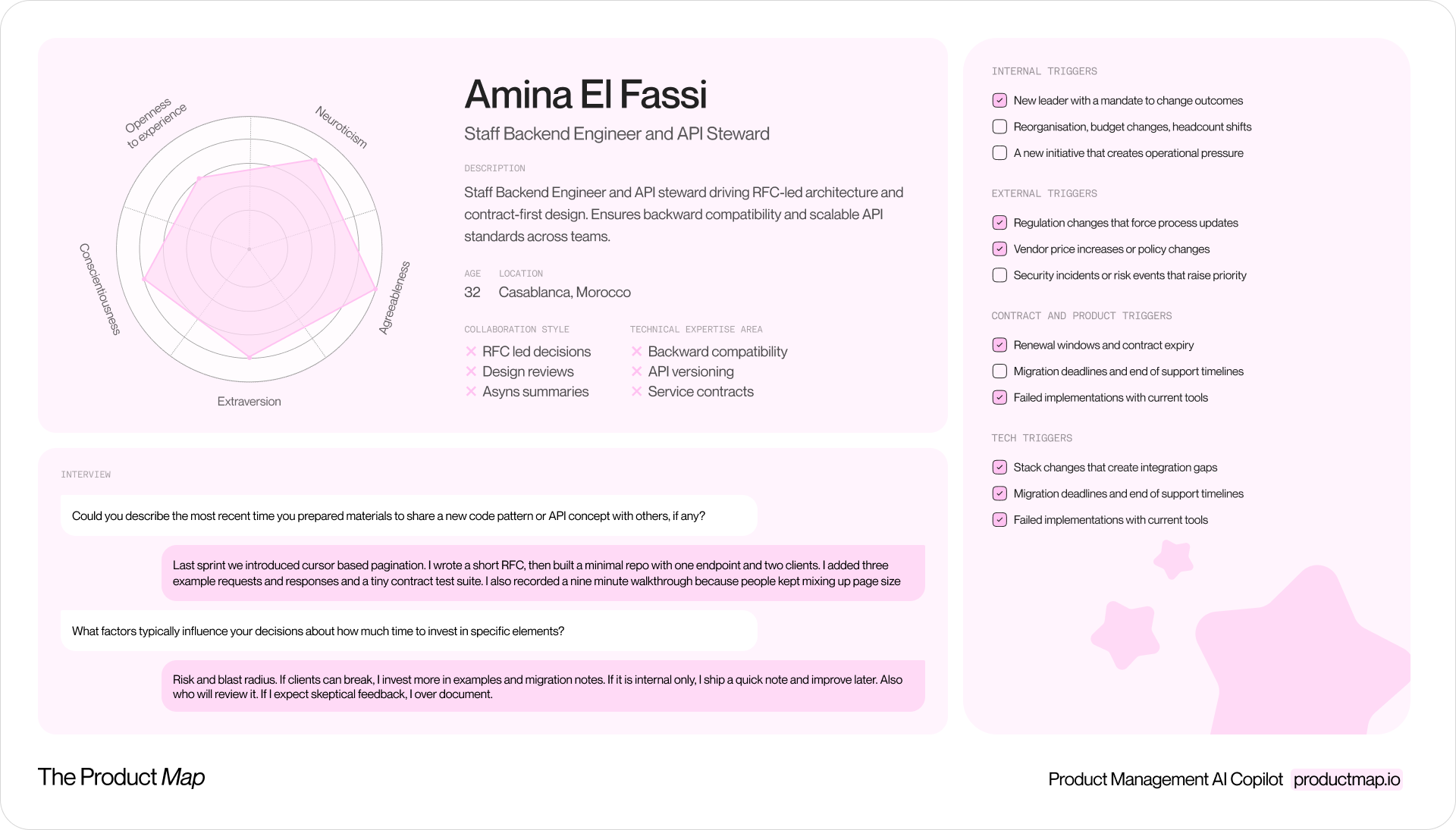
The trouble starts when a directional signal gets treated as evidence. A synthetic user is a model's best guess at what an average person matching a description might say. It has no memory of last Tuesday's billing error, no budget it actually controls, and no reason to surprise you. Real users contradict themselves, change their minds mid-sentence, and want things that make no sense until you understand their context. That friction is the signal. Synthetic users sand it off.
A synthetic user can tell you whether your questions are clear. It cannot tell you whether your customer exists.
Use them to rehearse, never to conclude. The moment a synthetic transcript starts shaping what you'll build, you've crossed from accelerating research into manufacturing it.
Match method to question
Most AI discovery goes wrong before a single prompt gets typed, because the wrong method was chosen for the question. The user research methods you already know still decide what good looks like; AI just runs them faster.
Map the tool to the phase:
- Generative questions (what problems do users face, what goes unsolved) need real people in their real context. Field studies, problem interviews, and ethnographic conversations. AI helps you synthesize the output, not generate the input.
- Evaluative questions (does this flow work, where do users stall) lean on usability tests and first-click studies. AI can summarize sessions and flag repeated friction.
- Quantitative questions (how often, how many) come from surveys and analytics. AI clusters open-ended responses and detects sentiment at a scale you can't read by hand.
The rule holds across all three: AI is allowed near the analysis. It's never allowed to stand in for the user when the user is the thing you're trying to understand. Generative work is where teams cheat most, because talking to people is the slowest part. It's also the part with no shortcut.
Use a discovery agent to surface new opportunities
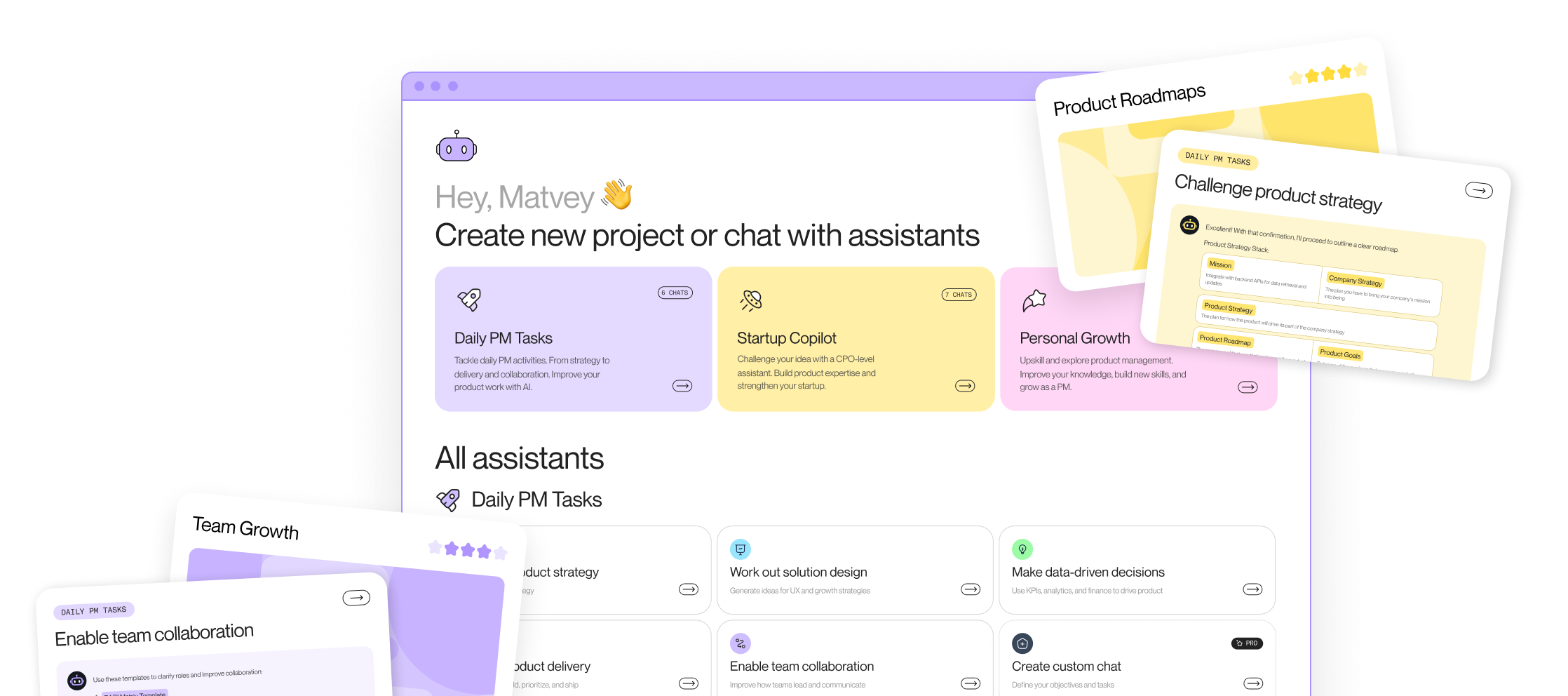
This is where an AI agent stops being a transcript summarizer and starts doing product work. Point a discovery agent at the research you've actually collected, your interview transcripts, support tickets, sales-call notes, and feedback, and ask it to find what you missed.
Product Map's product discovery agent runs against your own research repository, not a generated one. It reads the corpus, clusters recurring problems, and proposes opportunity areas mapped to the kind of structure Teresa Torres calls an opportunity solution tree. The output is a ranked set of unmet needs with the verbatim evidence attached to each one, so every opportunity points back to a real quote from a real person.
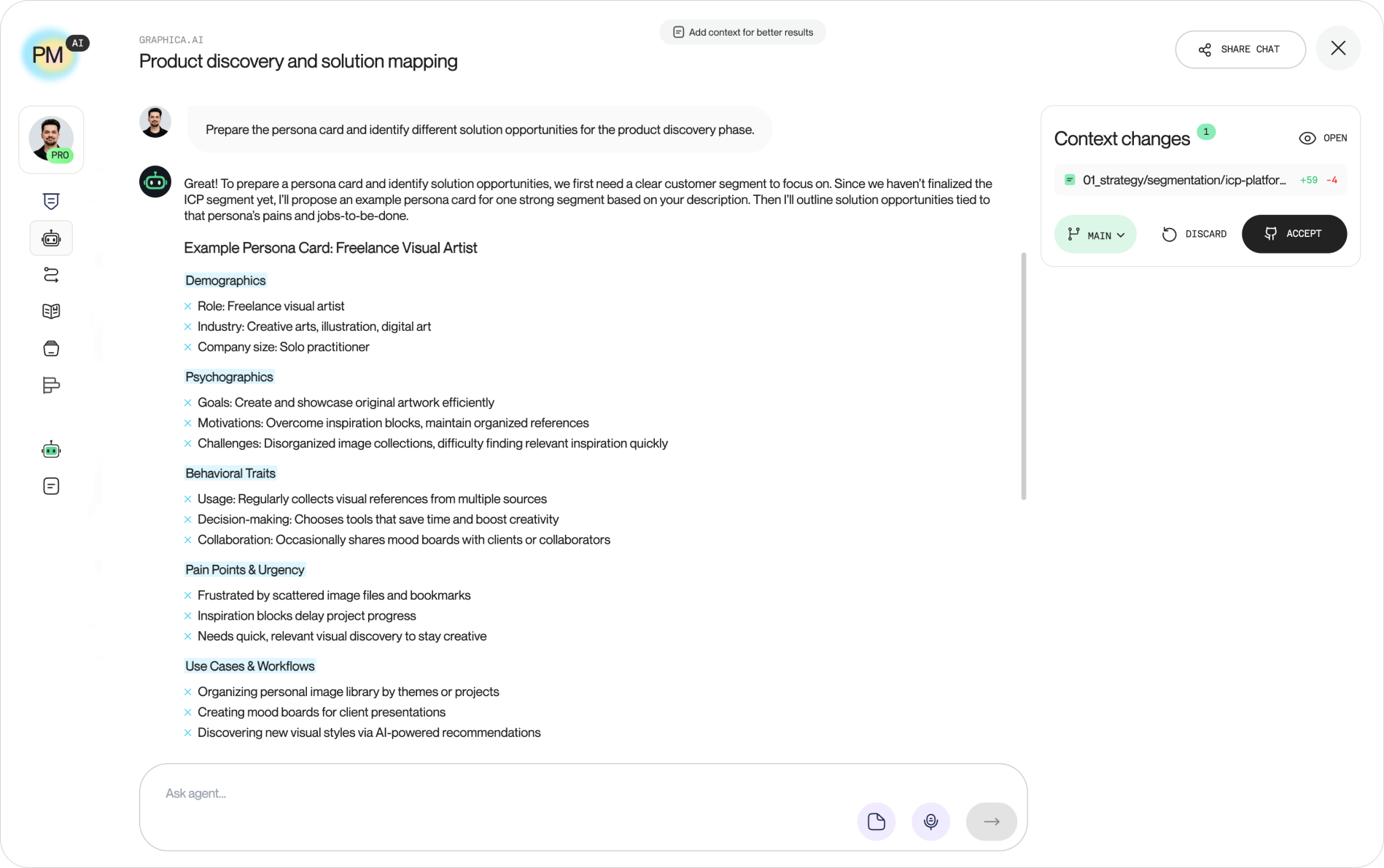
The agent is good at the work humans skip when they're busy: re-reading old research, connecting a complaint from March to a churn reason from June, noticing the need three different customers described in three different words. It widens the funnel of opportunities you consider. It does not pick which one to pursue.
Run it as a standing job, not a one-off. Continuous discovery means a small, steady habit of talking to users and feeding what you learn back into the same repository. An agent reading that growing corpus every week turns a pile of transcripts into a live map of where the next bet might be, and keeps the map current as new evidence lands. The same workflow can run a synthetic interview to rehearse a guide before you take it to real customers, which keeps the practice sharp without faking the data.
A check before you decide
Before any opportunity from an AI pass earns a place on the roadmap, run it through one filter. Trace every claim back to a real source.
- Name the human. Which real user said this, in which session, on which date? If the answer is "the model inferred it," it's a hypothesis, not a finding.
- Find the contradiction. Real research contains tension; users want opposite things. If your AI summary is perfectly consistent, it probably smoothed over the disagreement that mattered.
- Check the sample. Did this come from three customers or thirty? AI will state a pattern with the same confidence either way. You have to supply the denominator.
- Read one raw transcript yourself. Not the summary. The actual conversation. If the summary and the source feel like different stories, trust the source.
Teams that skip this filter end up with a roadmap that's internally tidy and externally wrong. The check costs twenty minutes. Shipping the wrong quarter costs the quarter.
The continuous discovery checklist
Run this before any AI-assisted discovery cycle ships into a decision. If you can't check an item, you have a gap to close before the finding earns trust.
- Real input, not generated input. Every transcript, ticket, or note the AI reads came from an actual user, not a synthetic persona.
- Evidence attached. Each opportunity links back to a verbatim quote with a name, a session, and a date.
- Denominator stated. You know whether a pattern came from three customers or thirty, and you wrote it down.
- Contradiction preserved. The summary keeps the tension where users wanted opposite things instead of smoothing it over.
- One raw source read. You read at least one full transcript yourself, not just the AI summary of it.
- Method matched to question. Generative questions went to real people; AI only touched the synthesis.
- Synthetic work labeled. Anything a synthetic user produced is marked as rehearsal, never filed as evidence.
- Standing habit, not a sprint. New research keeps landing in the same repository, and the agent reads the growing corpus on a schedule.
- Human made the call. A person, not the model, decided which problem is worth solving and can say why.
Discovery is still your job
AI changes the economics of discovery, not the responsibility. You can now read more evidence, synthesize it faster, and surface more opportunities than any team could a year ago. What you can't outsource is the part that was always the point: deciding which problem is worth solving, for which real person, and why.
The PMs who get this right treat AI as a force multiplier on real signal and a liability on invented signal. They run the methods they always ran, just faster. They let an agent widen the field of opportunities, then narrow it with judgment the model doesn't have. And they keep talking to customers, because the one thing AI cannot do is be surprised by a person it has never met.