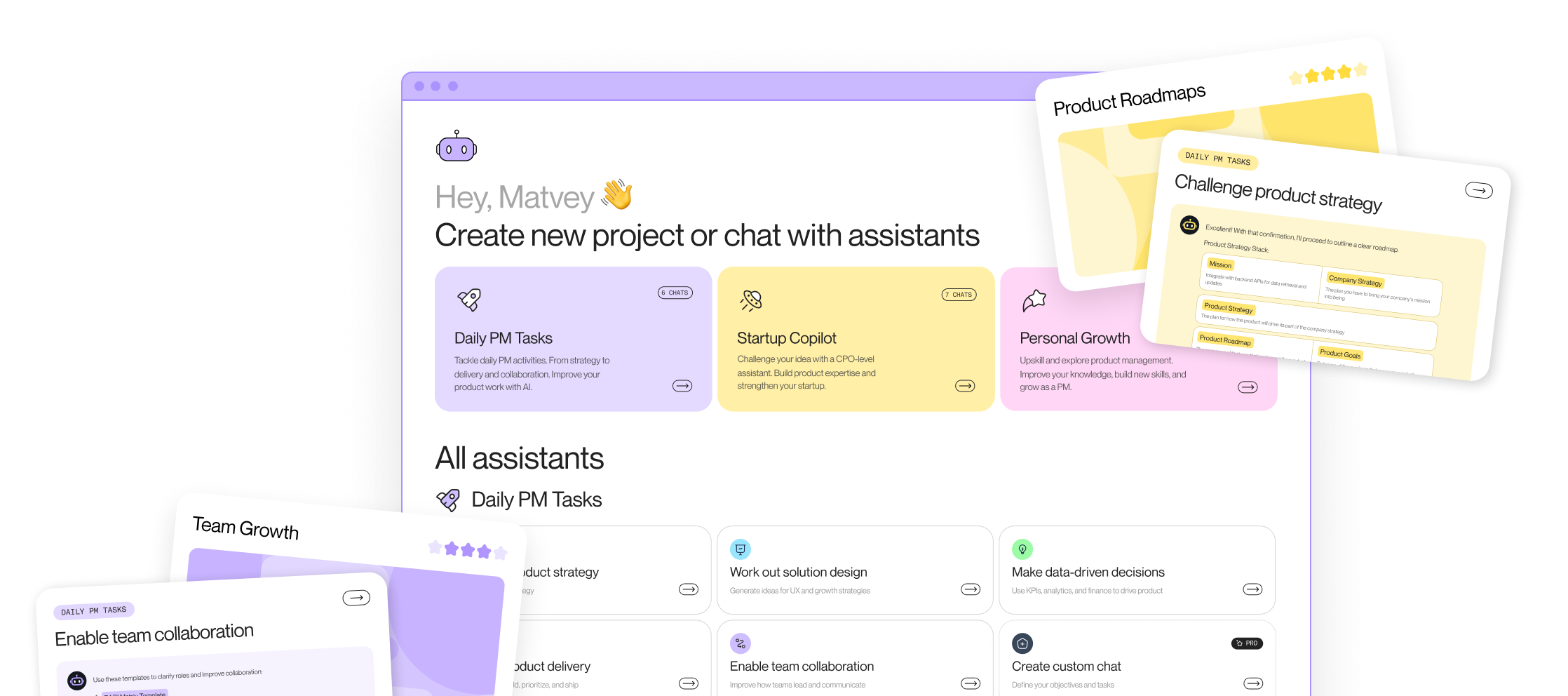





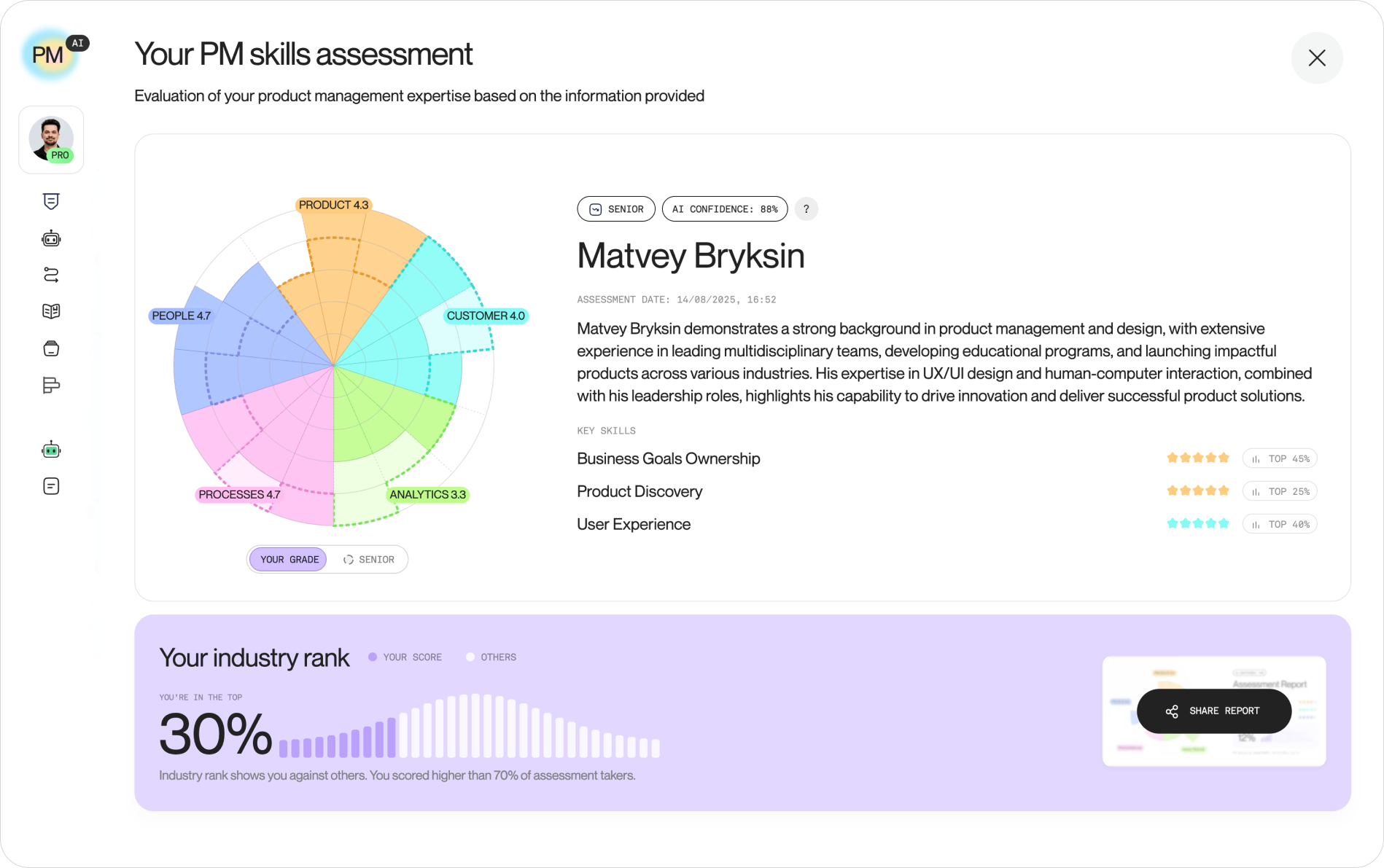
Product Map has published more than 1,800 product management skills assessments in our State of the Product Management 2025 report. We score working PMs against the skills the job demands now, then watch which topics they work in across our topic catalog and which tracks they pick from the specializations catalog. That gives us a live read on what the product job is becoming, not a guess from the sidelines.
Here's what the data shows. Product management jobs aren't disappearing. They're sorting.
Two roles can carry the same title and live on opposite sides of a widening gap. One PM ships a working prototype, an eval set, and a margin model in a week, alone. The other waits on a designer, an analyst, and an engineer for the same output, and writes a tidy spec while doing it. Same job description. Different decade.
This guide draws on that assessment data and the topics PMs actually engage with to map the line running down the middle of the market: who's gaining, who's eroding, what separates the two, and what you can do this quarter to land on the right side.
The market is splitting, not shrinking
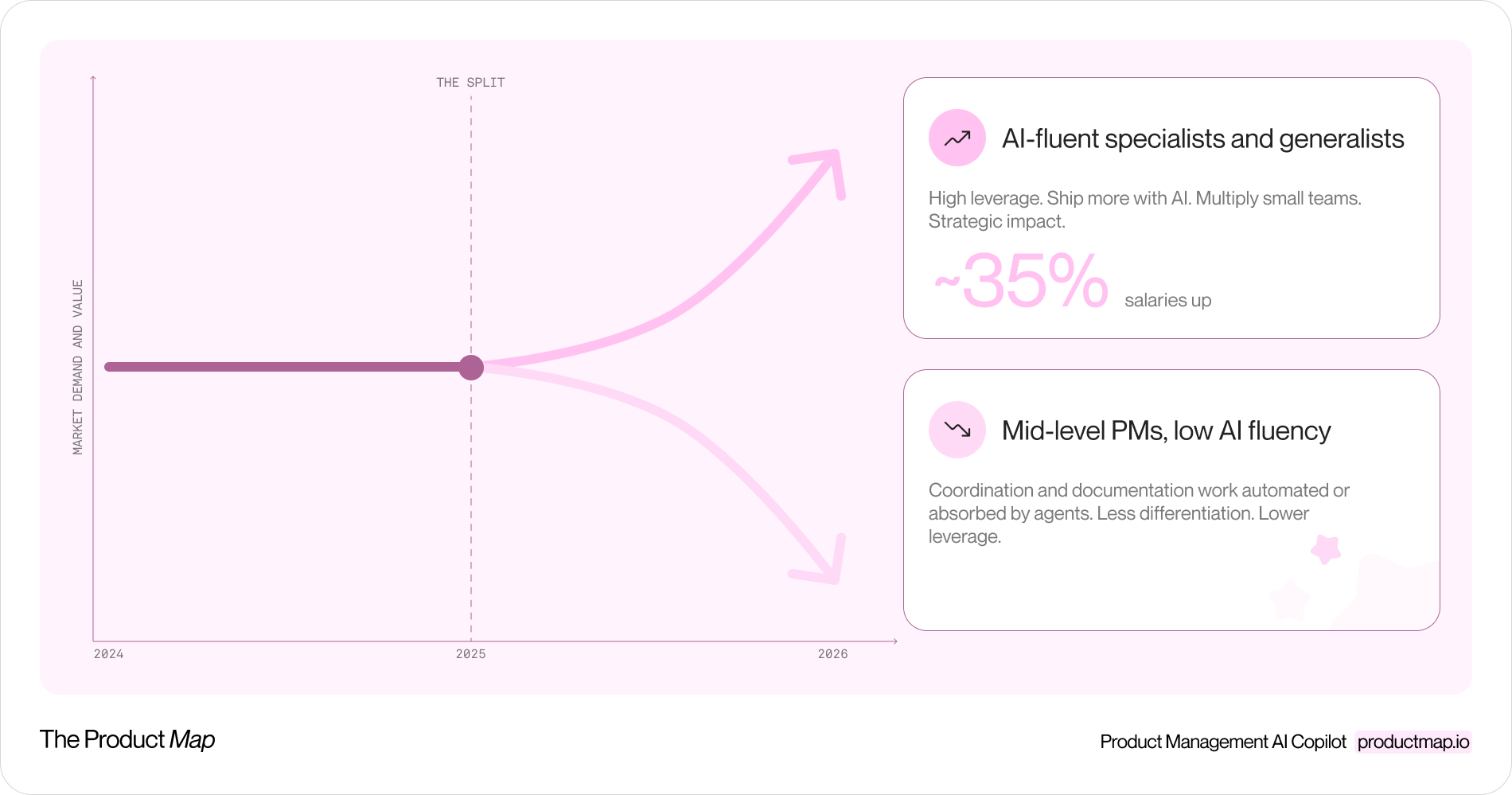
The shape to picture is a K, not a downward slope. The top arm is rising: AI-fluent specialists and generalists who turned AI into a system. The bottom arm is sinking: mid-level generalists whose value was coordination and documentation, the exact work agents now absorb.
The numbers point the same way. Roles that name AI fluency carry a salary premium of roughly 35 percent over comparable generalist postings, while about 75 percent of employers say they can't find candidates who actually have the skills. A shortage at the top and a glut in the middle, at the same time. That's not a contraction. It's a reshuffle.
The misread is treating this as a headcount story. It's a composition story. Companies aren't cutting product management to zero. They're paying up for the people who multiply a small team and quietly stepping back from the people who only move work between meetings.
What our assessment data shows about the job
Every assessment we publish scores a PM against the skills the role needs today, not the role as it looked five years ago. Two patterns repeat across the 1,800-plus we've collected.
The specializations catalog has a clear front-runner. The AI product manager track is the fastest-growing pick, while traditional generalist tracks flatten out. PMs are voting with their attention for the side of the market that's hiring.
The topics PMs spend time on have moved too. Engagement concentrates on context engineering, evals and product quality, AI unit economics, and discovery done with AI rather than handed off. The topics built around coordination and status reporting draw less time each quarter.
Read together, the assessment scores and the catalog activity say what the salary data says. The job is reweighting toward judgment exercised through AI, and away from the work an agent now absorbs. That's the vantage point behind everything below.
The dividing line is judgment, not tool count
The easy answer is "learn the tools." It's also wrong, or at least incomplete. Tool count is a weak predictor. Plenty of people who've opened Cursor once still sit on the eroding side.
The real line is the capacity to operate in ambiguity. An agent is fast and confident inside a well-framed problem. It collapses when the problem is vague, the goal is contested, or the right move is to not build the thing at all. That framing work, deciding what's worth doing and what good looks like, is the part that didn't speed up. It's also the part that pays.
So the question a hiring manager is asking isn't "how many AI tools do you use." It's "can you take a fuzzy business problem, shape it into something an agent can execute, and then judge whether the output is any good." Tool fluency is table stakes underneath that. Judgment is the differentiator on top.
An agent amplifies a sharp decision and amplifies a sloppy one as fast. The PM's job is to make sure the decision underneath is worth amplifying.
What sits on each side of the line
The eroding middle looks like this. Writing detailed specs as the main output. Running status updates between functions. Producing analysis by asking someone else for the chart. Using AI for isolated one-off tasks, a draft here, a summary there, with nothing repeatable left behind. Owning a narrow slice of the lifecycle and handing off at every seam.
The rising side looks different. The PM builds repeatable systems with AI instead of doing the work by hand each time. They work across discovery, analysis, delivery, and operations rather than one lane. They ship dashboards, prototypes, and workflows themselves, fast, then keep strategy and judgment human while automating the execution underneath.
None of that requires becoming an engineer. It requires treating AI as standing capability you build on, not a calculator you reach for. The person on the right side leaves behind a system. The person in the middle leaves behind a document.
What an AI product manager should actually know
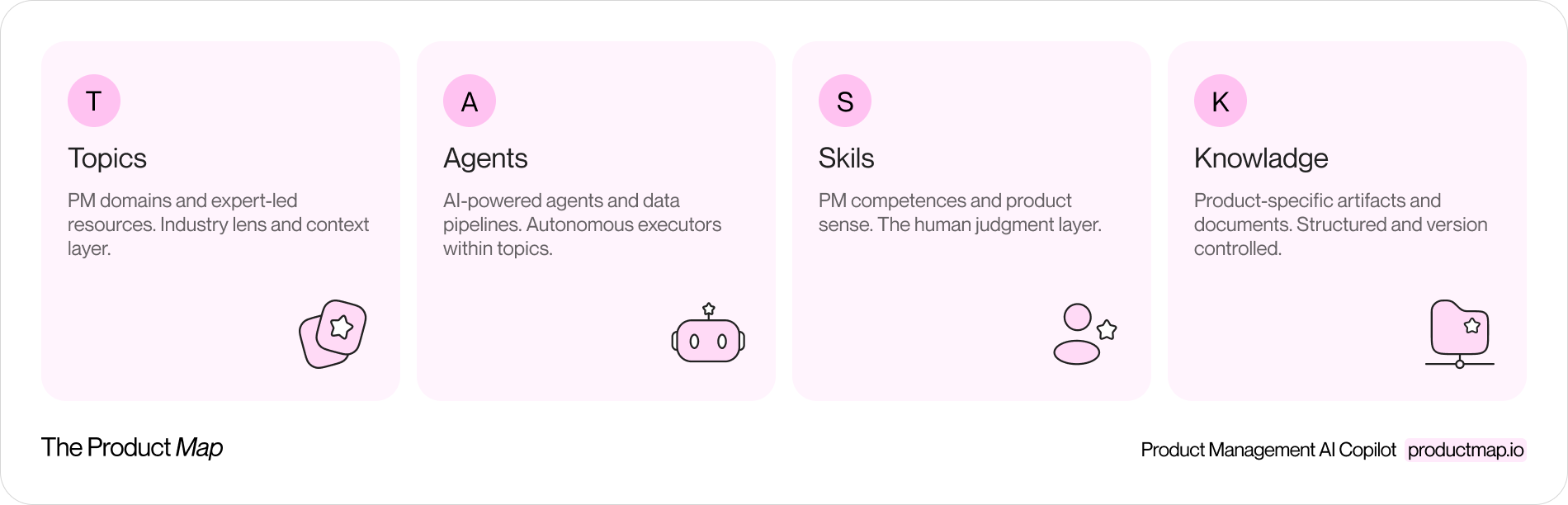
Here's the part most career takes skip: the concrete skill set that puts you on the right side. Product Map's AI product manager specialization is built around exactly this question, and it organizes the answer through the TASK framework: Topics, Agents, Skills, and Knowledge. Topics are the PM domains you work in. Agents are the AI assistants that execute inside them. Skills are your own judgment layer. Knowledge is the artifacts the loop produces and reuses. The shift the framework names is the one the market is paying for: moving from PM as operator to PM as orchestrator.
Underneath that, a handful of capabilities matter more than the rest for an AI product manager:
- Context engineering: the craft of writing the constraints, ground truth, and guardrails an agent reads before it acts. This is the skill behind the "PRD is dead" slogan, and it's a named topic, not a vibe. See context engineering.
- Data fluency and vibecoding: building dashboards and reporting tools yourself with Cursor, v0, or Bolt instead of waiting on an analyst. Data fluency is the single most cited skill gap for PMs, and it's now buildable solo.
- Product quality and evals: owning an eval set for a non-deterministic feature. When output varies run to run, "done" needs a testable definition, and that surface belongs to the PM, not only the ML team.
- AI unit economics: modeling per-interaction cost so a beloved feature doesn't quietly bleed margin. Every inference call is real money, which makes unit economics a frontline PM skill, not a finance afterthought.
- Strategy discovery, not generation: using AI to find real opportunities and synthesize research, while keeping the strategic call human. Asking a model to invent your strategy is the fastest way to ship a confident wrong answer.
The topics that rose in importance map cleanly onto these: context engineering, evals and product quality, AI-aware unit economics, agent orchestration, and discovery done with AI rather than outsourced to it. The Agentic PM programme runs through all of them across six modules, from setting up a plain-text knowledge base to building sales and operations agents that run without constant oversight. The throughline is the same one the market rewards. Automate the execution. Keep the judgment.
A 90-day plan to cross the line
You don't move sides by reading about it. You move by leaving behind systems instead of documents. A focused quarter is enough to change what you can point to in an interview.
- Weeks 1 to 3: build your context base. Put your product one-pager, strategy, and key decisions into plain-text files your agents read on every run. The artifact you're building is reusable context, the foundation everything else stands on.
- Weeks 4 to 6: ship one thing yourself that used to need a specialist. Build a working dashboard from an analytics export, or a clickable prototype from a one-pager. Pick something real on your roadmap, not a toy.
- Weeks 7 to 9: own quality on a non-deterministic feature. Write a ten-row eval set for an AI feature, with golden cases, edge cases, and known failure modes. This is the skill teams are most short on.
- Weeks 10 to 13: turn a manual loop into an agent. Automate a recurring workflow you do by hand, a weekly report, lead enrichment, research synthesis, so it runs on its own. Now you have a system to show, not a story to tell.
By the end you've replaced "I used AI for some tasks" with four artifacts that prove you operate as an orchestrator. That's the portfolio the rising side carries.
What hiring managers screen for now
The interview signal has shifted under the same title. Three years ago a strong PM candidate walked through a crisp prioritization framework and a clean roadmap. That still helps. It's no longer what decides the call.
What gets probed now is whether you can take an ambiguous problem and show the system you'd build around it, not the doc you'd write about it. Can you frame work an agent can execute? Can you judge whether its output is good enough to ship? Have you done it, with something to show? The candidates clearing that bar are scarce enough to command the premium. The ones who can't are stacking up in the middle.
The line isn't drawn by your title or your years. It's drawn by what you can build and what you can judge. Pick one item from the 90-day plan and start it this week. The side you land on is still yours to choose.