

The fastest way to not become an AI product manager is to spend six months studying machine learning math. Backpropagation, gradient descent, transformer internals. None of it appears in the interview loop for most AI PM roles. By the time you finish the course, the person who shipped one small AI feature has the job.
The skill hiring managers screen for is different. Can you frame a fuzzy problem so a model can act on it, then judge whether the output is good enough to ship. That's product judgment applied to non-deterministic systems, and you build it without writing production code.
This guide maps the whole path: the three kinds of AI PM roles hiring now, the skills that separate offers from rejections, and a five-step roadmap you can start this week. It's for PMs pivoting in and people breaking in with no title yet.
What an AI product manager actually does
An AI product manager owns products where the core value comes from a model, not fixed rules. Search ranking, a chat assistant, a recommendation feed, a fraud score. The output changes with the input, the data, and the prompt, so the job changes with it.
The daily work still looks like product management. You talk to users, write specs, prioritize, and ship. What shifts is the surface underneath.
You reason about training data, model behavior, evaluation, latency, and cost per call. You set a quality bar for a feature that answers differently every run, and you decide when a 92 percent accurate model is a launch and when it's a lawsuit.
How AI PM differs from traditional PM
- The spec is probabilistic. A classic PRD says "when the user clicks X, show Y." An AI feature says "when the user asks X, the model usually returns something close to Y." Your acceptance criteria become an eval set with golden cases and known failure modes, not a single expected result. This is why writing guardrails into the spec has become a core PM skill.
- The cost is variable. Every model call is real money. A feature users love can quietly lose margin at scale, so unit economics sits on your desk from day one, not finance's.
- Quality is a range, not a checkbox. "Done" needs a testable definition when the same input yields different outputs, and you own it.
The three types of AI PM roles
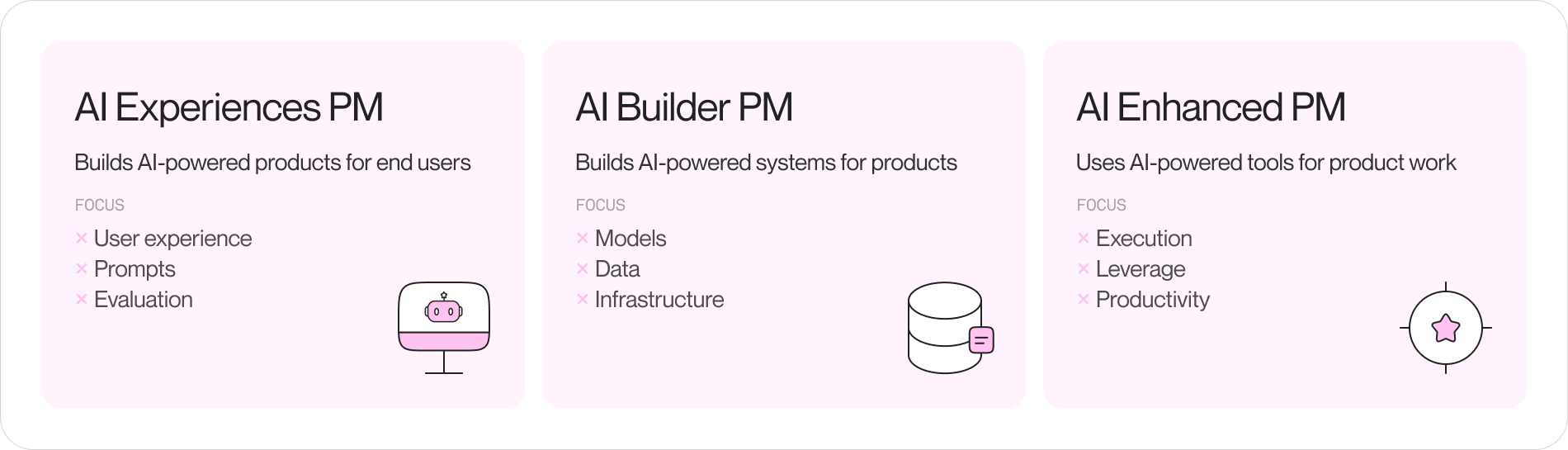
"AI product manager" hides three different jobs. Applying to the wrong one is a common reason strong candidates get filtered out. Know which you're targeting before you write a single application.
AI experiences PM
You build user-facing features on top of existing models. A copilot inside a SaaS tool, an AI writing assistant, a support chatbot, a smart search box. You don't train models. You compose them, prompt them, wrap them in a good experience, and measure whether users trust the output.
This is the most accessible entry point for a traditional PM. Your product sense transfers almost whole. You add prompt design, evaluation, and a feel for where models break. Most "AI PM" postings at application companies are this role.
AI builder PM
You own the model, the data pipeline, or the platform other teams build on. A ranking system, a foundation-model API, an internal ML platform, a fraud-detection engine. You work daily with ML engineers and data scientists, and deeper technical fluency is the price of entry.
These roles skew senior and usually want prior AI or data experience. If you're breaking in, this is rarely your first stop. Aim here after a year or two shipping AI experiences.
AI enhanced PM: a skill, not a job
This one isn't a career path. It's every PM using AI to work faster: drafting PRDs, synthesizing research, building prototypes and dashboards without waiting on a specialist. It won't put "AI" in your title. But it's now table stakes for any PM role, and it's the on-ramp that builds the muscles the first two roles pay for.
Core skills you need
Two capabilities decide whether you land an AI experiences role. Neither requires a computer science degree.
AI and ML literacy without coding
You need to understand how models behave, not how to build them. What a large language model can and can't do reliably. Why it hallucinates. What a token is and why it drives cost and latency. The difference between fine-tuning, retrieval, and prompting, and when each fits. Why an eval set beats a demo.
You learn this by using models hard and reading their behavior, not by studying linear algebra. Get fluent in prompt engineering first. It's the highest-leverage literacy skill, and every hour shows up in interviews.
AI product sense
Classic product sense asks "should we build this and will people want it." AI product sense adds three questions. Is this a problem a model can solve well enough to trust. What happens when it's wrong, and can the user recover. Does the value survive the cost per call.
The PMs who get hired can look at a workflow and tell, fast, whether AI makes it better or adds an expensive, unreliable step.
That instinct comes from shipping and watching real usage, which is why the roadmap below is built around doing.
A five-step roadmap to break in
You don't become an AI PM by finishing a syllabus. You become one by leaving behind evidence you can do the work. Each step produces something you can point to.
Step 1: build AI literacy
Spend two to three weeks using models daily, not reading about them. Rebuild a task you do by hand with a model in the loop. Push it until it breaks, then figure out why. Learn what a system prompt does, how context changes output, and where hallucination creeps in.
Goal: you can explain in plain language why a model fails and how you'd catch it. That single ability separates you from candidates who've only watched demos.
Step 2: take the right courses
Courses give you vocabulary and structure. Pick ones built for product people, not engineers. Product Map's AI product manager specialization is organized around the exact skill set hiring managers screen for, from context engineering to evals to AI unit economics. Reforge, Product School, and DeepLearning.AI's shorter courses cover the model-side fundamentals.
Don't stack five courses. Take one, finish it, and move to shipping. Certificates don't get hired. Artifacts do.
Step 3: ship a real AI project
This is the step that gets you the job. Build something that uses a model to solve a real problem, end to end. A resume screener, a meeting-notes summarizer, a support-ticket classifier. Use no-code and vibecoding tools if you can't code: v0, Bolt, Lovable, Cursor, or a chain of agents.
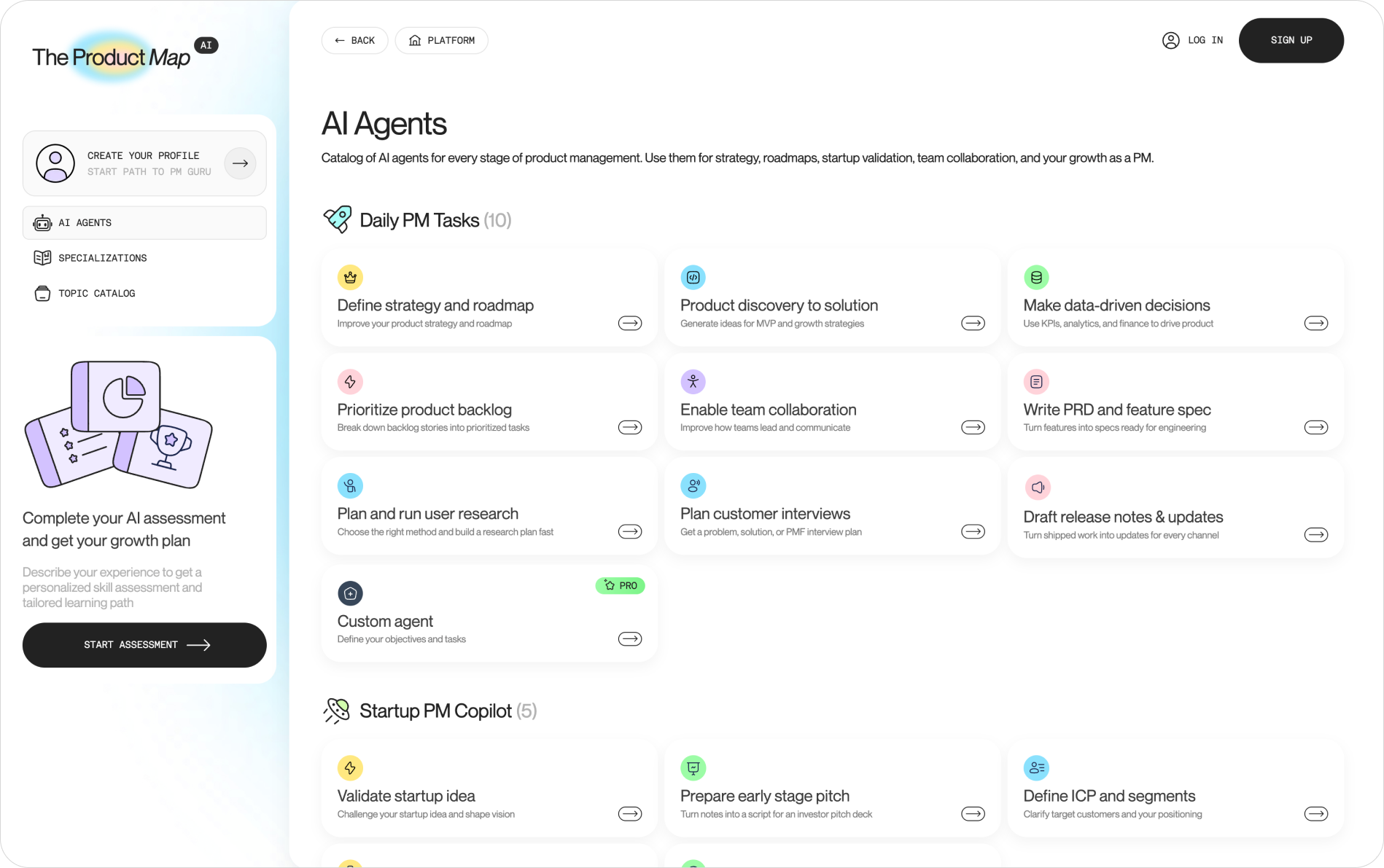
To see how real AI products are scoped, prompted, and bounded, work inside a catalog of purpose-built agents. Product Map's catalog of AI agents covers discovery, PRD writing, prioritization, monetization, and unit economics, so you can study how each decomposes a PM job before building your own.
Whatever you build, write an eval set for it. Ten cases with expected behavior, edge cases, and known failure modes. That eval set is often more impressive in an interview than the feature itself, because almost no junior candidate brings one.
Step 4: build a portfolio and public presence
Package the project so a hiring manager gets it in ninety seconds. A short writeup: the problem, why a model fit, what you built, how you measured quality, what broke, and what's next. Host it on a simple page or a public repo.
Then write in public. One post breaking down an AI product you admire, one on a lesson from your own build. You're not chasing followers; you're leaving a trail that says you think like an AI PM, and hiring managers read it.
Step 5: network and prepare for interviews
Talk to people doing the job. Comment with substance on their work, ask one sharp question, and offer a teardown of their product. Warm intros beat cold applications by a wide margin for AI roles, where trust in judgment outweighs a resume keyword.
For interviews, prepare to walk through your project as a case study, estimate cost and latency tradeoffs out loud, and answer "how would you know this feature is working." Practice AI-framed product-sense questions: where would you add a model, and where would you refuse to.
AI PM salary and job market demand
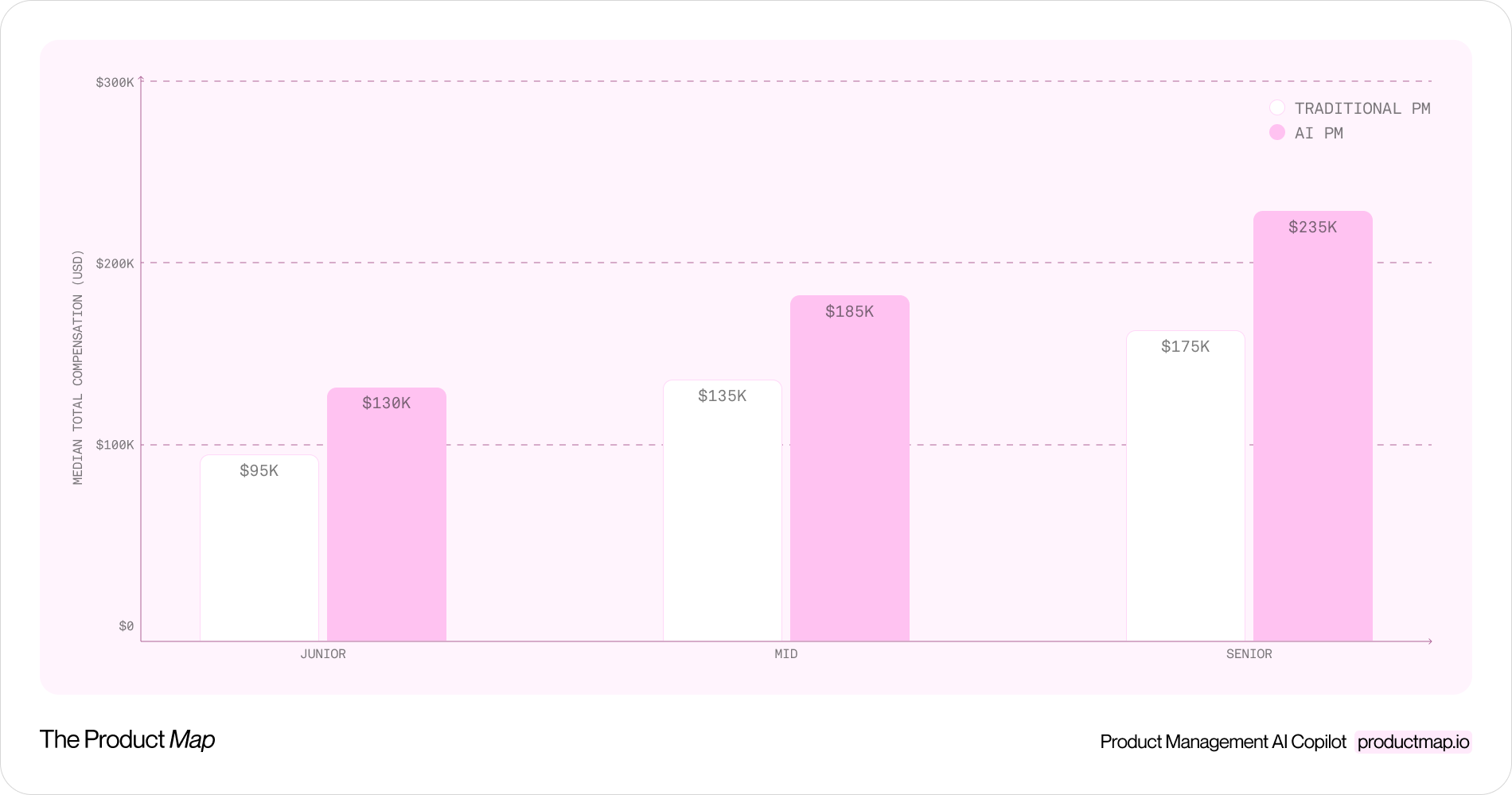
Demand is concentrated, not evenly spread. Roles that name AI fluency carry a salary premium of roughly 35 percent over comparable generalist PM postings, and a large share of employers report they can't fill them. A shortage at the top sits next to a glut of generalists in the middle.
In the US, AI PM total compensation commonly lands in the $180,000 to $250,000 range at mid to senior levels, higher at large AI labs, lower at early-stage startups that pay in equity. Numbers move fast, so treat any single figure as directional and check Levels.fyi or Glassdoor before you negotiate.
The signal that matters most for a switcher: companies are paying up for people who can multiply a small team with AI, and stepping back from roles whose value was coordination. Aim your skill-building at the first group.
Common mistakes to avoid
- Studying ML theory before touching a model. You'll learn more in a weekend of building than a month of lectures. Ship first, backfill theory as questions arise.
- Chasing builder roles too early. Applying to model-owning positions with no AI experience gets you filtered fast. Start with AI experiences roles where your product sense carries you.
- Collecting courses instead of artifacts. A wall of certificates signals studying, not doing. One shipped project with an eval set beats five completion badges.
- Ignoring cost and failure. Pitching an AI feature without a view on cost per call, or on what happens when the model is wrong, marks you as a beginner. Bring both to every discussion.
Start this week, not this year
The roadmap is cumulative. Literacy feeds the project, the project feeds the portfolio, the portfolio opens the conversations. You don't need permission or a new title to begin, only one small AI feature you built and can explain.
Pick a problem you understand, wire a model into it this week, and write down where it breaks. That artifact is the whole job in miniature. The title follows the evidence.
FAQ
What is an AI product manager?
An AI product manager owns products whose core value comes from a machine learning model rather than fixed rules. They do the usual PM work plus model-specific concerns: evaluation, quality bars for variable output, latency, and cost per call. Most openings are for AI experiences PMs building features on top of existing models.
What is the salary of an AI PM?
In the US, AI PM total compensation commonly runs from about $180,000 to $250,000 at mid and senior levels, with AI-named roles carrying roughly a 35 percent premium over comparable generalist roles. Check Levels.fyi or Glassdoor for current, company-specific figures.
Can AI do a product manager's job?
No. AI is fast and confident inside a well-framed problem and collapses when the goal is vague, contested, or when the right move is to not build at all. That framing work didn't speed up. PMs who use AI to execute now outpace those who don't, so the job is shifting from operator to orchestrator, not disappearing.