




Open your product strategy document and try to name one decision it rules out. Most strategy docs fail this test. They list ambitions, markets, and metrics, and they exclude nothing, which means they decide nothing.
The cost shows up in execution. Research published in Harvard Business Review found that only 55 percent of middle managers can name even one of their company's top five priorities. Half the people paid to translate strategy into work can't say what the strategy is.
A product strategy framework closes that gap. It's a repeatable structure that connects vision to the prioritization calls your team makes every week, in writing, where every teammate and every AI agent can read it.
Strategy, vision, and roadmap: three different jobs
The three words get used interchangeably in most companies, and the confusion is where alignment starts to rot. Richard Rumelt's definition from Good Strategy Bad Strategy is still the cleanest test for the middle layer:
The kernel of a strategy contains three elements: a diagnosis, a guiding policy, and coherent action.
Here's how the three artifacts divide the work:
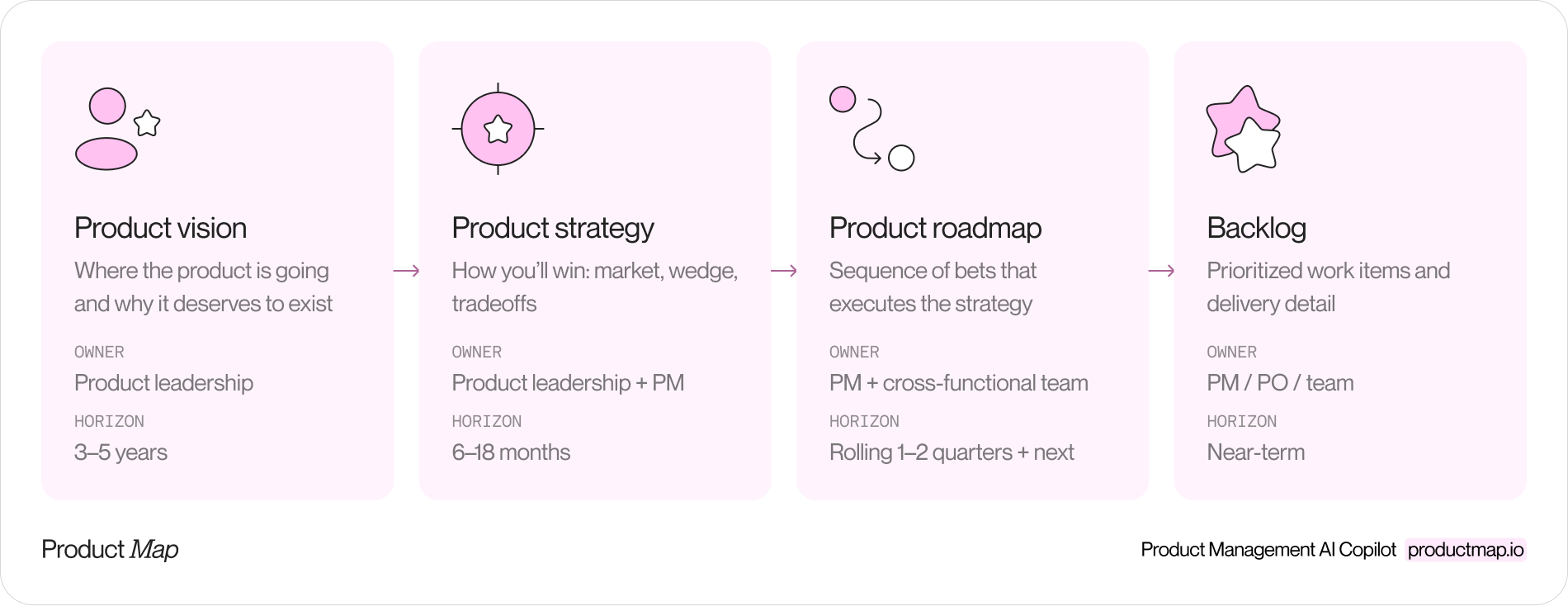
- Product vision: where the product is going and why it deserves to exist. A three-to-five-year horizon, owned by product leadership, and stable enough to survive several strategy revisions.
- Product strategy: the argument for how you'll win. Which market, which wedge, which tradeoffs. A six-to-eighteen-month horizon, revised when the diagnosis changes.
- Product roadmap: the sequence of bets that executes the strategy. A rolling one-to-two-quarter commitment plus a longer view of what's next, revised continuously.
The product vision vs product strategy distinction matters because they fail differently. A weak vision leaves the team uninspired. A weak strategy leaves them busy and misdirected. And in the product strategy vs product roadmap pairing, the roadmap is the output, never the input; a roadmap built without a strategy behind it is a feature wishlist with dates attached.
The five components every strategy framework needs
Formats vary; the load-bearing parts don't. A product management strategy framework holds five components, and a gap in any one of them shows up as a specific, recognizable failure.
- Product vision: the north star narrative. Without it, every strategy debate reopens first principles.
- Target market and user needs: the segments you serve and the pains you relieve, backed by research rather than assumption. Without it, positioning drifts toward whoever shouted last.
- Competitive positioning: why a buyer picks you over the alternatives, including the alternative of doing nothing. Without it, you compete on price by default.
- Business and product goals: the measurable outcomes the strategy must produce, usually three to five, with owners. Without them, nobody can say whether the strategy is working.
- Roadmap and prioritization rules: the sequence of bets plus the scoring logic behind it. Without an explicit prioritization method, the backlog reverts to stakeholder volume.
Write each component on one page or less. A framework nobody reads protects nobody.
The prioritization guide on Product Map is that scoring layer: process, frameworks, estimation, and the metrics that keep the ranking honest.
.png)
Build a product strategy from scratch in six steps
The order matters. Teams who start with goals or roadmap items skip the diagnosis, and a strategy without a diagnosis is a wish.
- Assess your current state and market. Gather what you know: usage data, win-loss notes, competitive moves, and market shifts. Write a one-page diagnosis of the situation you're in. This page is the foundation everything else argues from.
- Define your vision and differentiation. State where the product is going and the one advantage competitors can't copy in a quarter. If the differentiation sentence could describe a rival's product, keep working.
- Identify your audience and their pain points. Pick the segment you'll win first. Name their top three pains in their own words, sourced from interviews and support tickets rather than internal brainstorms.
- Set measurable goals. Translate the vision into three to five outcomes with numbers and deadlines. "Grow activation from 22 to 35 percent by Q2" survives scrutiny; "improve onboarding" doesn't.
- Connect the strategy to corporate business goals. Aligning product strategy with corporate business goals is what turns executive reviews from interrogations into updates. Map each product goal to the revenue, retention, or margin line it moves, and cut any goal you can't map.
- Establish KPIs and a review cadence. Pick the handful of metrics you'll check monthly and book the recurring review before you announce the strategy. The cadence is part of the framework, not an afterthought.
The whole framework fits in five to seven pages. If it's longer, you're documenting instead of deciding.
From strategy to roadmap
The roadmap is where strategy either becomes real or quietly gets overwritten by stakeholder requests. Two rules keep it honest.
Sequence by outcome, not by feature. A now-next-later roadmap organized around the goals from step four stays true as estimates move; a dated feature list breaks the first time an estimate slips. And every roadmap item should trace back to a strategy component. If a bet doesn't serve the diagnosis, the positioning, or a goal, it's on the roadmap because someone senior asked, and the framework exists to make exactly that visible.
The product roadmaps guide on Product Map covers this translation layer in depth: roadmap formats and when each fits, how to connect items to strategic goals, and the frameworks and templates for planning and communicating the sequence to stakeholders.
.png)
Four product strategy models and when each one fits
The framework is the structure; the model is the bet you place inside it. Four cover most products.
- Differentiation: win by being meaningfully different. Figma bet on multiplayer design in the browser when every rival sold desktop licenses. Fits crowded markets where you can change how the job gets done.
- Cost leadership: win on price through structural cost advantage. Zoho undercuts its competitors across an entire suite because it owns its stack and spends little on sales. Fits only when the cost advantage is structural; discounting alone is a losing version of this model.
- Quality: win on craft and reliability. Linear took project tracking, a solved category, and won teams over on speed and polish. Fits categories where incumbents grew bloated and users feel the friction daily.
- Focus and niche: win by serving one narrow segment better than any generalist can. Superhuman built email for people who live in their inbox and charged ten times the going rate. Fits small teams who need a defensible beachhead.
Match the model to your stage
- Startups: pick differentiation or niche, and keep the whole framework on two pages. Your advantage is speed of revision, so review monthly.
- B2B SaaS: positioning against incumbents carries the most weight, and goals should include expansion revenue, not only new logos. Sales will test your strategy daily in deal reviews; write it so they can quote it.
- Enterprise: the hard part is coherence across a portfolio. Each product's strategy maps to corporate goals, and the review cadence needs formal governance, because in a large org an unreviewed strategy is repealed by a thousand small exceptions.
Keep the strategy alive when the market shifts under you
Most strategy frameworks don't fail in the document. They fail in month four, when the doc is finished, the review never got scheduled, and decisions drift back to whoever argues loudest. A framework is something you operate, and it needs an owner and kill criteria: the observable signals telling you the diagnosis is stale.
When the market moves suddenly, the component structure is what makes a pivot survivable. Rewrite the diagnosis first, then trace which components it invalidates. Often the vision and audience hold while positioning and goals change; you're revising two pages, not starting over, and the team can see exactly what changed and why.
Generative AI compressed this loop from both sides. Competitors ship faster, so diagnoses expire in months rather than years. But the same tools now run the strategy work itself: an AI strategy agent that has read your product context can attack your diagnosis, flag the goals no longer connected to reality, and tighten the roadmap sequencing before your quarterly review does it for you, with an audience.
.png)
Put the first review on the calendar today. A strategy reviewed monthly earns the team's trust; a strategy reviewed never earns a shrug, and the framework, whichever model sits inside it, only works while someone is operating it.