




More than 50 product management frameworks have names polished enough to cite in a deck. The folder our team runs on holds four files: rice.md, jobs-to-be-done.md, okrs.md, and one called other-frameworks.md where MoSCoW, Kano, HEART, AARRR, and RACI share a single page.
That split is deliberate. Three frameworks carry our daily work: RICE for the backlog, Jobs-to-be-Done for discovery interviews, and OKRs for quarterly goals. The rest come out for specific situations, then go back in the drawer. Every AI agent we run reads the same folder, so the frameworks aren't posters on a wall. They're instructions in a repository.
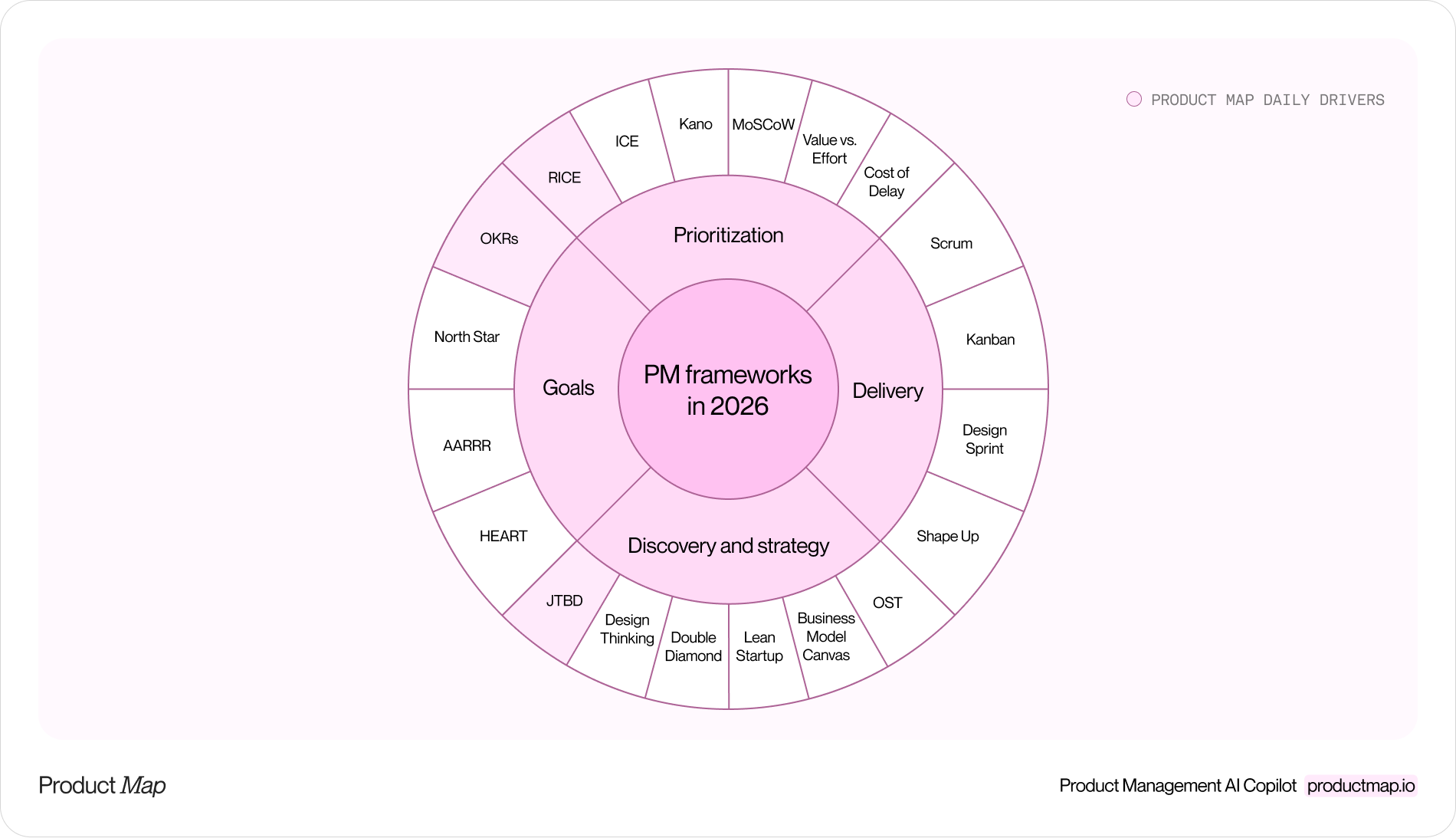
This guide sorts 20 frameworks into the four groups we use to organize the Product Management Map: prioritization, discovery and strategy, delivery, and goals. Then it covers the part most roundups skip: how to pick one, why adoption fails, and what changes when an agent can run the framework for you.
What counts as a product management framework in 2026
A product management framework is a repeatable structure for a recurring product decision. It defines the inputs you collect, the steps you run, and the shape of the output. RICE takes four estimates and returns a ranked list. JTBD takes an interview and returns a job statement. The framework doesn't make the decision. It makes the decision comparable across people, weeks, and now agents.
Frameworks earn their keep three ways. They speed up decisions by removing the "how should we even discuss this" step. They give a team a shared language, so a debate about a feature becomes a debate about a confidence score. And they make judgment auditable: six months later you can see why something ranked first.
The 20 models below fall into four categories, mapped to the same topics we teach on the Product Management Map:
- Prioritization: deciding what to build next
- Discovery and strategy: learning what to build at all
- Delivery and process: shipping it predictably
- Goals and measurement: knowing whether it worked
Prioritization frameworks: RICE, ICE, MoSCoW, and Kano
Prioritization frameworks answer one question: given more ideas than capacity, what ships first?
- RICE: score each item on reach, impact, and confidence, then divide by effort. Built at Intercom, strongest for backlogs of 20-plus items when you have usage data behind the reach number. We score our backlog with it monthly, though cheap building changed the math on the effort divisor.
- ICE: RICE's lighter cousin. Impact, confidence, ease, each scored 1 to 10. Fits growth experiments where speed of scoring beats precision.
- MoSCoW: sort scope into must, should, could, and won't. A negotiation tool more than a scoring tool; use it when a release has a fixed date and stakeholders want everything.
- Kano: classifies features as basic expectations, performance drivers, or delighters, based on a paired survey. Needs customer data, and repays the effort when you're deciding where polish matters.
- Value vs. effort: a 2x2 with no arithmetic. The right first framework for a new team; you'll outgrow it around the point your backlog crosses 30 items.
- Cost of Delay: prices urgency in money per week of waiting. The heaviest option here, and the one finance-driven enterprises take seriously.
Discovery and strategy frameworks: JTBD to Double Diamond
Discovery frameworks structure the learning before the backlog exists. They pair with the user research methods topic on the map.
- Jobs-to-be-Done: users hire a product to make progress in a situation. The framework turns needfinding interviews into job statements engineering can act on. Our discovery interview guides are built on it.
- Design Thinking: empathize, define, ideate, prototype, test. Broad and workshop-friendly; strongest when a cross-functional group needs to align on a fuzzy problem.
- Double Diamond: diverge and converge twice, once on the problem, once on the solution. The Design Council's model keeps teams from jumping to solutions before the problem is chosen.
- Lean Startup: build, measure, learn. Frame the riskiest assumption, ship the smallest MVP capable of testing it, and let evidence pick the next move.
- Business Model Canvas: the whole business on one page across nine boxes. A founder tool; product teams use it when a feature decision is secretly a business-model decision.
- Opportunity Solution Tree: Teresa Torres's map from outcome to opportunities to solutions to experiments. The connective tissue between discovery and prioritization, and the reason continuous discovery took over the vocabulary.
Delivery frameworks: Scrum, Kanban, and Design Sprint
Delivery frameworks structure the shipping itself. They're also where framework fatigue lives, so the bar for adding ceremony should be high.
- Scrum: fixed-length sprints, a groomed backlog, planning, review, and retrospective. Fits teams shipping on a cadence with dependencies to coordinate.
- Kanban: continuous flow with work-in-progress limits. Fits interrupt-heavy work and small teams; no sprint boundary, so nothing waits two weeks to start.
- Design Sprint: Google Ventures's five-day path from problem to user-tested prototype. A discovery tool wearing a delivery name; run it when a big bet deserves a week of focus before a quarter of building.
- Shape Up: Basecamp's six-week cycles with an appetite instead of an estimate. Fits senior teams tired of sprint overhead; risky for teams needing tight external commitments.
Goal and metric frameworks: OKRs, North Star, and AARRR
Goal frameworks connect product work to business results, the territory of the product metrics topic.
- OKRs: a qualitative objective with three to five measurable key results, set quarterly. The third framework in our daily rotation; it's what keeps the other frameworks pointed somewhere.
- North Star: one metric capturing the value users receive, plus the input metrics teams can move. Pairs with OKRs rather than replacing them.
- AARRR: acquisition, activation, retention, referral, revenue. Dave McClure's funnel is still the fastest way to locate where a growth problem lives inside your product analytics.
- HEART: happiness, engagement, adoption, retention, task success. Google's model for measuring UX quality at the feature level, where a North Star is too blunt.
How to choose a framework without slowing the team down
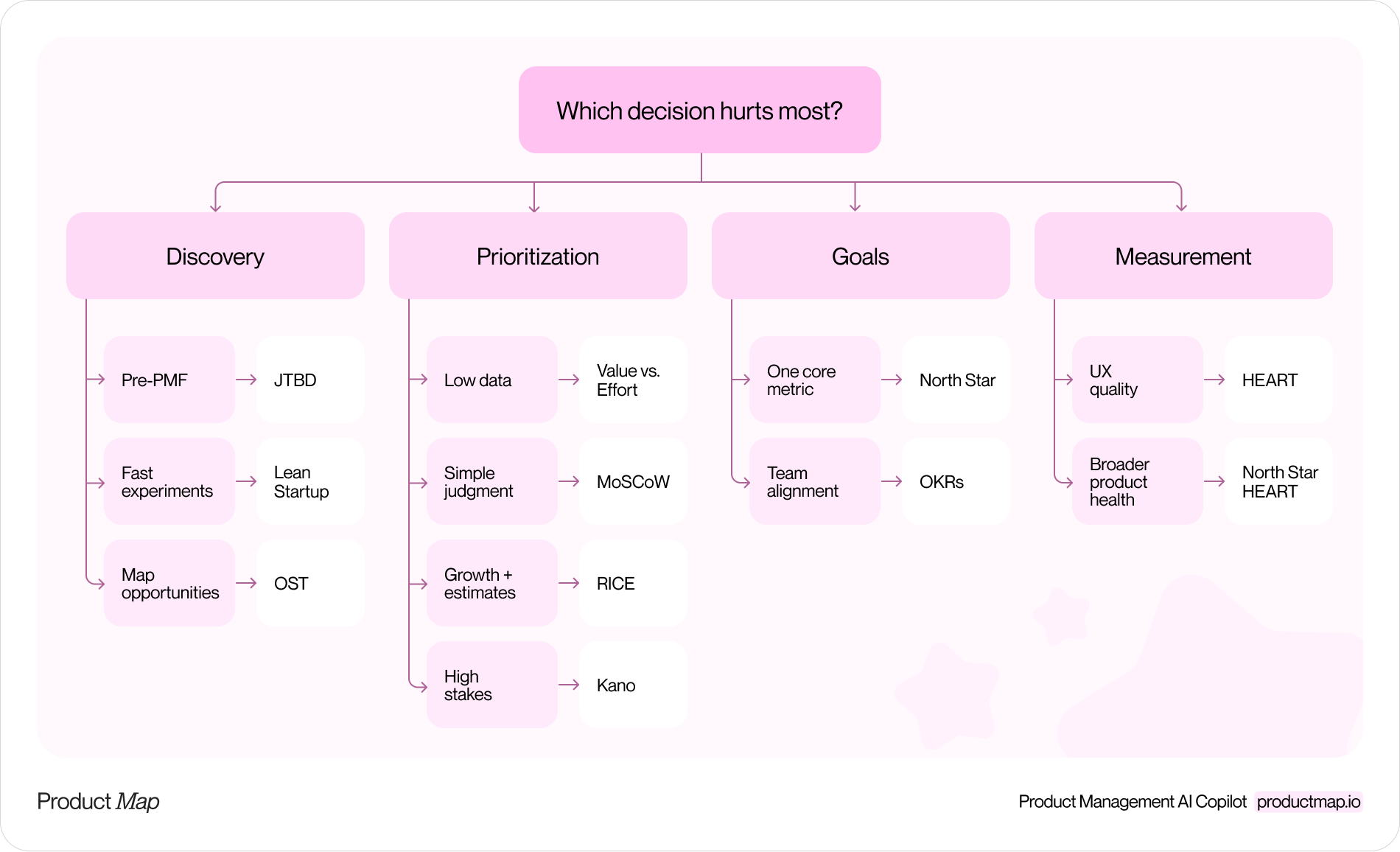
Skip the framework-first question. Start from the decision your team repeats most often and argues about longest. That decision names the category; your context picks the model inside it.
- Match your stage. Pre-product-market fit: JTBD, Lean Startup, and value vs. effort, because judgment is faster than data you don't have. Growth stage: RICE, North Star, and OKRs. Enterprise and platform teams: Cost of Delay, Kano, and HEART, where the cost of a wrong bet justifies heavier inputs.
- Match your data. RICE and Kano are estimate-hungry; feeding them guesses produces confident nonsense. MoSCoW and value vs. effort run fine on judgment alone.
- Match your team size. A four-person startup running Scrum, RICE, and OKRs simultaneously spends more time on ceremony than on customers. One framework per category is the ceiling, and you won't need every category on day one.
- Expect to combine. The categories are complementary, not competing. A common stack: JTBD feeds discovery, an Opportunity Solution Tree connects it to bets, RICE ranks the backlog, OKRs sit above all of it. That's four frameworks working as one system.
Why frameworks fail, and the operator mistake behind it
Most framework failures aren't a wrong pick. They're adoption as ritual. The team runs the scoring meeting, fills the spreadsheet, and ships whatever the loudest stakeholder wanted anyway. The framework becomes theater, and everyone quietly learns the numbers don't matter.
The operator mistake underneath: adopting a framework without attaching decision rights to its output. If RICE produces a ranking and an executive can reorder it without explanation, you don't have a prioritization framework. You have a prioritization performance. The fix costs one sentence in the working agreement: overrides are fine, and overrides get written down next to the score they overrode.
The second failure is treating scores as measurements. Every RICE input is an estimate with an error bar, and dividing estimates multiplies the error. Sensible teams use the scores to sort the backlog into thirds, not to defend why item 7 beat item 8.
A framework is a shared language for a decision, not a machine that makes it. When the output disagrees with your judgment, the disagreement is the finding. Investigate it instead of shipping the spreadsheet.
How AI turns frameworks from documents into agents
The biggest shift in framework practice since Intercom published RICE: frameworks are becoming executable. A model with your product context can apply RICE to 60 backlog items in minutes, draft the job statements from an interview transcript, or check a quarter's key results against the metrics. The PM's job moves from running the procedure to auditing the inputs and arguing with the output.
This is how we build Product Map. The frameworks in our repository double as agent instructions, so the backlog prioritization agent runs RICE scoring against your own product context instead of a generic rubric, and the discovery agents structure interviews around JTBD. The framework knowledge and the execution live in one place.
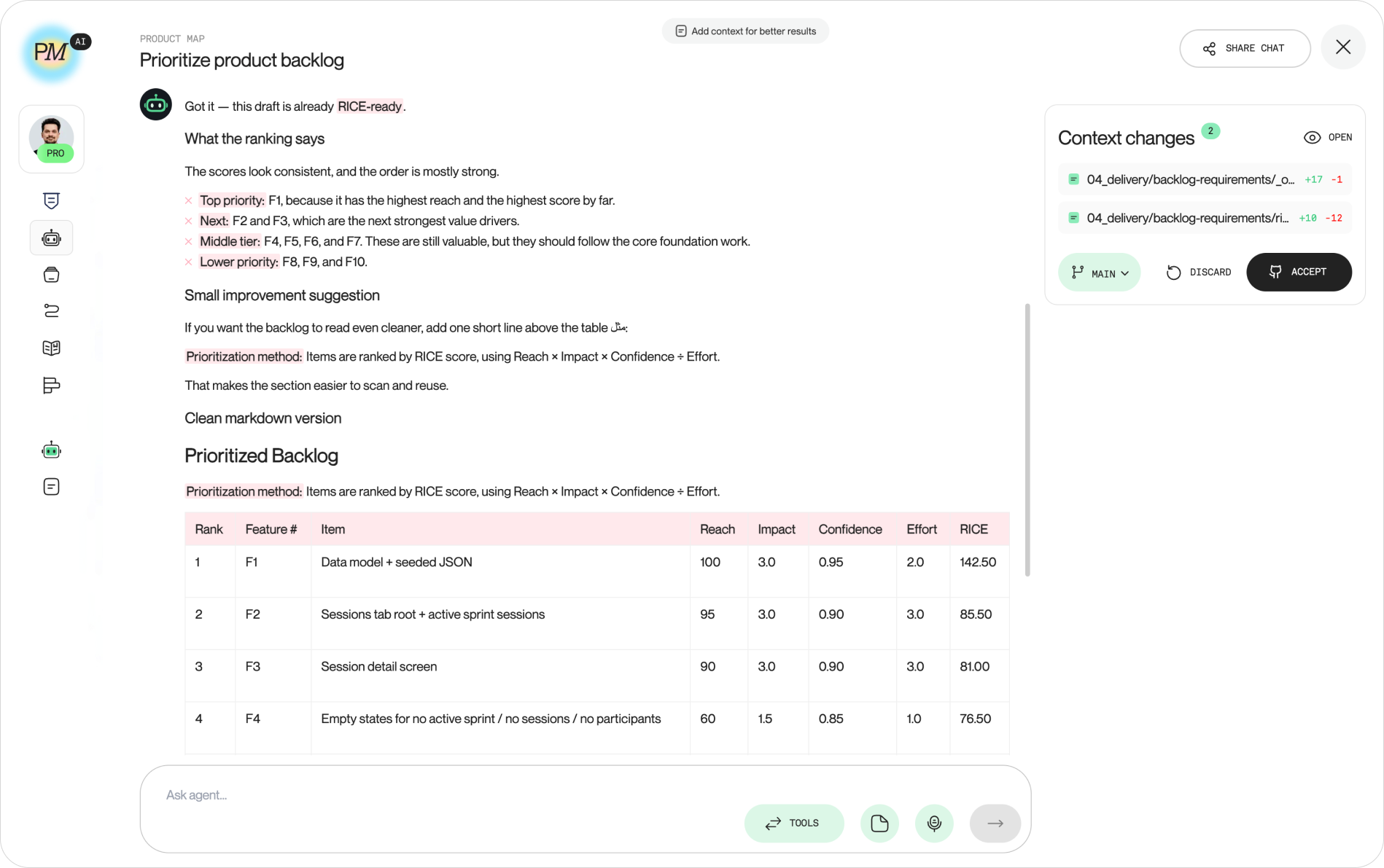
One caution for 2026: an agent applies a framework consistently, which also means it applies a bad estimate consistently. Keep a human on the confidence and impact inputs. The hybrid pattern winning right now is agent-scored, human-challenged.
FAQ
How do I bring frameworks into a startup with no budget?
Start with value vs. effort on a whiteboard and five JTBD-style customer conversations a month. Total cost: two hours a week. Add RICE when the backlog outgrows the whiteboard, and OKRs when headcount passes the point where everyone hears every decision.
Can I combine frameworks?
Yes, and you should, as long as each comes from a different category. JTBD plus RICE plus OKRs is a system. RICE plus ICE plus MoSCoW is three tools for the same job, and the team will relitigate every ranking across all three.
What changes between early-stage and enterprise teams?
Early-stage teams optimize for decision speed, so judgment-based frameworks win. Enterprise teams optimize for defensibility across stakeholders, so data-heavy frameworks like Cost of Delay and Kano earn their overhead. The failure mode runs both directions: startups drowning in enterprise ceremony, and enterprises making gut calls on nine-figure bets.
How do I know whether a framework works for my team?
Watch two signals over six weeks. Decisions get faster, and decided items stay decided. If the scoring meetings grow longer while rankings still get overturned in hallways, the framework is theater; drop it or fix the decision rights.
Start with one framework
Pick the recurring decision your team argued about most last month. Adopt one framework for it, run it for six weeks with overrides written down, and check the two signals above. Keep it if decisions speed up. Swap it if they don't.
Then let the frameworks compound. Ours went from a wall poster idea to four markdown files to instructions our agents execute daily. The teams getting the most from frameworks in 2026 aren't the ones who know the most models. They're the ones whose three chosen models run without friction, every day, in one place.