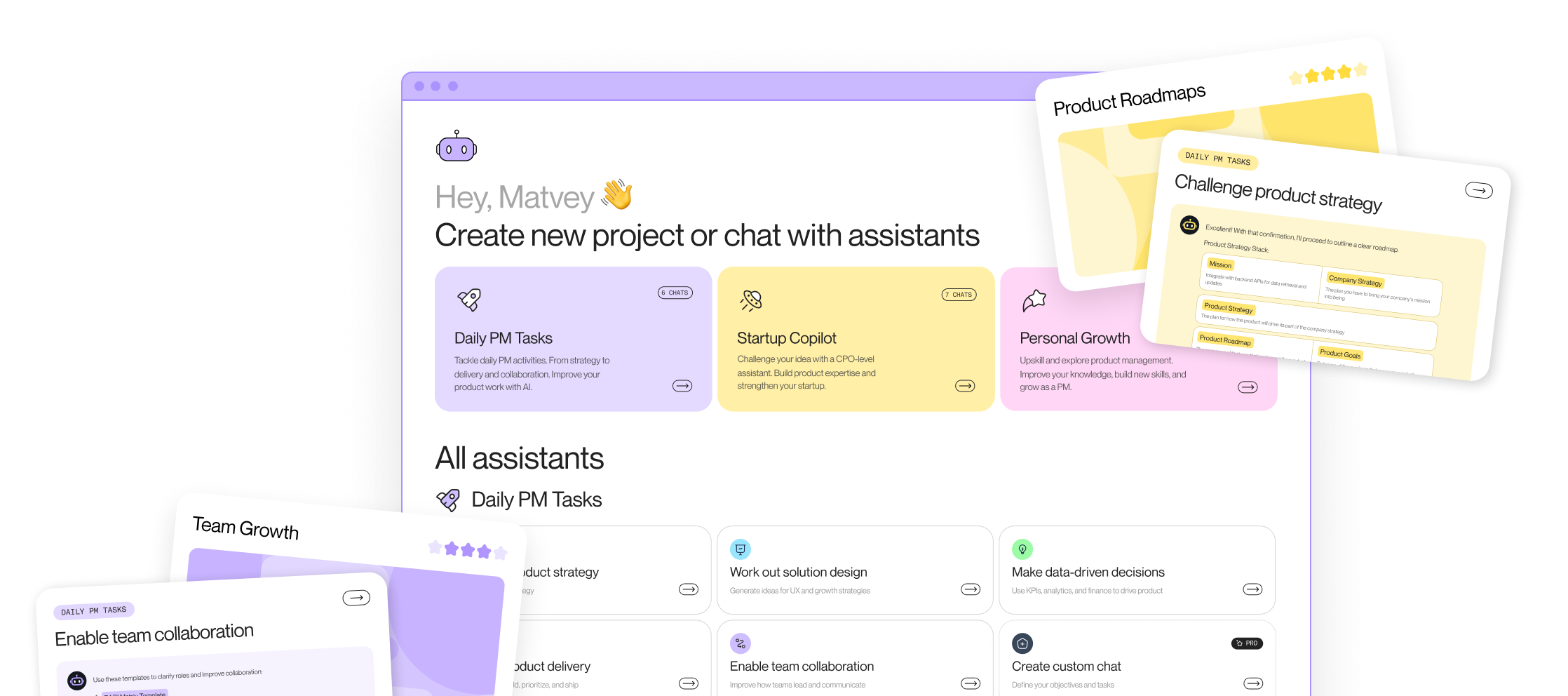


Your morning used to start with Slack and a standup. For a growing number of product managers in 2026, it starts in an agent dashboard. You open the console, scan overnight runs, read three failed conversations, flag one for retraining, and only then look at the roadmap. The agent shipped months ago. It still needs you every day.
Harvard Business Review named the role in February 2026: the agent manager, the person who owns a deployed fleet the way a floor manager owns a shift.
The blind spot most teams hit is simpler than the title suggests. They launch an agent, celebrate the demo, and assume it runs itself. It doesn't. An agent that behaves differently on two identical inputs is a system that needs an operator, not a one-time author.
This is a different job from writing the spec. A PRD defines the guardrails before launch. Agent ops is what happens after, every day, for as long as the agent is live, and it's a product operations discipline in its own right.
Why a deployed agent needs a manager
A deterministic feature is done when it ships. You wrote the code, it does the same thing on every click, and the only reason to touch it again is a bug or a new requirement. An agent breaks that model on day one.
Three properties make it a living system rather than a finished artifact:
- It's non-deterministic. The same question returns different answers across runs. A pass rate of 94% means one in every sixteen users saw something you never tested.
- Its inputs move. Users phrase requests in ways you didn't anticipate. The model provider ships a new version. Your own product data shifts under the agent's feet.
- It fails without erroring. A broken API throws an exception someone gets paged for. A confident wrong answer looks exactly like a correct one, and nobody gets paged at all.
Gartner projects that 40% of enterprises will embed agents in production by the end of 2026, with 57% already running multi-step agent workflows. Most of those teams staffed the build and forgot the run. The agent is treated as a project that closed, when it's a service that opened.
The agent-ops daily loop
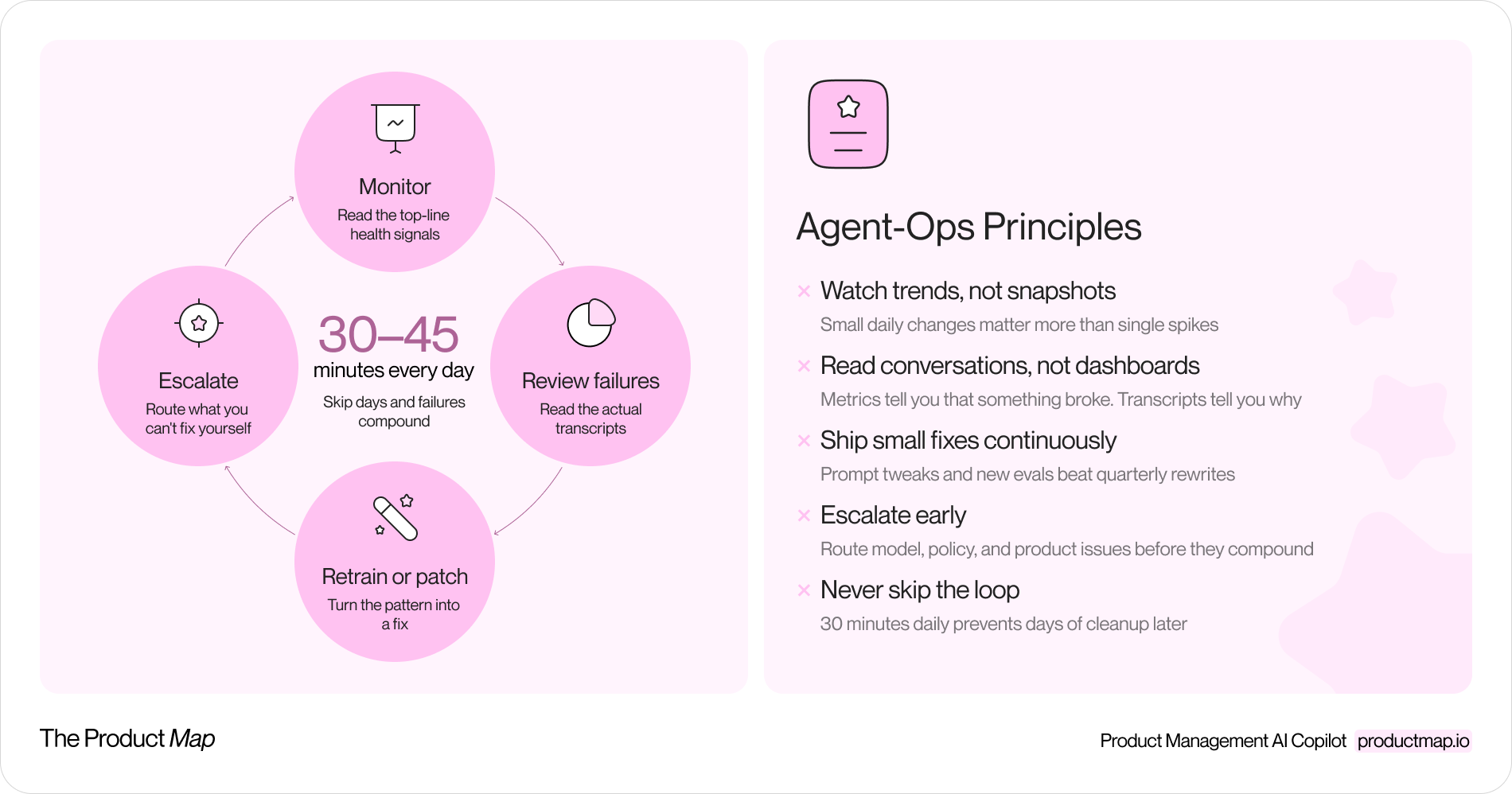
Running a fleet is a repeatable cadence, not a heroic intervention when something breaks. The operators who do this well run the same short loop every day. Four moves:
- Monitor. Open the observability view and read the top-line health numbers first: volume, pass rate, escalation rate, cost per run. You're looking for a delta from yesterday, not an absolute. A pass rate that slid from 93% to 88% overnight is the signal.
- Review failures. Read the actual transcripts, not the aggregate. Pull the ten worst conversations from the last 24 hours and read them end to end. Aggregates tell you something broke. Transcripts tell you what and why.
- Retrain or patch. Turn the failure pattern into a fix: a prompt edit, a new example in the eval set, a guardrail, or a routing rule that sends a hard case to a human. Small, frequent corrections beat quarterly overhauls.
- Escalate. Some failures aren't yours to fix. A model regression goes to engineering. A policy gap goes to legal or support. Your job is to catch it, label it, and route it fast.
The loop takes 30 to 45 minutes a day for a healthy fleet. It balloons when you skip days, because failures compound quietly and you end up reading a week of transcripts at once.
What an agent scorecard tracks
You can't manage a fleet on vibes. But a dashboard built for a deterministic web measures the wrong things for an agent. Sessions and page views tell you nothing about whether the agent did its job.
An agent scorecard tracks outcomes and health, not traffic:
- Task completion rate: the share of conversations where the agent finished the job the user came for. This is your north star, and it's the hardest to measure because it needs a judgment call on what "done" meant.
- Escalation rate: how often the agent handed off to a human. Rising escalation is an early warning; falling escalation with flat completion means the agent is guessing instead of asking.
- Cost per resolved task: the model spend divided by successful outcomes, not by raw calls. A cheap-per-call agent that fails half the time is expensive per result.
- Eval pass rate: performance against a fixed set of test cases you run on every change. This is your regression net.
- Latency at the tail: the p95, not the average. The slow one in twenty is the one that makes a user abandon.
Pick two or three that map to the outcome the agent exists to produce. A support agent lives or dies on resolution rate and escalation. A drafting agent lives on acceptance rate: how often a human keeps the output instead of rewriting it.

Catching drift before your users do
The failure mode nobody plans for is slow. Your agent doesn't crash. It gets a little worse each week until the numbers are bad and no one can point to the day it broke.
Drift comes from three directions. The model provider updates the base model and behavior shifts under you. Your product data changes, so the agent answers from a stale picture. User behavior evolves, and questions the agent handled well in January show up in a new shape by June. None of these trip an alarm on their own.
Two habits catch it. First, run your eval set on a schedule, not only when you change something, so an external model update shows up as a pass-rate drop you didn't cause. Second, watch the trend, not the snapshot. A single day at 90% is noise. Fourteen days sliding from 94% to 89% is drift, and it's the thing a weekly glance at a number will miss and a plotted line will catch.
A deployed agent has no steady state. Left alone, it doesn't hold its launch-day quality; it decays. The operator's job is to notice the decay while it's still five points, not fifty.
The agents you manage across the lifecycle
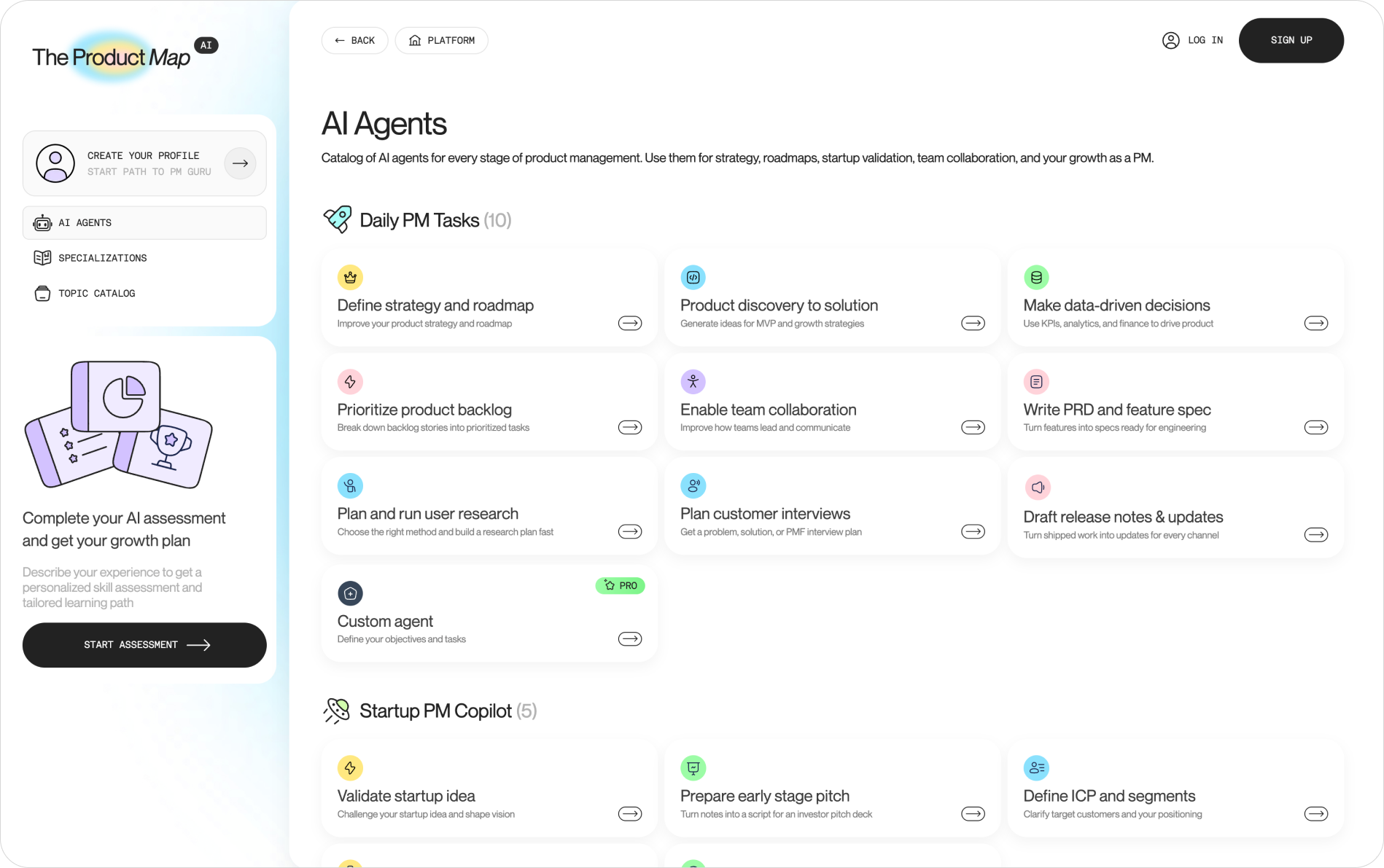
Most PMs won't run one giant agent. They'll run a fleet of smaller, specialized ones, each owning a slice of the product lifecycle. That's already how the Product Map agent catalog is built: a set of purpose-built assistants mapped to the phases of product work, not one general chatbot trying to do everything.
Open the catalog and you're picking an operator for a specific job:
- Strategy and discovery: a strategy and roadmap agent, a product discovery agent that moves from problem to solution, and a user research agent that picks a method and builds the plan.
- Voice of customer: a customer interviews agent that produces a problem, solution, or PMF interview plan you can run this week.
- Delivery: a PRD agent that turns a feature into a spec ready for engineering, and a release notes agent that turns shipped work into updates for every channel.
- Analysis: a data-decisions agent for KPIs and analytics, plus unit economics for LTV, CAC, and contribution margin.
- Team and growth: collaboration, backlog prioritization, monetization, and ICP agents for the work around the build.
Each one is a scenario chat grounded in your product context, not a blank prompt. The reason this matters for agent ops is coverage. When your fleet is organized by lifecycle phase, your daily loop has a clear map: you know which agent owns discovery, which owns delivery, and where a failure belongs the moment you read the transcript.
Where agent ops sits in the org
Here's the question that stalls most teams, and the one HBR's framing raises but few articles answer: who owns the running fleet? Engineering built it. Support feels the failures. Product decided it should exist. So the agent lands in the gap between all three and gets managed by no one.
The operator role is closest to product, and here's why. Judging whether an agent's output is good enough to ship is a product-quality call, not an engineering one. Deciding which failures matter, which get patched now, and which get escalated is prioritization. Owning the outcome the agent produces is what a PM already does. The agent manager is a PM whose backlog is a live system instead of a feature list.
That doesn't mean the PM does everything. A working split looks like this:
- Product owns the loop: the scorecard, the failure review, the call on what "good enough" means, and the prioritization of fixes.
- Engineering owns the plumbing: model updates, latency, infrastructure, and the eval harness that runs the tests.
- Support owns the human escalation path and feeds real failure patterns back into the loop.
The teams that get this wrong leave the loop unowned and call it "everyone's responsibility," which means it's checked by no one until a bad week forces a fire drill. Name the operator before you launch, not after the first incident.
The shift is quieter than the headlines about agents replacing people. The scarce skill isn't building an agent; the tools for that keep getting cheaper. It's running one well after it ships, every day, so the fleet gets better instead of slowly worse. That's a standing job now. Put someone's name on it.