




In 2012, mobile-first had a precise meaning, and most companies ignored it. It did not mean shipping an iPhone app next to your website. It meant designing for the small screen first, so every later decision inherited its constraints. Teams that treated mobile as a checkbox got a worse product on both screens.
AI-first product management sits at the same fork. Adding a chat window to your product is the 2026 version of "we shipped an app." Going AI-first means something narrower and harder: the product's core value comes from a model, and the process of building it runs on agents instead of on one overloaded product manager. Both halves matter.
This guide defines the term, walks through the principles and skills the shift demands, and gives you an operating model, the TASK framework, to run it.
AI-first, AI-powered, and traditional: the difference
Three terms get blended in most writing on this topic, and the confusion is expensive because each one implies a different investment.
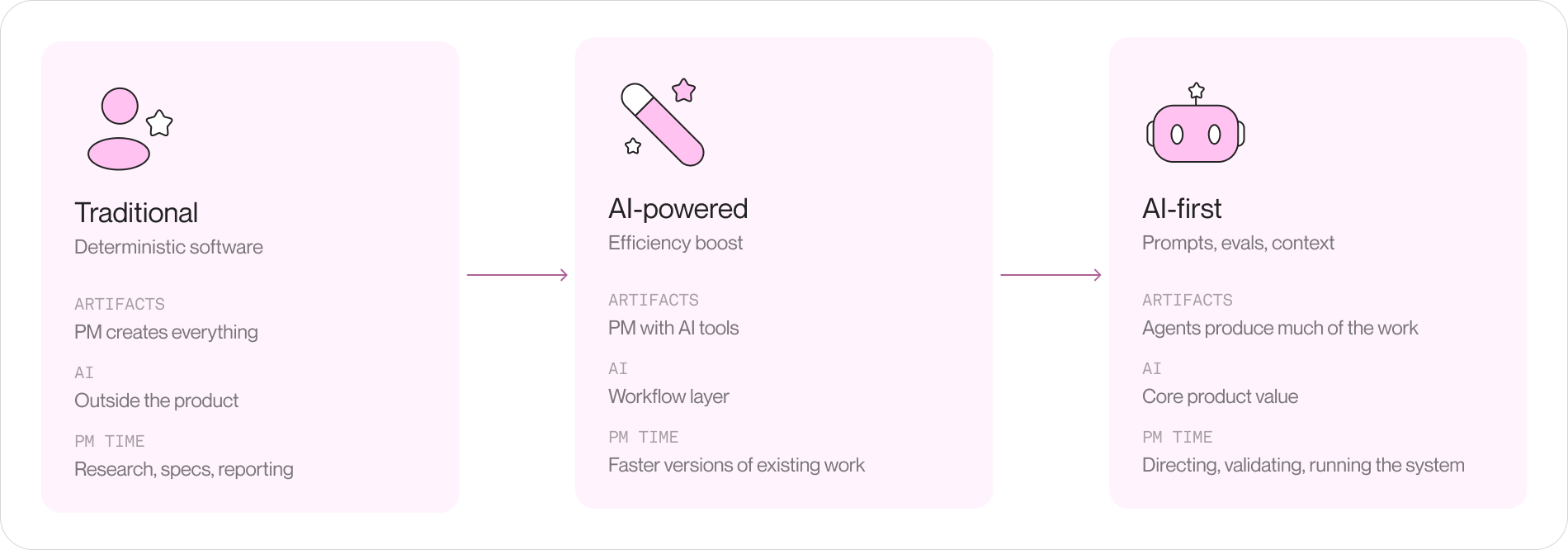
- Traditional product management: the product is deterministic software, and the PM produces every artifact by hand. Research, specs, prioritization, and reporting all flow through one person's calendar.
- AI-powered product management: the PM uses AI tools to speed up existing workflows. Dovetail AI synthesizes interviews, ChatPRD drafts specs, Jira suggests story breakdowns. The product itself may contain no AI at all. Useful, but it's an efficiency layer on an old operating model.
- AI-first product management: the model sits at the core of the product's value, and agents carry a large share of the execution. Prompts, eval sets, and context files become first-class artifacts. The PM's job shifts from producing documents to directing and validating a system able to produce them.
The distinction matters for hiring, budgets, and metrics. An AI-powered team buys tool subscriptions. An AI-first team redesigns how work flows, what gets measured, and what the PM's hours are for.
How AI-first changes the job of the product manager
Traditional product management makes the PM the integration point for everything: research, prioritization, documentation, stakeholder alignment, delivery tracking. The model breaks under AI velocity. Anthropic reported its engineering output roughly tripled with coding agents while product output stayed flat. The queue now forms in front of the person deciding what to build.
An AI-first team removes the queue by changing the PM's role from operator to orchestrator. A research agent runs competitive analysis overnight. A drafting agent produces the first version of a PRD. A prioritization agent scores the backlog. The PM defines the domain each agent works in, sets the quality bar, and spends the recovered hours on calls no model can make: which market, which bet, which tradeoff.
This isn't headcount reduction. It's a change in what human hours buy. The same week of PM time moves from producing artifacts to reviewing them, and from chasing status to shaping direction.
Three working principles for building AI-first products
Start with the customer problem, not with the model
The most common AI-first failure is a backlog full of model demos in search of a user. Write the problem statement and the quality bar before anyone picks an architecture. A useful test: describe the feature without naming the technology. "Billing tickets resolve without human touch in 70% of cases" survives the test. "Add an LLM to support" does not.
Model choice comes last, and it's reversible. The problem definition is the durable asset.
Treat the model as a permanent line on the roadmap
A deterministic feature is finished when it ships. A model-backed feature never is. Providers deprecate versions, behavior drifts, costs change, and a prompt tuned in March performs differently in July. AI-first roadmaps carry a standing line for evaluation, regression testing, and model migration, the way engineering carries one for infrastructure.
Budget it explicitly. Teams that skip this fund it anyway, as unplanned firefighting after quality drops in production.
Build in governance and guardrails from the first sprint
Guardrails retrofitted after launch cost multiples of guardrails designed in. The artifact set is known: an eval set the feature must pass before release, a model card recording capabilities and limits, a guardrails document defining refusal and escalation behavior, and a prompt versioning changelog so you can trace which change moved which metric. Bias audits belong here too; ethical review is cheaper as a design input than as a PR response.
None of this requires a data science hire. It requires the PM to treat model behavior as a spec surface.
What going AI-first buys you, and what it breaks first
The gains are real and show up fast:
- Speed: first drafts of research synthesis, specs, and analysis arrive in minutes. General-purpose LLMs can draft first versions of roughly 70% of text-based PM artifacts.
- Coverage: a three-person startup can run competitive analysis, GTM planning, and cohort reporting in the same week without hiring for each.
- Compounding context: every artifact an agent produces feeds the next run, so the knowledge base gets more useful with age instead of going stale.
So do the costs, and they arrive in a predictable order:
- Margin: every generation carries a per-use inference cost. A well-loved AI feature can quietly take eight points off gross margin before finance notices.
- Quality variance: the same input produces different outputs on different runs, so review discipline has to be designed, not assumed.
- Trust: agents produce confident wrong answers, including synthetic user feedback conveniently aligned with your roadmap.
- Skills: the team needs new muscles (evals, context engineering, cost modeling) before the first feature ships, not after.
Run the AI-first operating model with the TASK framework
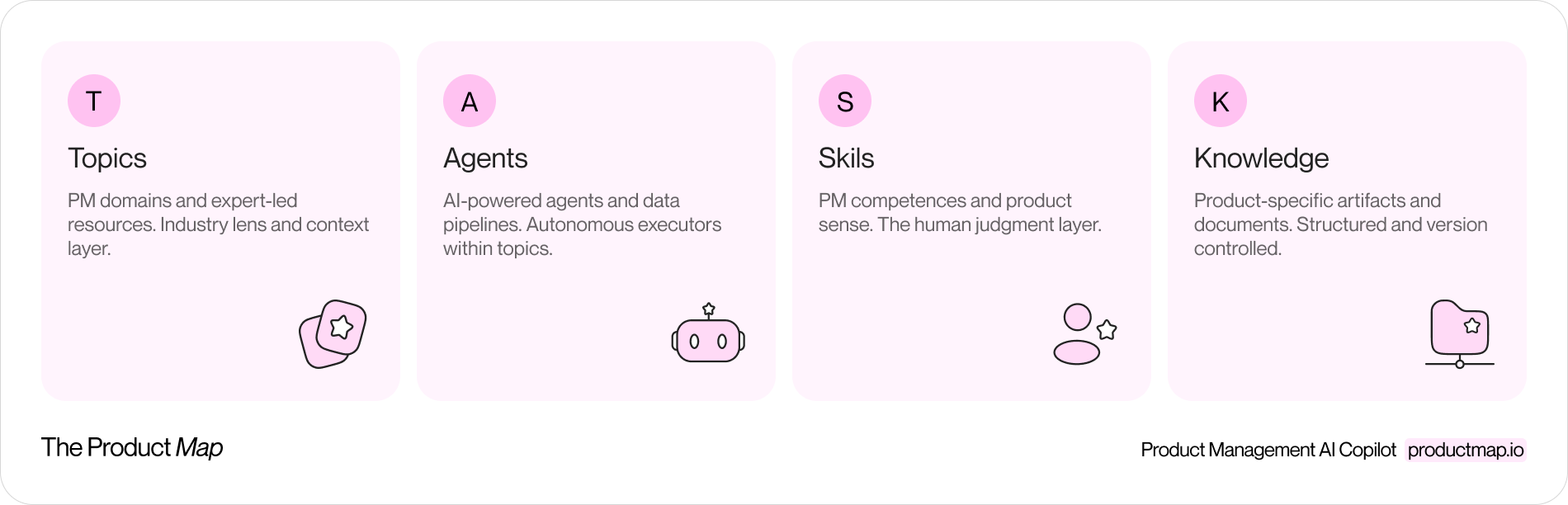
You can adopt the principles above piecemeal and still end up with scattered prompts and unowned agents. The TASK framework, published by the Product Map team in April 2026, packages the AI-first operating model into four pillars:
- Topics define the operating space: each PM domain (strategy, discovery, delivery, growth, people) with the expert resources and quality standards attached. Topics give agents the context to know what good work looks like without step-by-step instruction.
- Agents are the executors: autonomous AI agents working inside topics. One runs research, one drafts PRDs, one scores the backlog, each with its own prompt, memory, and scoped knowledge files.
- Skills are the human judgment layer: the PM's 15 core competencies decide which work gets delegated, how agents are directed, and where a person steps back in.
- Knowledge is the output layer: every run produces a versioned artifact (spec, report, decision log) stored in plain text so the next run reads it.
Agents amplify skills; they don't replace them. The PM brings the expertise shaping how agents are directed and the quality bar their outputs must meet.
In practice the framework runs as a loop: define the topic, assign the agent, apply your skills to validate the output, and commit the result to the knowledge base. Each cycle beats the last because agents read the accumulated knowledge from every previous one.
Start small:
- Pick one topic you're working in this quarter. Don't build the full system at once.
- Move the existing documents for it into a folder of plain Markdown and CSV files.
- Put the folder under Git version control.
- Define one agent: a system prompt scoped to the topic, with access to those files and a clear task.
- Run the loop. Validate the output with your own judgment, then commit it back.
Skills AI-first teams need
For startups the question is sharper, because there's no one to delegate the gaps to. Five competencies separate AI-first teams from teams with AI subscriptions:
- Fluency with data: you can't judge a model you can't measure. Reading eval results and cohort reports is now table stakes for every PM on the team.
- Product discovery: agents make it cheap to build the wrong feature quickly. Discovery discipline keeps validation honest when the synthesis is machine-generated.
- Software engineering literacy: not writing production code, but working in repositories, reviewing diffs, and versioning prompts the way engineers version code.
- Context engineering: writing the topic definitions, knowledge files, and quality directives agents read. The richer the context, the less intervention each run needs.
- Stakeholder management for probabilistic outcomes: explaining to a CEO why the feature works 92% of the time, and why 92% is the honest number.
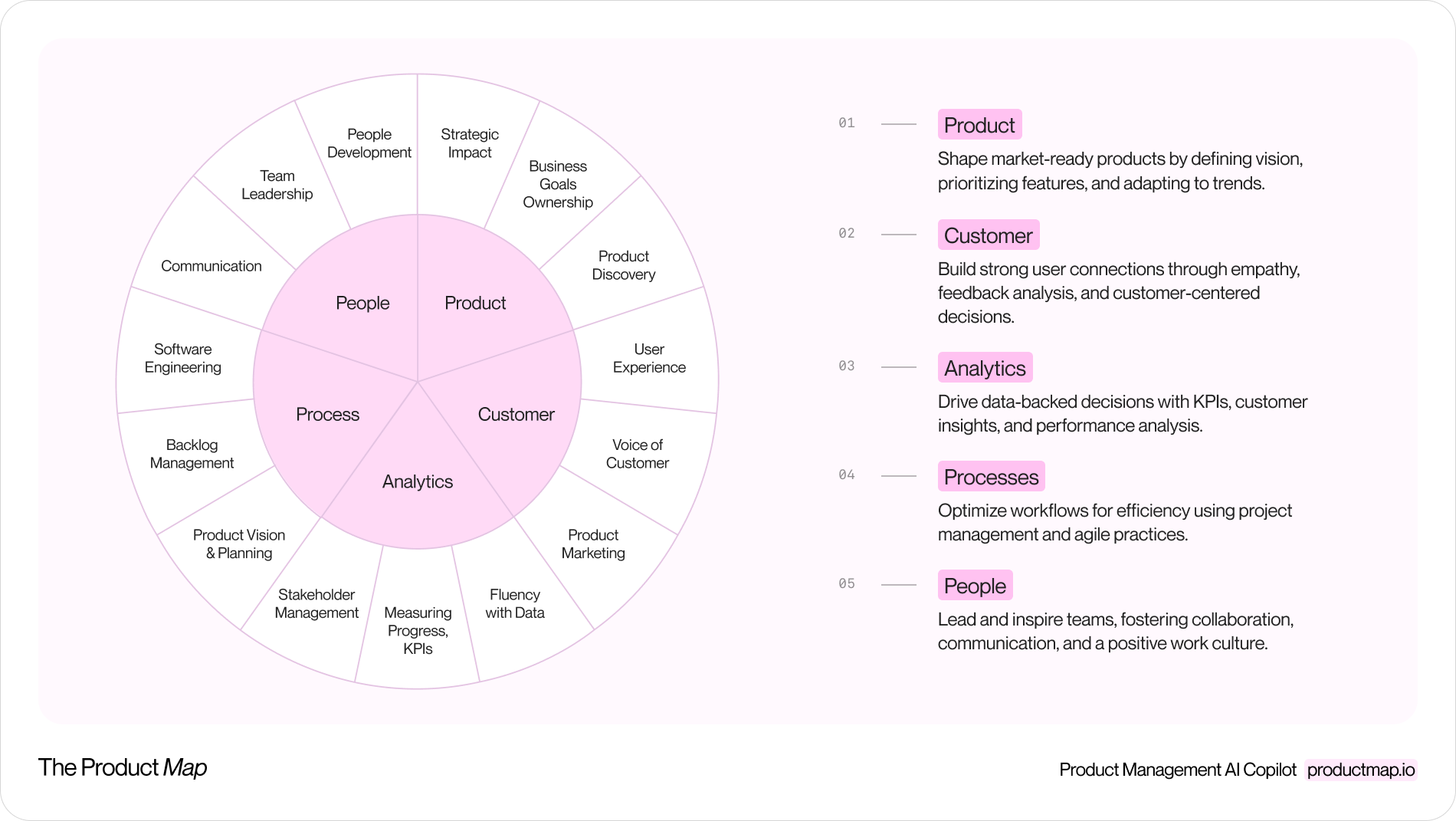
Assess before you train. The Product Management Map scores you across the 15 core PM skills and shows which of these five need work first.
Metrics and OKRs when the feature is a distribution
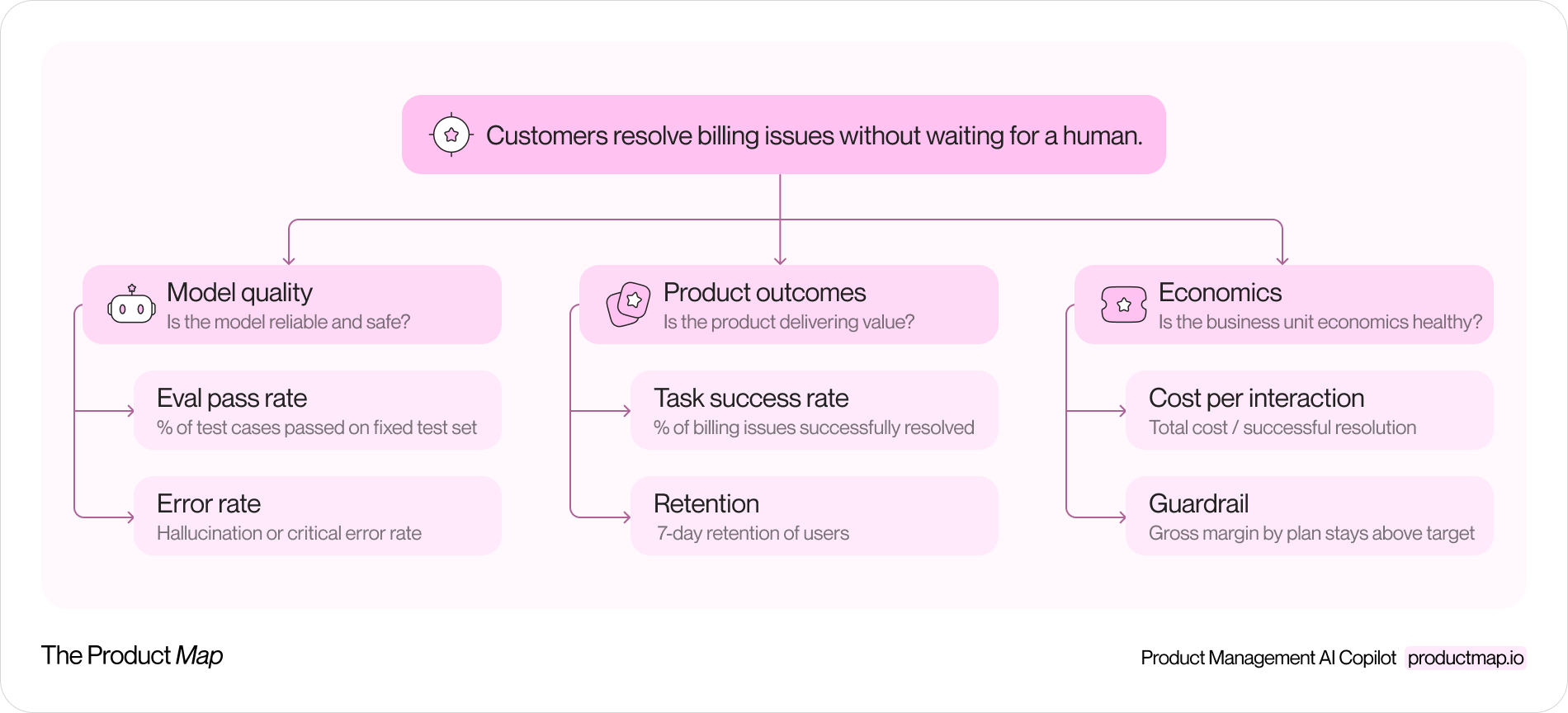
Average-based dashboards flatter AI products. A 4.2-star mean rating hides the 6% of sessions where the model invented a refund policy. AI-first teams measure the spread, not the midpoint, and they track three layers at once:
- Model quality: eval pass rate on a fixed test set, error or hallucination rate, containment rate for support-style agents, and drift across model versions.
- Product outcomes: adoption, task success, and retention, the same metrics as before, because the model is a means and the user outcome is the point.
- Economics: cost per interaction, cost per resolved task, and gross margin by plan, tracked from the first week in production.
Pair every success metric with a guardrail. Containment rate climbing while escalation quality collapses is a failure wearing a green dashboard.
A working OKR for an AI-first team looks like this. Objective: customers resolve billing issues without waiting for a human. KR1: containment rate on billing intents rises from 34% to 60%. KR2: eval pass rate on the billing test set stays above 95% across model updates. KR3: cost per resolved ticket stays under $0.40 at target volume.
Questions product teams ask before they go AI-first
Do I need a technical background to run an AI-first team?
No. You need working literacy: reading a diff, writing an eval case, understanding what a context window is. All of it is learnable in weeks, and none of it involves training models. Judgment about what to build stays the scarce skill.
Is AI-first product management only for AI companies?
The operating model applies to any product team. Agents can run your research, drafting, and analysis even when your product contains no model at all. The full definition, model at the core of the product plus agents at the core of the process, applies when AI is your value proposition, but the process half pays off everywhere.
What's the difference between an AI feature and AI-first?
Remove the model and see what's left. If the product still works and the feature was a bonus, you shipped an AI feature. If the value proposition collapses, the product is AI-first, and everything in this guide applies: standing eval work, guardrail artifacts, and margin tracking from day one.
Can a small team go AI-first without a data scientist?
Yes, for products built on foundation models through APIs, which is most of them in 2026. What you need is eval discipline, not model training. The hire becomes necessary when you fine-tune models, build custom retrieval at scale, or need formal bias auditing for a regulated domain.
How long does it take to become an AI-first product team?
One loop cycle takes about a week: topic defined, agent configured, first artifact validated and committed. Expect a quarter before one domain runs reliably with light supervision, and six to twelve months before the operating model covers the full lifecycle. Start with the domain where you produce the most repetitive artifacts; delivery and research usually win, and the compounding starts from the first commit.