




Open ten job postings for an AI product manager and count the skills they ask for. Most of them are the ones you already have. Discovery, prioritization, stakeholder alignment, writing a clear spec. The gap between a traditional PM and an AI PM is narrower than the hype suggests, and it sits in a thin layer of new competencies you can build in weeks, not years.
The mistake is treating AI product manager skills as a separate discipline you start from zero. It isn't. It's your existing product craft plus a handful of AI-specific muscles, applied to products where the core value comes from a model instead of fixed rules.
TL;DR: AI PM skills are 80 percent traditional PM skills and 20 percent new. The new part is AI and ML literacy without coding, data readiness, prompt and tool fluency, working with ML teams, responsible-AI judgment, and the strategic judgment AI can't replace. Build the thin layer through shipping, not lectures.
What is an AI product manager?
An AI product manager owns products whose main value comes from a machine learning model, not from deterministic logic. A search ranker, a support copilot, a recommendation feed, a fraud score. The output shifts with the input, the training data, and the prompt, so the job carries that variability with it.
The daily work still looks like product management. You talk to users, prioritize, write specs, and ship. What changes is the surface underneath. You reason about data quality, model behavior, evaluation, latency, and cost per call. You set a quality bar for a feature that answers differently every run.
What AI-first product management means
AI-first is a default posture, not a job title. An AI-first PM reaches for a model or an agent as the first option for a workflow, then decides whether it earns its place, rather than bolting AI on after the fact.
In practice, that means three habits. You assume the spec is probabilistic and design acceptance criteria as an eval set. You treat data and cost as first-class inputs from day one. You judge AI-driven products by whether the value survives real usage, not by how well the demo lands. Skills required for an AI product manager grow out of those habits, not out of a certificate.
Traditional PM vs AI PM skill sets
Most core skills transfer directly. A few get a new dimension. Here's the map of traditional PM skill to its AI PM equivalent.
- Requirements writing: a fixed PRD becomes a spec plus an eval set with golden cases and known failure modes.
- Success metrics: a launch checkbox becomes a quality range, since the same input can yield different outputs.
- Prioritization: value versus effort gains a third axis, cost per call, because every model request is real money.
- User research: you still run discovery, and now you also probe where users will and won't trust a machine's answer.
- Stakeholder alignment: you translate model behavior and its failure modes for execs, legal, and engineering, not just the roadmap.
The takeaway from any traditional PM versus AI PM skill set comparison is the same. You keep the foundation. You add a layer for non-deterministic systems.
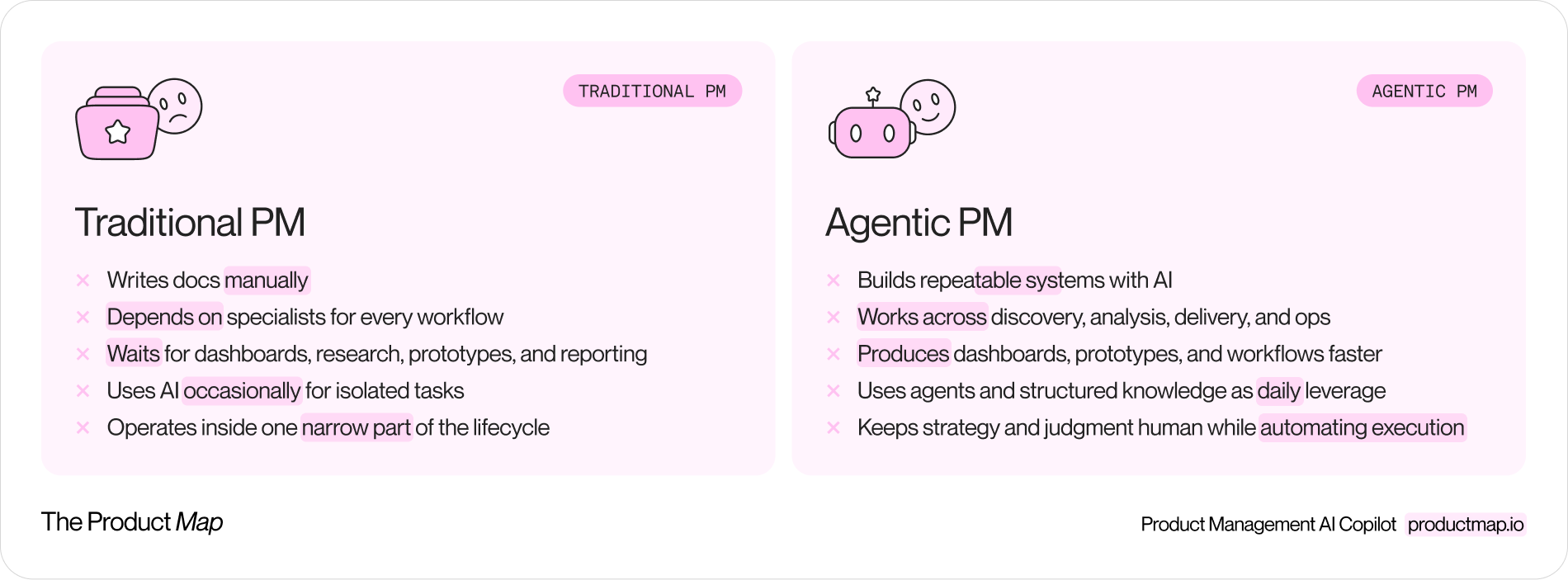
The 6 core competencies of an AI PM
Six skills separate a working AI PM from a generalist who added the label. None requires a computer science degree.
AI and machine learning fundamentals
You need to understand how models behave, not how to build them. What a large language model does reliably and where it breaks. Why it hallucinates. What a token is and how it drives cost and latency. When retrieval beats fine-tuning beats prompting. You learn this by using models hard and reading their output, not by studying linear algebra.
Data literacy and data readiness
AI features live or die on data. An essential skill for an AI product manager is judging whether the data you have can support the feature you want. You assess coverage, labeling quality, bias, and freshness before promising an outcome. You spot when a model looks accurate in a demo and fails on the long tail of real inputs.
Prompt craft and AI tool fluency
Prompt design is the highest-leverage literacy skill, and it shows up in every interview. You should be fluent enough in prompt engineering to shape a system prompt, control context, and diagnose why an output drifted. Tool fluency compounds it. Study how purpose-built agents scope a job by working inside a catalog of AI agents that covers discovery, PRD writing, and prioritization, then build your own.
Working with ML engineers and data scientists
You won't train the model, but you'll steer the people who do. The AI PM skill here is speaking enough of the language to collaborate with ML engineers and data scientists without slowing them down. You frame the problem, agree on the metric, and negotiate the tradeoff between accuracy, latency, and cost. Trust comes from asking sharp questions, not from pretending to know the math.
Responsible AI and ethical judgment
When a model is wrong, someone gets hurt, misinformed, or billed. You own the guardrails: what the system refuses to do, how it handles sensitive data, and how a user recovers from a bad answer. This is judgment, not a compliance checklist. The PMs who skip it ship features that pass QA and fail in the wild.
Strategic judgment AI can't replace
The scarce skill is deciding what's worth building and when to not build at all. AI is fast and confident inside a well-framed problem and collapses when the goal is vague or contested. Framing that problem, weighing the bet, and saying no is the work that didn't speed up. It's the reason the role isn't disappearing.
What employers look for in AI PM roles
Hiring managers screen for evidence, not vocabulary. The skills and qualifications that move you from screened-out to shortlisted are concrete.
- A shipped AI project, end to end, even a small one you built with no-code or vibecoding tools.
- An eval set for that project. Ten cases with expected behavior and known failure modes signal judgment almost no junior candidate brings.
- A cost-and-failure view. You can estimate cost per call and explain what happens when the model is wrong.
- Fluency in plain language. You can explain why a model fails and how you'd catch it, without jargon.
Certificates don't get hired. Artifacts do. One project you can walk through beats five completion badges.
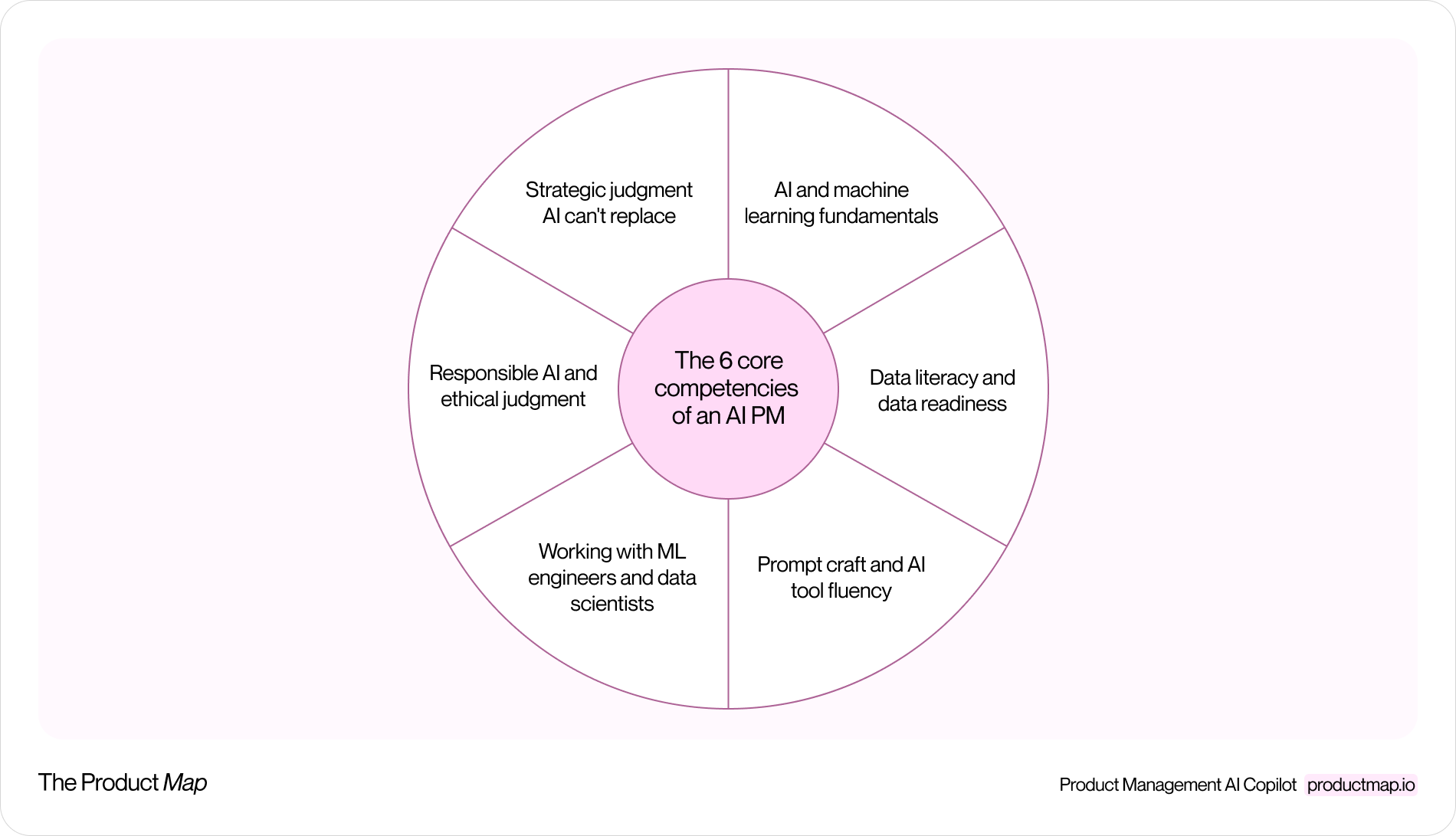
From traditional PM to AI-first PM
The transition from traditional PM to AI PM is cumulative. Each step produces something the next one uses.
A practical learning roadmap
- Spend two to three weeks using models daily. Rebuild a task you do by hand with a model in the loop, then push it until it breaks.
- Take one course built for product people, not engineers, and finish it. The Product Management Map lays out the AI-first skill set as a structured path so you can see what to build and in what order.
- Ship one real AI project and write an eval set for it.
- Package it as a short writeup and share what you learned in public.
Don't stack five courses before you build. Vocabulary without an artifact reads as studying, not doing.
Mistakes PMs make when adding AI to their title
- Studying ML theory before touching a model. A weekend of building teaches more than a month of lectures.
- Chasing model-owning roles too early. Start where your product sense carries you, on features built atop existing models.
- Ignoring cost and failure. Pitching an AI feature with no view on cost per call or failure modes marks you as a beginner.
- Treating unit economics as finance's job. A feature users love can quietly lose margin at scale, and that's yours to catch.
FAQ
Do AI product managers need to know how to code?
No. You need to read model behavior, not write production code. Understanding tokens, context, evaluation, and cost matters far more than syntax. No-code and vibecoding tools let you ship a real AI feature without an engineering background, which is enough to prove the skill in an interview.
What certifications or courses help you build AI PM skills?
Pick courses built for product people over engineering deep-dives. A structured path like the Product Management Map, plus shorter model-side fundamentals from Reforge, Product School, or DeepLearning.AI, covers the ground. Take one, finish it, and move to shipping. A single project with an eval set outweighs a wall of certificates.
How long does it typically take to become an AI-first PM?
If you already work as a PM, the thin layer of new skills takes a few months of consistent practice, not years. Two to three weeks build basic model literacy. A shipped project and its eval set follow within a quarter. Breaking in with no PM title takes longer, since you're building product judgment at the same time.
What's the biggest AI skills gap most PMs have?
Evaluation. Most PMs can write a prompt but can't define what "good enough to ship" means for a feature that answers differently every run. Building an eval set, setting a quality bar, and judging output against it is the skill hiring managers find missing most often.
Is a data science background necessary for an AI PM?
No, though data literacy is. You need to judge whether your data can support a feature and spot when a model fails on the long tail. That's assessment, not modeling. A data science background helps for model-owning roles, but most AI PM openings build user-facing features on existing models.