




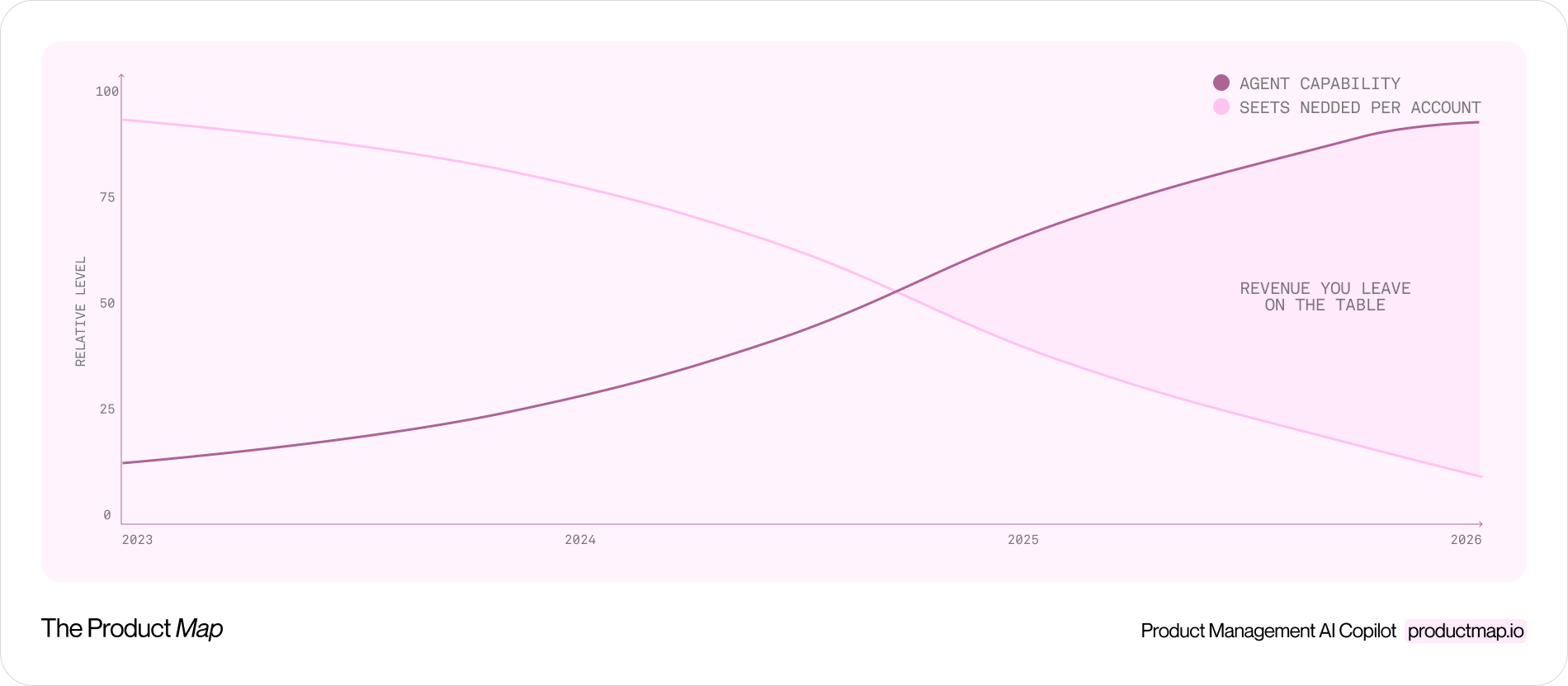
An AI agent that closes a support ticket on its own did exactly what you sold it to do. It also erased the seat you were about to bill for. That's the quiet arithmetic breaking per-seat pricing in 2026. The better the agent works, the fewer people a buyer needs logged in, so seat billing pays you to under-deliver.
The market already moved. Pure per-seat pricing fell from 21 percent of SaaS vendors to 15 percent in a single year, while hybrid models climbed from 27 percent to 41 percent. Buyers moved too: 43 percent now prefer consumption-based pricing and 27 percent want to pay for outcomes. Some procurement teams screen out seat-only AI vendors before they'll take a demo.
Seat pricing didn't fade because it stopped working operationally. It faded because the incentive under it inverted.
Most PMs still price AI features on seat intuition, the same instinct that worked for fifteen years of software. Here's the model choice underneath it, and how to make it without torching your existing revenue.
Seats punish a working agent
For fifteen years, seats and value pointed the same way. More people using the product meant more people logging in, which meant more seats, which meant more revenue. A feature that helped a team do more work sold more seats to that team. Everyone's incentives lined up.
An agent snaps that line in half. Its whole promise is to do the work a person used to do. A support agent that resolves tickets means fewer support reps logged in. A research agent that drafts the analysis means fewer analysts touching the tool. The feature works by removing the human from the seat you were charging for.
A seat-priced agent gets punished for competence. Every efficiency gain you ship hands the buyer a reason to remove seats, so your best release becomes your worst renewal.
So the better your agent gets, the faster it eats its own pricing model. You ship a stronger version, the buyer needs fewer seats, and your revenue falls the quarter your product improved. That's the trap, and it's structural, not a packaging mistake you can tweak your way out of.
The three pricing models that replaced the seat in 2026
Once you decouple price from seats, three live models take over in 2026. Each charges for a different layer of what the agent does, and each fits a different kind of feature.
- Usage-based: charge for what the agent consumes, like API calls, messages, tokens, or compute minutes. It fits infrastructure-shaped features where consumption is unpredictable and maps closely to your own cost. The weakness is forecasting; a buyer can't sign off on a bill they can't estimate.
- Output-based: charge for what the agent produces, like documents drafted, records enriched, or tickets triaged. It fits when the output is countable and each unit carries obvious value. Buyers understand it because they can see the pile of work getting done.
- Outcome-based: charge for the result the agent achieves, like a ticket resolved, a lead qualified, or a refund prevented. It commands the highest willingness to pay because you're selling the result the buyer came for. It's also the hardest to run, since you need clean attribution and a definition of "done" both sides trust.
The rule of thumb: move up the ladder from usage to outcome as your ability to measure value cleanly improves. Usage is easy to meter and hard to love. Outcome is easy to love and hard to meter. Output-based pricing sits in the middle and works for most agents that produce something concrete on every run.
.png)
Why hybrid became the default
Almost no serious AI product ships one pure model. The 41 percent of vendors now on hybrid pricing landed there for a reason: a base platform fee plus metered consumption solves the two problems a single model can't.
The base fee does three jobs. It covers your fixed cost to serve, it captures the value of access itself, and it gives the buyer a predictable line item they can budget. The meter on top captures the heavy tail, the accounts whose consumption would sink a flat plan. Predictability for the buyer, upside for you, in one structure.
Credits are the packaging most AI teams wrap around that meter. The customer buys a pool of units and spends them across actions, which turns a scary variable bill into a budget they approved once.
Credits work when a buyer can map them to real work. They fail the moment the exchange rate feels arbitrary, so publish what a credit buys in the buyer's own units, not yours.
The base also protects you from the seat-erosion trap. Even if an account shrinks its human headcount to near zero, the platform fee holds a revenue floor while the meter grows with the work the agent does. Value and revenue point the same way again.
Five tests your value metric must pass before launch
Picking usage, output, or outcome is the easy half. The hard half is the metric inside it, and a metric that fails one of these tests will crack within two quarters of launch.
- Scales with customer success: the bill grows when the buyer wins, not when your infrastructure bill grows. Resolutions pass. GPU seconds don't.
- Measurable by you: you can meter it in production, bill it, and defend the count in a dispute without a manual reconciliation every month.
- Understandable to the buyer: your champion can explain the line item to their CFO in one sentence, with no spreadsheet.
- Forecastable in procurement: finance can model next year's spend inside a reasonable band before anyone signs.
- Fair as volume grows: expansion reads like a better deal, not a penalty for adopting the product faster than planned.
Tokens fail three of the five. They're easy for you to meter and close to meaningless to everyone else in the room. That's why so many AI features launch on token pricing and quietly repackage within a year.
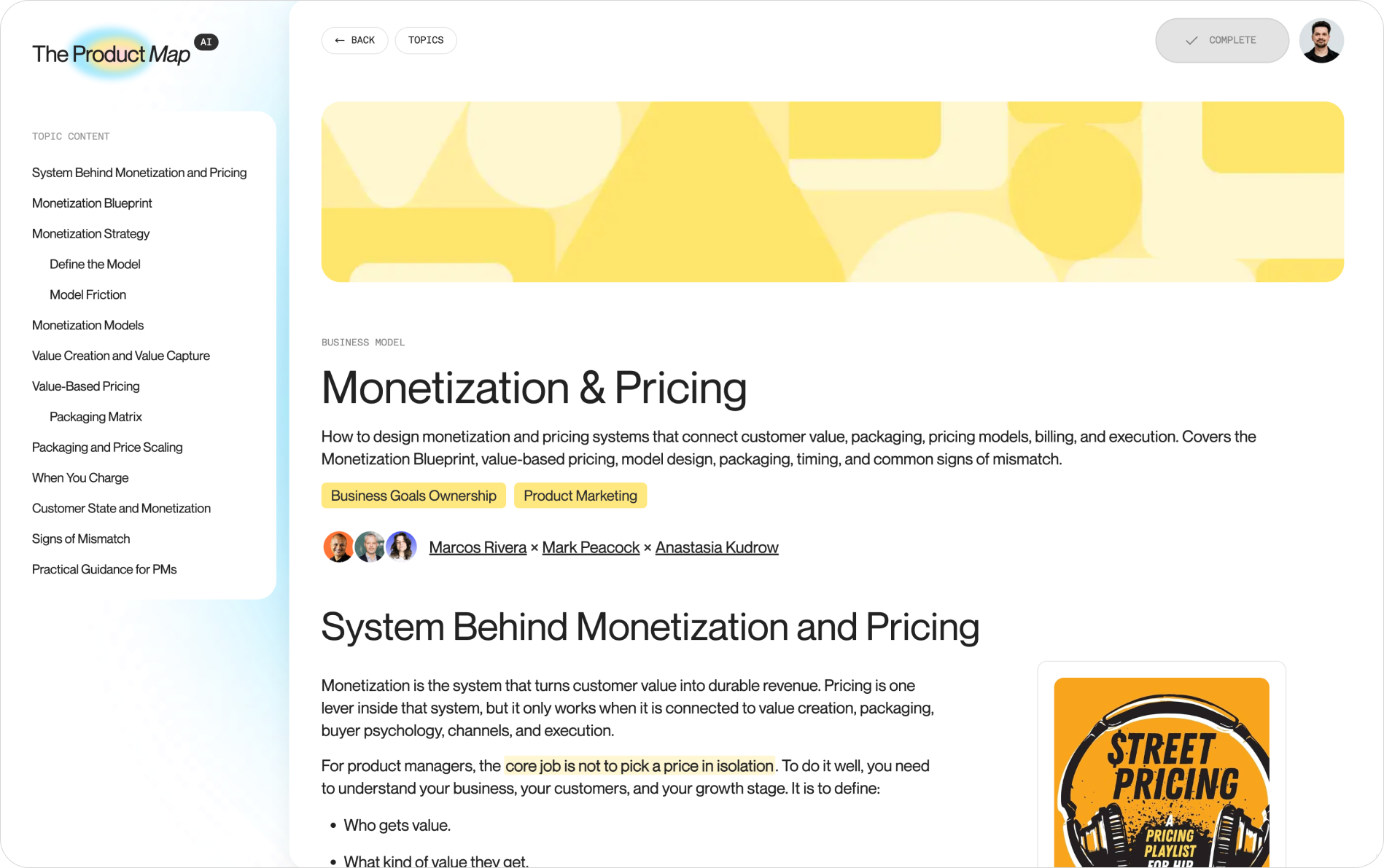
Every model puts friction somewhere; the choice is where. Product Map's monetization and pricing guide walks the whole chain from value creation to the number on the page, including the packaging matrix and billing timing decisions most teams make by accident.
Put the friction after value is proven, not in front of it. A buyer who can't estimate the bill before they adopt will either stall the deal or cap their own usage once they're in, and both outcomes cost more than the friction you saved.
Worked example: pricing a support agent by resolution
Take a support agent and price it the way Intercom prices Fin. Fin charges per resolution, around a dollar for each conversation the agent closes without a human. That single choice carries a lot of design, and it's worth walking through.
- Pick the value metric. A resolution is what the buyer buys, not a message or a token. It maps directly to a cost they already understand, since a human-handled ticket runs several dollars in labor. Pricing below that number is an easy yes.
- Set a floor with a base fee. Charge a platform fee for access, deployment, and the fixed cost of running the agent. This keeps revenue from collapsing on a quiet month and pays for the parts of the product usage-based billing never touches.
- Define "resolved" before launch. The whole model rests on a count both sides trust. Decide what qualifies, how a reopened ticket is handled, and what happens when the user rates the answer poorly. Ambiguity here becomes a billing dispute later.
- Cap the downside for the buyer. Offer a not-to-exceed ceiling or a volume tier so a spike in tickets doesn't produce a surprise invoice. Buyers pay a premium for a bill they can predict.
Working through those four choices for your own feature is where most teams stall, because the value metric and the floor interact and the tradeoffs aren't obvious. The monetization and pricing AI agent on Product Map is built to run that decision with you. It maps your feature's value metric, weighs usage against output against outcome for your cost structure, and flags where each model adds friction for the buyer.
.png)
Most pricing problems are not pricing problems at all
Here's what senior operators learn the expensive way: the symptom shows up on the pricing page, and the fix almost never lives there. Teams reprice, watch nothing change, and reprice again. Read the symptom first.
- Low paywall conversion: an activation or value communication problem. Someone who never reached value won't convert at any price, so a discount only buys you a cheaper version of the same failure.
- Chronic discounting: packaging or positioning, not sales execution. When every deal closes below list, the list price describes something the buyer doesn't recognize as theirs.
- Margin collapse on heavy users: the AI-native failure. A thin slice of accounts drives most of your inference cost because nothing governs consumption. Credits, caps, or a hybrid floor fix it; a price rise across the base doesn't.
- Churn right after an upgrade: a post-upgrade onboarding problem wearing a pricing costume. The higher tier's promise didn't land fast enough to justify the new invoice.
- Growth flattens in the current use case: willingness to pay for that job is saturated. The next move is a new use case, segment, or packaging layer, not a new number.
- CAC above LTV: usually a segment problem. You're acquiring the wrong customer, and no pricing model rescues that.
Run this list before you touch the number. It costs an afternoon and it saves you from repricing a product whose real problem sits in onboarding, positioning, or the accounts you're buying.
Migrate off seats without creating a revenue cliff
Here's the question that keeps heads of product from ever switching: how do you move an existing seat-priced product to a new model without a churn event and a revenue drop? Most pricing articles skip it, and it's the part that decides whether you move at all.
Start by pricing the new floor at or above what the account pays today. If a customer spends $2,000 a month on seats, the base platform fee plus expected consumption should land near that number, not below it. The meter grows revenue from there; it isn't a discount.
Grandfather current customers on their existing terms and introduce the new model on new value, a new agent, a new tier, or new accounts first. Run both structures in parallel long enough to prove the new one holds up, and give migrating accounts a generous included allowance so their first metered invoice looks familiar, not alarming. Communicate the value metric in the buyer's language, resolved tickets or qualified leads, not tokens.
The mistake to avoid is flipping everyone at once to protect a clean pricing page. A revenue cliff from a botched migration costs more than the messiness of running two models for a quarter.
Seats made sense when software helped people work. Agents do the work, so the thing worth charging for is the work itself, metered on a floor that holds when the humans log off. Pick the value metric, wrap it in a base fee, and price the outcome your buyer already wants. Do that and your best release stops being your worst renewal.