




Two documents describe the same customer. The first says: B2B SaaS company, 200 to 1,000 employees, Series B, second product manager hired last quarter. The second says: Priya, 34, Head of Product, reads Lenny's Newsletter on Sunday night, hates status meetings. Sales works from the first. Marketing works from the second. Neither team has opened the other's file.
That split is the whole ideal customer profile vs buyer persona debate in one paragraph. The two artifacts answer different questions and sit at different levels of the funnel. Treat them as interchangeable and you get personas so vivid nobody can tell which companies to call, or an ICP so firmographic nobody can write an email from it.
This guide covers the difference between ideal customer profiles and buyer personas, when each earns its keep, how the two nest, and the 2026 twist: grounded properly, a persona becomes a synthetic user you can interview before you book a real call.
What an ideal customer profile describes and decides
An ideal customer profile (ICP) describes the type of customer who gets the most value from your product and is most likely to buy, stay, and expand. In B2B the unit is the account: the company, not the person inside it. In B2C or product-led motions the unit is a type of person who self-serves, still a category, not a character.
A working ICP includes:
- Firmographics: industry, company size or revenue band, geography, funding stage
- Technographics: the tools already in the stack
- Pain and trigger: the top three problems you solve, ranked, and the event that starts the search
- Economics: budget range, deal size, sales cycle length
- Qualification and disqualifiers: signals a lead fits, and the conditions under which you walk away
The ICP is used for prospecting, territory design, lead scoring, and roadmap focus. It answers "which accounts should we spend effort on" and, as important, "which ones should we decline." Product Map's ideal customer profile topic treats the anti-ICP as a required section. An ICP without disqualifiers is a wish list.
What a buyer persona covers
A buyer persona is a composite portrait of one person involved in buying or using your product, built from research into real people. Where the ICP says "Head of Product at a Series B SaaS company," the persona says what that Head of Product worries about on Sunday night and which newsletter they trust.
A persona card typically includes:
- Role and context: title, seniority, who they report to
- Goals: what they're measured on this quarter
- Pain points: the top three frustrations, each backed by a quote
- Behaviors: tools, information sources, how they decide
- Objections: why they say no, and what would change it
Personas are used for messaging, onboarding, sales enablement, and UX decisions. They answer "how do we talk to this person and what do we build for them" once the ICP has decided the person is worth talking to.
The difference between ideal customer profiles and personas
Three distinctions cover most of the confusion.
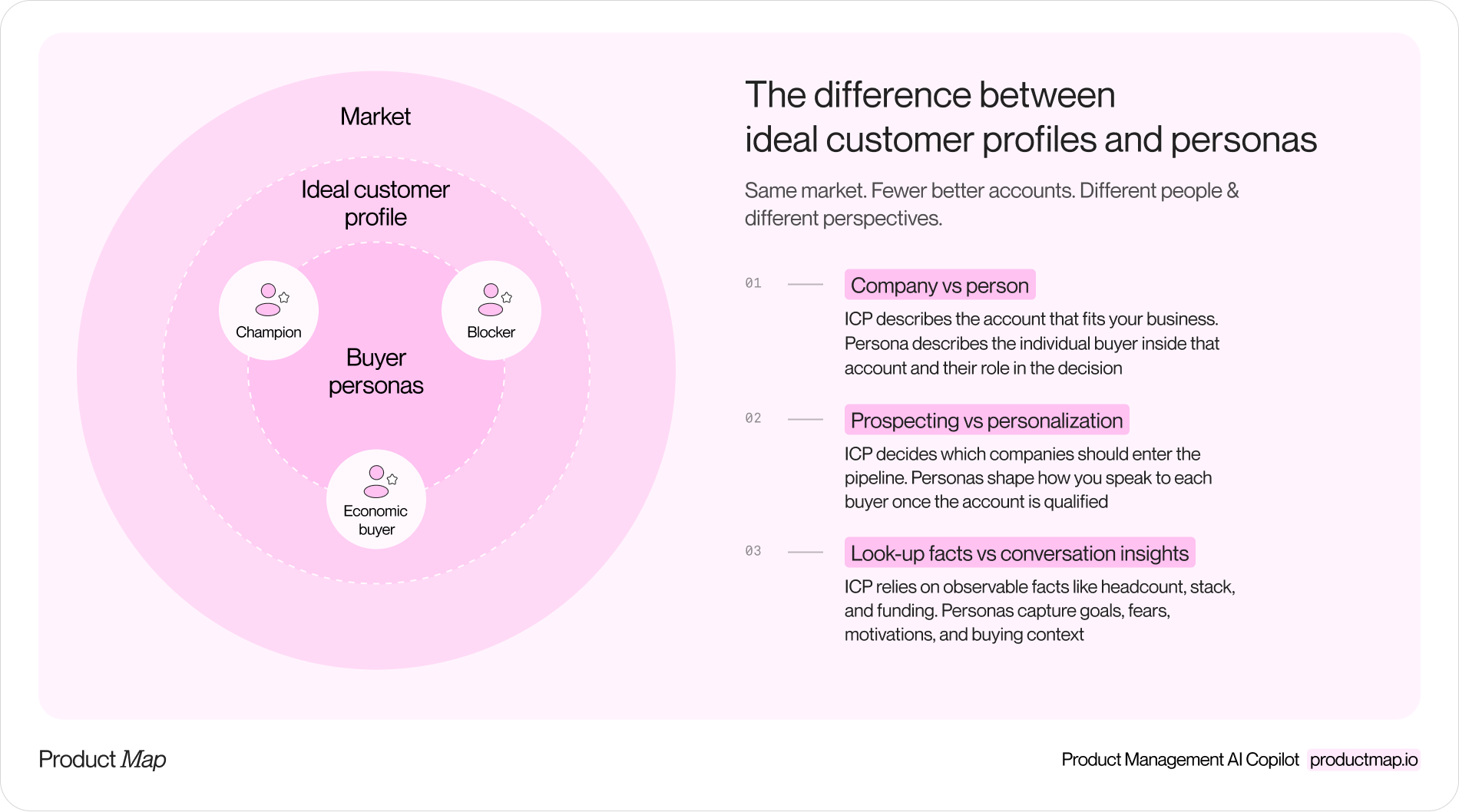
- Company focus vs person focus: An ICP profiles the account. A persona profiles a human inside it. One Series B account can hold three personas: the champion PM, the CPO who signs, and the engineering lead who blocks.
- Prospecting vs personalization: The ICP decides who enters the pipeline. Personas decide what those people read, hear, and see once they're in it. Filtering happens first, tailoring second.
- Account-level vs buyer-level targeting: ICP criteria are facts you can look up before a conversation: headcount, stack, funding. Persona traits are what you learn in the conversation: goals, fears, the tool they abandoned.
The owners differ too. Sales or revenue operations usually own the ICP, built from the CRM. Marketing or product own the personas, built from interviews. When one team owns both, the other team stops reading.
What they have in common
Both are built from the same evidence: the customers who bought, stayed, and expanded. Both go stale within two quarters if nobody owns them. And both fail the same way when written from imagination: a persona invented in a workshop is fiction with a stock photo, and an ICP written from ambition is a target audience.
The shared test: could a new sales rep, given only these two files, decide in ten minutes whether to call an account and what to say? The ICP handles the first half. The persona handles the second.
When to reach for the ICP and when for the persona
Reach for the ICP when the decision is about where to spend effort:
- Building an outbound list or buying enrichment data
- Scoring and routing inbound leads
- Deciding which segment next quarter's roadmap serves
Reach for a persona when the decision is about how to communicate or design:
- Writing landing page copy or a nurture sequence
- Designing onboarding for a specific role
- Preparing a sales call with a named stakeholder type
A B2C or product-led company can run on personas alone, because buyer and user are the same person. B2B can't. Once a committee is involved, the account has economics and procurement rules no persona captures.
Define the ICP first, then build personas inside it
Order matters. Personas built before the ICP describe people you'll never sell to.
Step 1: Define the ICP from the accounts you already won
Pull the accounts that bought, renewed, and expanded. Find the shared firmographics, the common trigger, and the pattern in who churned. Write the profile with numeric thresholds a salesperson can check in a minute.
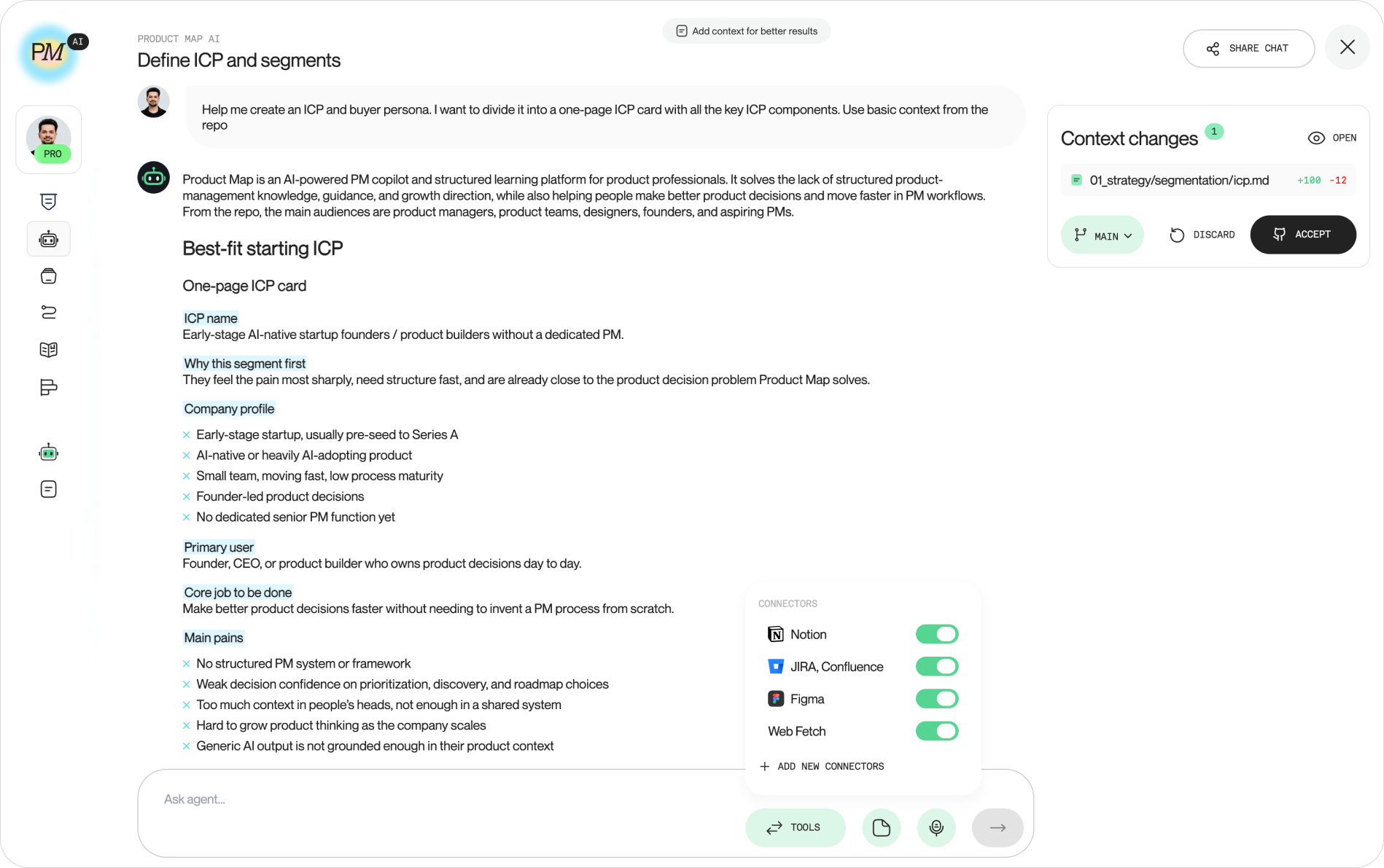
The Define ICP and segments agent runs this as a five-step conversation: map the problem space, split the market into segments, pick the one with the strongest pain and clearest value, write the positioning, then stress-test the choice through objections, edge cases, and go-to-market implications. The output is a file you commit next to your strategy docs. The ideal customer profile template article has the full field list.
Step 2: Build the personas inside the ICP boundary
For each ICP, name the two to four roles who touch the decision: champion, economic buyer, influencer or blocker, end user. Interview five to eight real people per role and write the card from what they said. Each persona inherits the ICP's frame, so none of them belongs to a company that can't buy.
Step 3: Point the ICP at targeting and the persona at copy
The ICP feeds list building, lead scoring, and segment choice. Personas feed copy, onboarding, and call prep. When a campaign underperforms, check which layer broke: wrong accounts is an ICP problem, right accounts ignoring the message is a persona problem.
Personas become synthetic users you can interview early
Feed a persona card to a language model and it answers questions as that person. That's a synthetic user, and it's what changed since most persona guides were written.
Synthetic user vendors advertise 85 to 92 percent parity with real interviews, and the Stanford and Google DeepMind generative-agents study matched human survey answers at 85 percent from two-hour interview transcripts. Product Map's operating number is lower. Count only the insights that change a build decision, and synthetic interviews reliably surface about half. That half arrives in minutes and tells you which questions deserve a human's time.
The number depends on one variable: what the persona is grounded on. Personas written from demographics alone are guesswork with a headshot, and synthetic users built from them return noise with confidence. Personas grounded in real transcripts and support tickets reproduce the customer's vocabulary, the recurring problems, and a first read on whether positioning lands.
This is where the ICP-first order pays off twice. The ICP sets the boundary of who the synthetic user can be. Each persona card fills in the human detail inside it: one skeptical of AI tools, one three weeks into a new job, one who left a competitor. Vary them. Ten interviews with the same average customer produce one insight ten times.
A synthetic interview can tell you whether your questions are clear. It cannot tell you whether your customer exists.
Two rules keep the method honest. Label every synthetic transcript with a synthetic- prefix so it can never be mistaken for a real one. And treat synthetic output as rehearsal: it sharpens the interview guide and the messaging draft, and it never files as roadmap evidence without a real conversation behind it.
.png)
The question nobody assigns: who re-grounds the profile
Most guides end at "review your ICP and personas regularly." Nobody says who, or what regularly means, so it doesn't happen.
Both artifacts decay. Your product ships new surface area and a competitor resets the reference point. The persona keeps describing the customer who bought in 2025. If it has become a synthetic user, it keeps answering confidently about a world that no longer exists, and nobody gets an error.
Fix the ownership before the cadence.
- Name one owner per artifact. Revenue operations or the founder owns the ICP. Product marketing owns the personas. Both names go in the file header.
- Tie the review to an event, not a calendar. Every closed-lost review updates the ICP thresholds. Every real interview round lands in the same product context repository the personas read from, so the next synthetic round reads current evidence.
- Version the files. A Markdown ICP in Git shows a diff when it changes. A slide deck shows nothing.
Decide the account first, then learn the person inside it
The ICP decides who is worth the effort. The persona decides what to say and build. Write the ICP from the accounts you've already won, build two to four personas inside its boundary, and ground each one in real transcripts. Then spend every real interview on what a model can't reach: the budget the persona doesn't control, the tool they won't admit to using, the gap between what they said and what they did. That gap is where the roadmap gets decided.
FAQ
Why keep an ICP if the personas are already detailed?
Because people sit inside accounts that may never buy. A vivid persona at a company with no budget owner is a perfect description of a lost deal. The ICP filters accounts first so persona work lands on people who can say yes.
How do sales and marketing align on one framework?
Give each team the layer it owns and make both read the other's file. Sales owns ICP thresholds and disqualifiers. Marketing owns persona goals, objections, and channels. Both live in one folder with one commit history, so alignment becomes a diff instead of a meeting.
Can a small team build both with almost no customer data?
Yes, with labels. Write the ICP from your first ten conversations and tag every line EVIDENCE or ASSUMPTION. Build two personas, not six, and spend the real calls on the assumptions.
How often should you update the ICP and the personas?
On triggers, with a quarterly floor: the ICP after each closed-lost review, the personas after every interview round. If a quarter passes with neither, the fact nothing changed is the finding.