




Our team shipped twice as much this year. So did every competitor with a coding agent. When a feature demo can be cloned in weeks, shipping speed stopped being a moat. It became table stakes.
What can't be cloned is how fast your organization notices a change, updates its beliefs, and ships a different answer. Amy Mitchell put it plainly in her 2026 product trends review: the hard part was never the AI. The hard part was organizational learning.
Most leaders still chase output velocity. Ship more, faster, with fewer people. The teams pulling ahead measure something else: learning velocity, the time between "we noticed" and "we changed." This playbook shows how to instrument the loop, where AI agents genuinely shorten it, and how the Product Map team wired its own version.
Features are cloned in weeks. A team's speed of belief revision is the one asset a competitor's coding agent cannot copy.
Output velocity vs learning velocity in product teams
Output velocity counts shipped things: features per quarter, story points, release notes. Learning velocity counts changed minds: decisions reversed, bets resized, roadmap items killed because new evidence arrived.
Teams confuse them because output is easy to see. A release train produces artifacts every sprint. Learning produces something quieter: a belief held on Monday and abandoned by Friday because a churn cohort, a lost deal, or a support pattern said otherwise.
Here's the test. Look at your last quarterly review. Count the slides celebrating what shipped. Now count the moments where someone said "we believed X, the data said Y, so we're doing Z instead." Most reviews score ten to zero in favor of output.
That imbalance is learning theater: rituals shaped like learning with none of the belief change. Retros run every two weeks and produce the same action items. Research reports get presented, praised, and filed. The roadmap survives every review untouched, which sounds like stability and is closer to deafness.
Turn your AI roadmap into a list of beliefs to test
A classic roadmap is a promise list: feature X in Q3, feature Y in Q4. It has no slot for being wrong, so evidence against it arrives with nowhere to go.
Rewrite each roadmap item as the belief underneath it. "Ship AI onboarding assistant in Q3" becomes "We believe new users churn because setup takes 40 minutes, and an assistant cuts it under 10." Now the item is falsifiable. A signal can confirm it, weaken it, or kill it, and killing it is a legitimate outcome instead of a planning failure.
This matters twice as much for AI features, because their quality moves with every model release. A belief written down in January ("users won't trust auto-generated PRDs") can flip by June without anyone on your team touching the product. If your roadmap can't absorb a belief flip, it will misprice every AI bet on it.
Three changes make a roadmap learn:
- Attach the belief and its kill condition to every item. One sentence each. If you can't write the kill condition, you're not making a bet; you're making a wish.
- Date the evidence, not only the delivery. Each item gets a "last confirmed" stamp. A belief unconfirmed for two quarters is stale inventory.
- Track reversals as a health metric. A quarter with zero killed or resized items means the roadmap ignored every signal it received. Somewhere between 10 and 30% of items should move per quarter; zero movement is the red flag, not the badge.
How AI agents shorten the loop from signal to decision
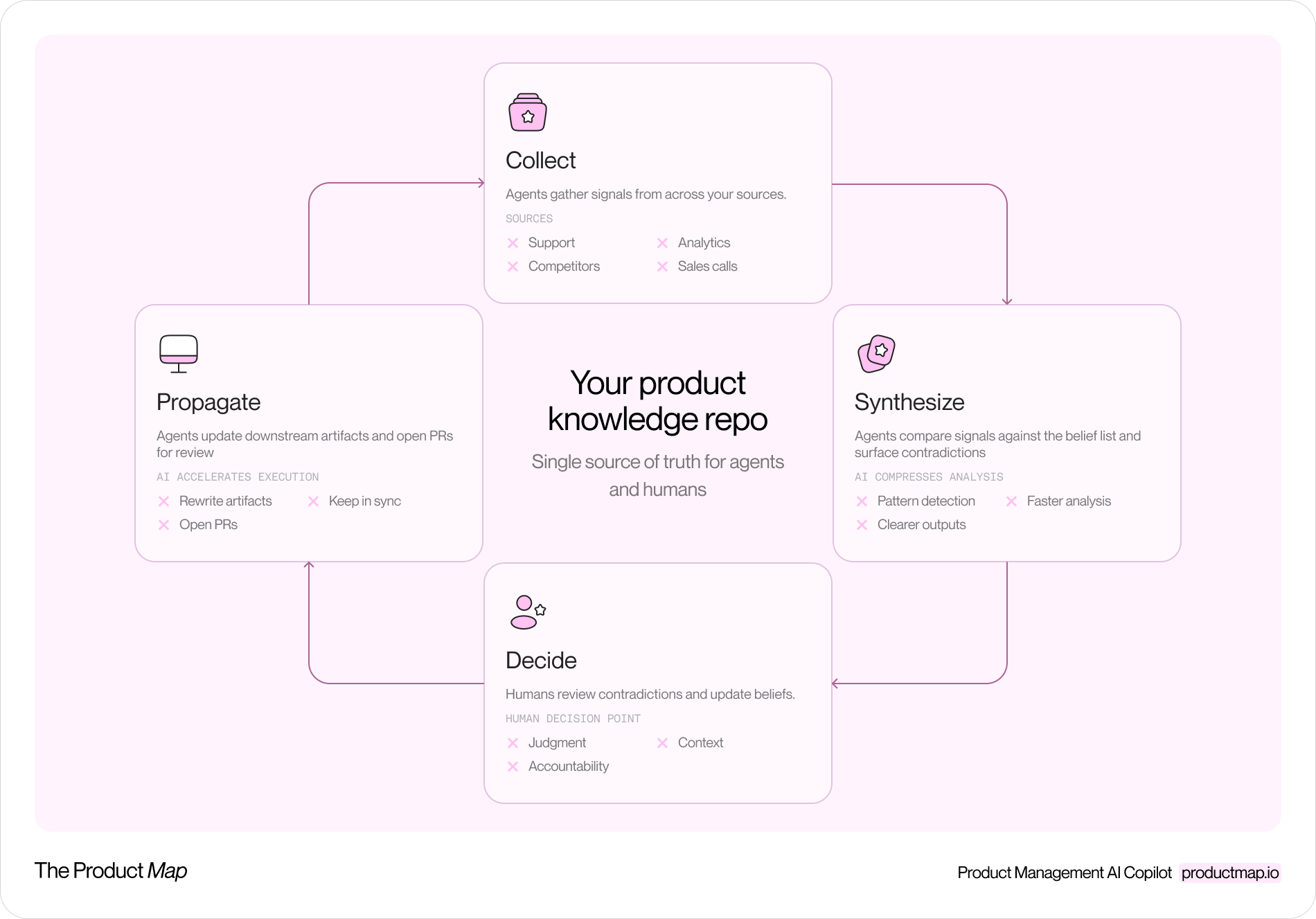
The signal-to-decision loop has four stages: collect, synthesize, decide, and propagate. Measure the elapsed time across all four. For most teams it runs four to eight weeks; the review meeting alone adds two.
AI agents compress three of the four stages. They don't decide; they collapse the distance between raw signal and a decision-ready brief.
- Collect: agents monitor support tickets, sales calls, analytics events, and competitor releases continuously instead of quarterly. The signal arrives the day it happens.
- Synthesize: an agent reading a week of feedback against your current roadmap beliefs returns a contradiction report in minutes: which beliefs got support, which took damage, which face new evidence.
- Propagate: once a decision is made, agents rewrite the affected artifacts: the roadmap entry, the PRD, the stakeholder update. The change reaches every document the same day instead of decaying through stale copies.
The decide stage stays human, and it becomes the honest bottleneck. That's the correct design. You want judgment to be the slowest step, not data assembly.
One warning: agents also shorten the loop for noise. A fleet summarizing everything produces beautiful reports about signals worth nothing. The filter is the belief list from the previous section; an agent tasked with "tell me what challenges belief #4" is useful, an agent tasked with "summarize the feedback" is a noise amplifier.
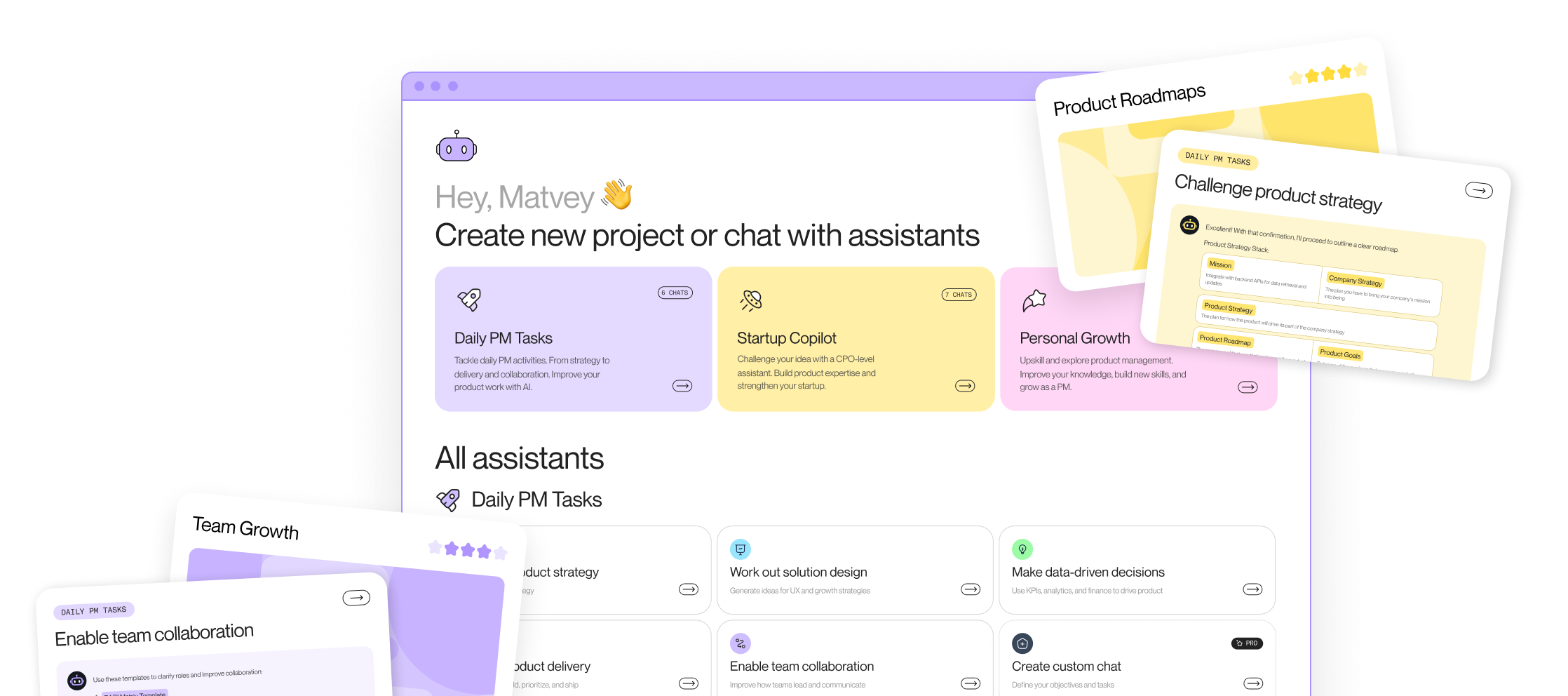
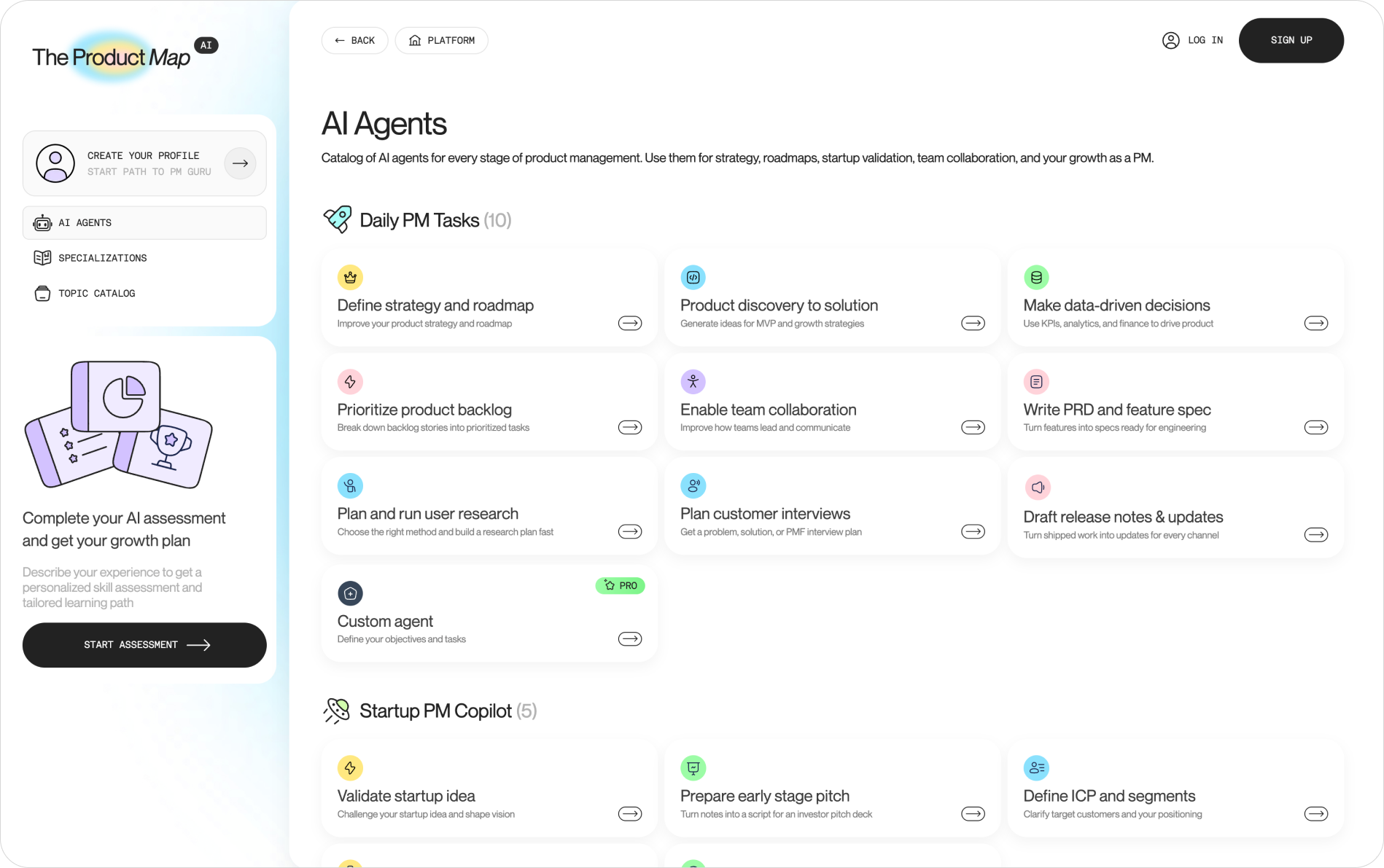
The Product Map agent catalog packages the collect and synthesize stages as ready agents: discovery and ideation, PRD specification, backlog prioritization, monetization, and unit economics among them. Each one reads your product context and returns decision-ready output, so you're not building the fleet from scratch.
How Product Map built its learning system with AI agents
We run Product Map on the system this article describes, so here's the honest version from the inside.
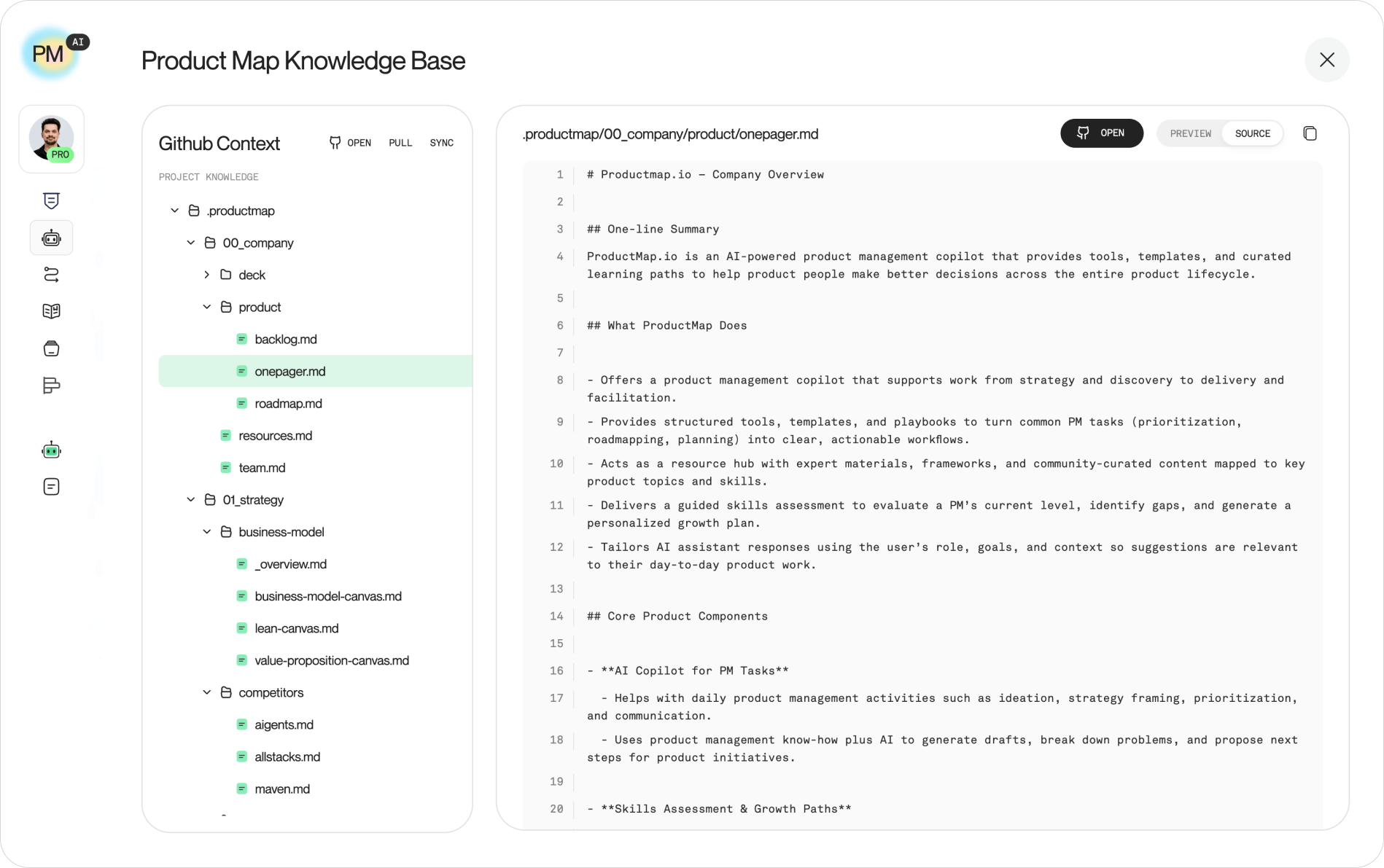
Everything starts with context engineering. Our product knowledge lives in a Git repository as plain Markdown: strategy, research, metrics, delivery artifacts, and a tone-of-voice file, organized in numbered lifecycle folders. Every agent we run reads the same repository before it acts. No agent starts from a blank prompt, and no agent works from a stale copy, because there is exactly one copy.
On top of the context sits what we call loop engineering: designing the recurring loops that force belief updates instead of waiting for them. Our content radar is one example. Before any article gets written, an agent scans PM discussions across Reddit, LinkedIn, and Substack, scores ten candidate ideas against our topic catalog, and checks a do-not-repeat list of everything published and every direction already explored. The radar run is dated, versioned, and committed to the repo. When the next run contradicts the last one, we see our own beliefs moving in the diff.
The same pattern runs our partnership discovery, our weekly cohort analysis, and this blog. Each loop has a trigger, an agent, a human decision point, and a commit. The commit is the part most teams skip, and it's the part compounding over time: six months of committed loop outputs is a searchable history of what we believed, when we changed our minds, and why.
The Product Map bot automates the setup for teams on the platform. Connect a GitHub repository and the bot generates the full knowledge structure under a .productmap folder: lifecycle folders, starter templates, and a proposal in each file describing what to fill in. From then on it reads every push to main, so the context your agents reason over is always current, and when an agent has a change to propose, it opens a pull request your team reviews like any other change. The Context Engineering topic covers the discipline in depth.
What surprised us: the payoff wasn't speed on any single task. It was that updating a belief became cheap. When the radar flags a shift, rewriting the affected roadmap items, briefs, and drafts costs an afternoon instead of a planning cycle. Cheap updates get made; expensive updates get deferred, and deferred updates are how a team goes deaf.
A checklist to build your product operating system
You can assemble the same system for your own product. The sequence matters more than the tools; each step feeds the next.
- Set up the context layer. One Git repository holding your product knowledge as Markdown: one-pager, ICP, roadmap beliefs, research, and metrics. Wire your agents to read it on every session.
- Write the belief list. Convert every roadmap item into a belief with a kill condition. This becomes the filter every agent works against.
- Build the collection loops. Point agents at your signal sources: support, sales calls, analytics, and competitor releases. Schedule them; a loop run on demand is a loop nobody runs.
- Add the synthesis step. One recurring agent job: compare this period's signals against the belief list and report contradictions.
- Keep the decision human and dated. A short weekly review of the contradiction report. Every belief change gets committed to the repo with a date.
- Automate propagation. When a belief changes, agents rewrite the downstream artifacts and open pull requests for review.
Expect the full stack to take about two weeks of focused setup alongside normal work. That's the exact scope of the Agentic PM Sprint: a two-week hands-on intensive where you build this operating system on your own product, from the context repository and data pipelines through discovery, analytics, and delivery agents. You leave with the loops running, not with notes about loops.
Frequently asked questions on AI agent learning systems
Do I need engineers to build an agent learning system?
No. The stack is a Git repository, Markdown files, and agent tools like Claude Code or Cursor reading them. A PM comfortable with a terminal can set up the context layer and first loops in days. Engineering help becomes useful at the pipeline stage, when you connect analytics databases or CRM exports, and even there a light script an agent writes for you usually covers it.
How many AI agents does a product team need to start?
Two. One collection agent watching your highest-volume signal source, usually support tickets or user feedback, and one synthesis agent comparing those signals against your belief list weekly. Add agents only when a specific loop stage is the measured bottleneck. Teams starting with ten agents spend their time managing agents instead of updating beliefs.
What data do AI agents need to update a roadmap?
Three inputs: the roadmap written as beliefs with kill conditions, a dated stream of signals (feedback, metrics, competitor moves), and your product context so the agent knows what matters. Without the belief list, an agent can summarize data but can't tell you what it contradicts, and contradiction is the whole point.
How do you stop AI agents from adding noise to the loop?
Task agents against specific beliefs, never against "the feedback" in general. "Find evidence for or against belief #4" produces a verdict; "summarize this week's feedback" produces a report nobody acts on. And cap the output: a contradiction report longer than one page means the filter failed upstream.