




Jaclyn Konzelmann runs an AI PM hiring loop and writes up what stands out in her interviews each week. Her read this year is blunt: the candidates who break through aren't the ones with the cleanest framework or the tidiest case walkthrough. They're the ones who open a laptop and show something they built.
That's a real shift in what the loop rewards. For a decade the PM interview ran on hypotheticals. "How would you improve YouTube." "Walk me through how you'd prioritize this backlog." You narrated judgment you never had to prove. In 2026 that narration is cheap, and every hiring manager knows it.
Most candidates haven't caught up. They still drill 2023-style case frameworks while the loop moved on to artifacts and live scrutiny. This is the prep plan for the interview that exists now: what changed, what to build, and how to defend it when a senior PM starts poking holes.
What changed: take-homes lost their signal
The take-home exercise used to be the filter. You got a brief, spent a weekend on a PRD, and the quality of that document sorted the pile. AI dissolved that filter. A candidate can paste the brief into a model and hand back a polished spec in twenty minutes. Reviewers can no longer tell real effort from a good prompt.
So companies did two things. They downgraded or dropped the take-home, and they added live rounds that can't be bluffed. "Walk me through a decision you actually made." "Build a rough version in front of us." Both reward the person who did the work, not the person who described it well.
Portfolios came back at the same time. A link to something real does the screening a take-home used to do, without the noise:
- A prototype of the exact problem the team owns, clickable in the browser.
- An eval sample showing you ran real inputs through an AI feature and labeled what broke.
- A shipped side project, even a small one, with a handful of real users.
Any of these clears the first-round bar faster than a five-page document a model could have written.
Show what you built, don't describe what you'd do
Interviewers keep reporting the same contrast. "Here's what I built" lands harder than "here's what I would do." One is evidence. The other is a promise, and the room has heard a thousand promises.
A candidate who brings a working prototype of the problem the team is hiring for starts three steps ahead. The interviewer stops testing whether you understand product work and starts reacting to a decision you already made. The conversation shifts from audition to collaboration.
It also flips the power dynamic. You're presenting your own work on your own terms, not improvising under interrogation. That change alone settles most interview nerves.
A framework tells the room you know the vocabulary. An artifact tells the room you can do the job. Only one of those is hard to fake in 2026.
Build an interview-ready artifact in a week
You don't need a shipped feature from a famous company. You need one artifact that proves a decision, and a week is enough to make it. Pick the type closest to the role you want.
For most product roles, build a prototype. Tools like v0, Lovable, Bolt, and Replit turn an idea into a clickable page in an afternoon, so the constraint is judgment, not code. Product Map covers when to ship a prototype instead of a spec and which tool fits which problem.
For an AI PM role, build an eval sample instead. Take a real LLM feature, run twenty inputs through it, and label the failures into a short taxonomy: wrong, unhelpful, off-brand, unsafe. That proves data intuition no framework can, and almost no other candidate will bring it.
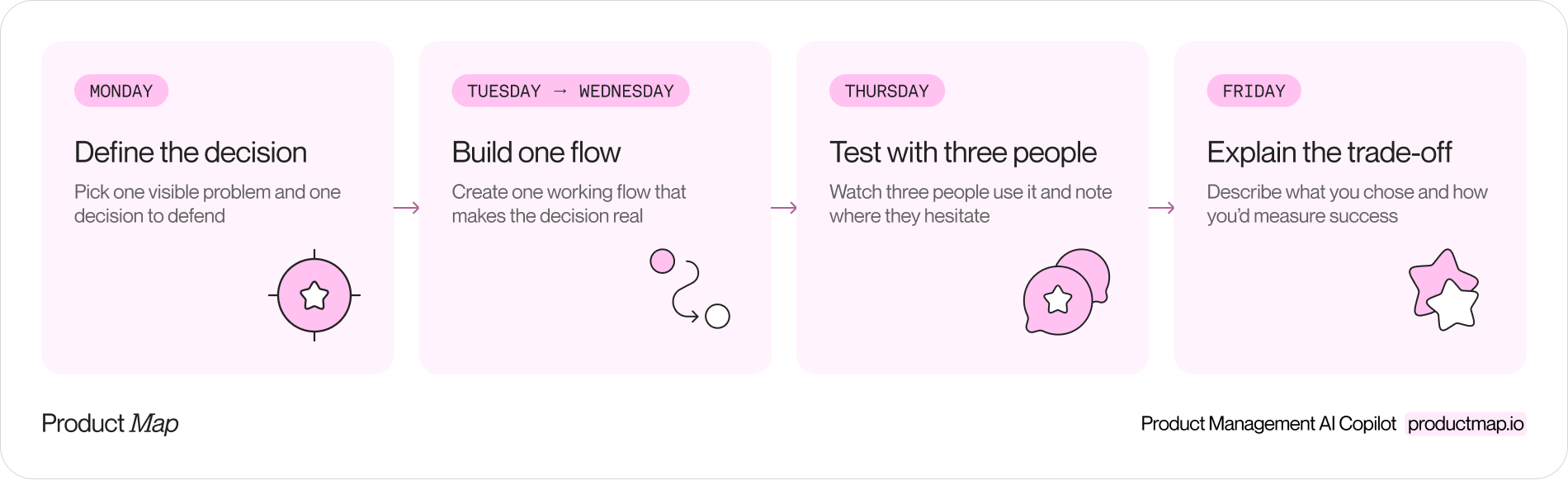
Keep the scope brutal. One flow, one decision, one week:
- Monday: pick a problem the target company visibly has, and name the one decision your artifact will defend.
- Tuesday and Wednesday: build the smallest version that makes that decision real. Resist adding a second feature.
- Thursday: put it in front of three people and note where they hesitate.
- Friday: write two sentences on the trade-off you made and how you'd measure whether it was right.
That last step matters more than the build. The artifact opens the door. The decision behind it wins the room.
Survive the live decision walk-through
The artifact gets you into the room. The live walk-through decides the offer, and it tests something different: whether you can defend trade-offs instead of listing features.
Expect the pressure questions. Why did you cut that. What would you measure. What breaks at ten thousand users. What would you do differently now. Defending "I built a chat interface" is weak. Defending "I chose chat over a form because the riskiest assumption was that people wouldn't know what to type, and here's the metric I'd watch to kill that bet" is strong. Same artifact, opposite outcome.
Before you rehearse answers, pressure-test the document that gets you the loop. Most candidates lose before the artifact conversation because their CV lists activities while the panel reads for outcomes.
Score your CV against 15 PM skills
Upload your LinkedIn export or resume PDF and ask the agent to map your experience against Product Map's skill framework. It flags strengths with evidence from your profile and gaps worth closing before you apply.
.png)
Rewrite bullets from activities to outcomes
The career coaching agent walks you through why each rewrite lands differently. It pushes you from task lists toward measurable impact and strategic context, the shift senior interviewers scan for in the first thirty seconds.
Once the CV reads like evidence, practice defending your artifact out loud before the loop, not during it. Product Map's CV and interview preparation agent runs mock questions against your real story so the defense is rehearsed before it counts.
.png)
Watching experienced PMs tear into a weak answer teaches the skill faster than reading about it. The ProductDive community ran a live session roasting real CVs and interview prep alongside a skills assessment workshop, and seeing where a confident answer falls apart tells you exactly what the panel is listening for.
Map your prep to 15 PM skills
Product Map's 15 PM skills guide splits the role into five groups, three skills each, with five levels defined per skill. Read it as the panel's scoring rubric, not a curriculum.
- Product: Strategic Impact, Business Goals Ownership, and Product Discovery. This group decides whether the room reads you as senior or as an executor.
- Customer: User Experience, Voice of Customer, and Product Marketing. Bring evidence from real users, not personas you invented on the way to the interview.
- Analytics: Fluency with Data, Measuring Progress and KPIs, and Stakeholder Management. The metric you name for your artifact gets scored here.
- Process: Product Vision & Planning, Backlog Management, and Software Engineering. AI PM loops probe the engineering line hardest.
- People: Communication, Team Leadership, and People Development. Every walk-through tests communication whether the panel says so or not.
The levels matter more than the labels. Level 2 applies a method someone handed you. Level 3 leads the effort and synthesizes user, market, and business inputs. Level 5 sets direction for the whole org. Pick the two skills the job description leans on, name the level you're at, and bring one story that proves it.
.png)
What AI PM loops test that old loops didn't
Here's the operator blind spot most prep guides skip. A prototype is necessary now, but it is not enough, because the AI PM loop tests three things the classic loop never did.
- Judgment under scrutiny, not recall. They want to watch you reason in real time and change your mind when the evidence moves, not recite a framework you memorized.
- Building and evaluating, not only speccing. Can you stand up a prototype, read an eval, and work alongside an agent, or do you stop at the document.
- Taste. Is the thing you built good, or is it obvious AI boilerplate with no point of view. A generated artifact you didn't think hard about reads worse than no artifact at all, and interviewers can smell it in the first click.
That third one is the trap. Candidates race to bring something, anything, and hand over a prototype they can't defend because they never made a real choice while building it. The panel opens it, asks one "why," and the whole thing collapses.
Ground the week of prep in the skills the job screens for now. Product Map's guide to product management skills maps what the modern loop tests, and the skills assessment shows you the gaps before an interviewer finds them for you.
The interview caught up to the job. Product work is now building, evaluating, and defending decisions with real artifacts, so the loop tests exactly that. Before your next loop, spend the week making one thing you're proud to click through and can defend under pressure. That's the whole prep.