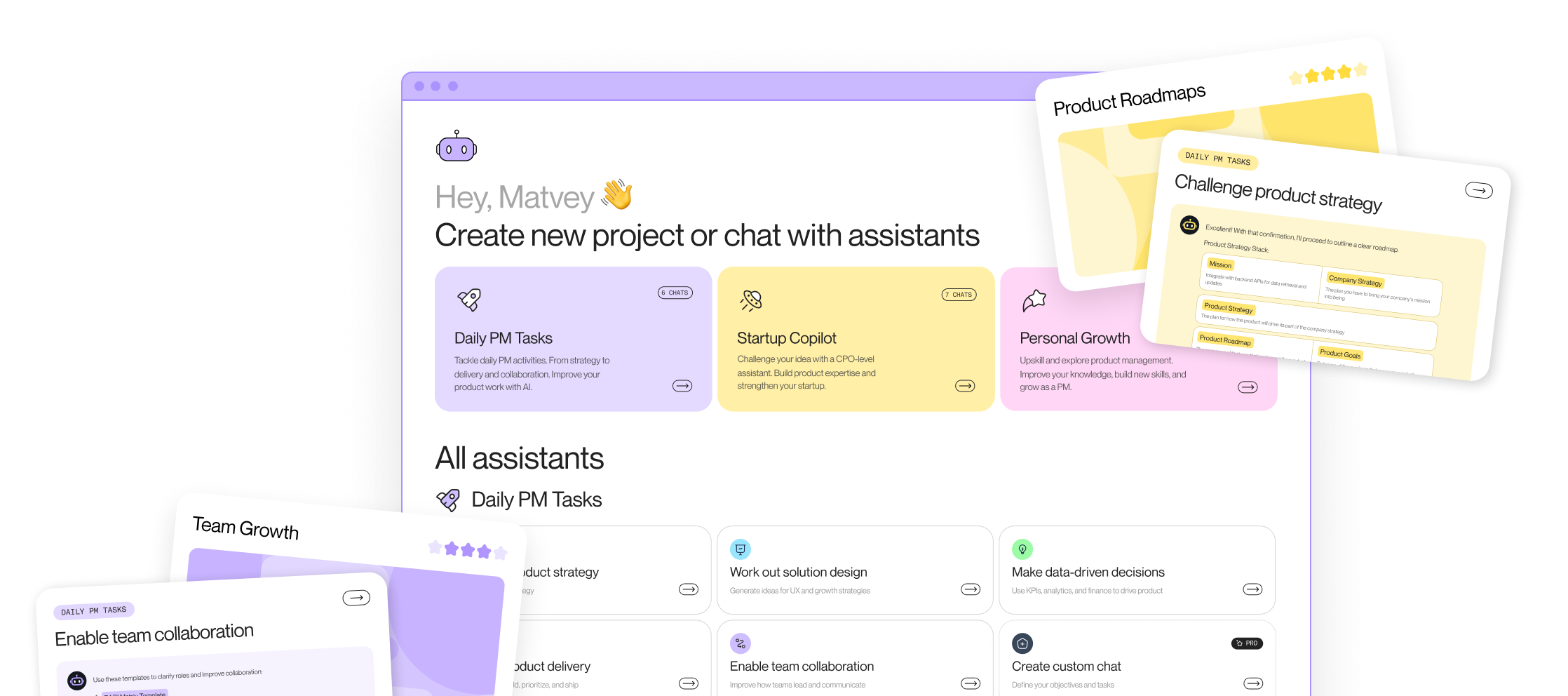





Most PMs treat AI like a speedier assistant who types for them. Draft this update. Summarize these notes. Clean up that spec. The output lands in seconds, the day feels lighter, and almost none of it changes a decision.
The real return shows up elsewhere. AI stops being a task tool and starts earning its place when you point it at the parts of the job that are genuinely hard: reading every piece of feedback, pricing a tradeoff, arguing against your own plan before a stakeholder does. That shift, from faster output to better decisions, is the whole game.
This is a practical guide to how to use AI as a product manager without pretending it's magic. Where it fits at each stage of the work, how to run it as a thinking partner instead of a stenographer, three workflows worth copying, and a verification step so the speed never costs you the decision.
AI writes the first draft in seconds. The judgment about whether that draft is right still takes you the same twenty minutes it always did. Skip that twenty minutes and you've automated being wrong faster.
Why product managers should use AI in the first place
The math is simple. Most PM output is reading and writing: research to synthesize, specs to draft, updates to send, backlogs to groom. AI compresses the mechanical half of all of it, which returns hours to the half that needs a human.
The teams pulling ahead treat this as a compounding advantage, not a one-off. Every workflow you hand to AI frees attention for the work AI can't do: talking to customers, making the call, owning the outcome. A PM who reclaims six hours a week spends them where judgment moves the number.
There's a quieter reason too. When product managers can use AI to build a rough prototype, run a first-pass analysis, or pressure-test a strategy alone, the dependency chain shortens. Fewer tickets to engineering for a throwaway mockup. Fewer waits on an analyst for a simple cut. The job gets less about coordinating other people and more about deciding what's worth doing.
Where AI fits at each stage of the product lifecycle
AI isn't one tool you bolt onto product management. It's a different assistant at each stage, and the useful question is what job you're handing it, not which app you open.
.png)
Discovery and user research
Feedback arrives faster than any PM reads it. Point AI at the pile: support tickets, interview transcripts, app store reviews, sales call notes. It clusters thousands of comments into themes and surfaces the pattern you'd miss reading anecdotes one at a time.
The trap is letting the model invent evidence. AI is strong at compressing real customer input and dangerous at generating fake customers to fill a gap. Feed it transcripts and ask what recurs. Never ask it to imagine what users might say. Synthesis on real data, yes; synthetic interviews standing in for the real thing, no.
Strategy and roadmap planning
Strategy is where AI works best as an opponent. Paste your positioning, your bets, and your reasoning, then ask it to argue the other side. Where's the weak assumption? What would a competitor do to make this bet fail? Which slice could you cut and lose nothing?
You still own the strategy. The model runs the pre-mortem you'd otherwise skip because you're too close to it.
Feature prioritization
Scoring a long backlog by hand gets inconsistent by item forty. When AI prioritizes features, it applies the same framework, RICE or weighted scoring, to every item without fatigue, and flags where your gut disagrees with the evidence.
Treat the score as an input, not a verdict. The value isn't the ranking; it's the moment the model scores something low that you feel strongly about, which forces you to name the reason you believe it. That argument is the prioritization work.
Writing PRDs and specs
This is the fastest win. A rough problem statement becomes a structured first draft: context, goals, requirements, edge cases, open questions. The good tools draft in your team's format so the output reads like your team, not a template.
The draft starts at 70% done. The remaining 30%, the scope cuts and the tradeoffs, is exactly the part that needs you, and it's the part AI can't fake because it doesn't know what you decided to leave out.
Delivery and sprint planning
Grooming is the most automatable job in product. AI splits oversized stories, flags missing acceptance criteria, spots duplicates, and tags incoming tickets before planning, so the meeting starts from a clean list instead of a mess.
[IMAGE: A horizontal diagram of the PM lifecycle with six stages, discovery, strategy, prioritization, PRDs, delivery, and post-launch, each labeled with the specific AI job it hands off and the human judgment it keeps]
Post-launch monitoring
After launch, natural-language analytics removes the wait for a data pull. Ask a question in plain English, get the chart back, and check whether the feature moved the metric you promised. AI can watch for anomalies and explain a drop faster than a weekly review would catch it.
The number tells you what happened. Deciding what to do about it is still yours.
Run the model as a thinking partner, not as a typist
Here's the shift that separates PMs getting real value from PMs saving twenty minutes on emails. Using LLMs for drafts is table stakes. Running one as a standing thinking partner is the unlock.
Load a model with your real context, your strategy docs, your research, your last three decisions, then use it to interrogate your thinking. Not "write me a roadmap," but "here's my roadmap and my reasoning, tell me where I'm fooling myself." The best setup a PM can build argues back like a chief product officer who read everything your team ever decided.
The difference is what you ask for. A typist gives you output you already knew you wanted. A thinking partner gives you the objection you were avoiding. One saves time. The other changes the decision.
.png)
AI workflows worth copying
Abstractions don't ship. Here are three concrete workflows product teams use AI to run today, each replacing a task that used to eat a day.
- Feedback to themes in an hour. Export a quarter of support tickets and reviews into a model, ask for the top ten recurring problems ranked by frequency, then pull five verbatim quotes per theme. What took a research sprint becomes a morning, and every claim traces to a real customer sentence.
- Concept to clickable prototype in an afternoon. Describe the feature to a prompt-to-app tool and get a working interface users can click, not a static mockup. Put it in front of five people before an engineer touches it. The prototype settles arguments a slide deck would keep alive for weeks.
- Strategy to stress test before the review. Before you present a plan, paste it into a model and ask it to play the most skeptical exec in the room. Collect the three sharpest objections, then walk into the meeting having already answered them.
None of these need code. Each one removes a bottleneck that used to sit between you and a decision.
.png)
Build AI fluency without signing up for any bootcamp
You don't need to learn machine learning to use AI applications well. The skill that matters is closer to writing a good brief than to programming: give the model context, constraints, and a clear ask, then judge the output hard.
Start with one workflow you run every week and route it through AI for two weeks. Notice where the output is useful and where it's confidently wrong. That feedback loop, not a course, is how fluency builds. The PMs who get good at this get good by reps, on real work, on their own product.
Two habits separate fluent PMs from dabblers. They give the model real context instead of a cold prompt, because generic input produces generic output. And they never ship the first draft without reading it as if a junior PM wrote it, because that's effectively what happened.
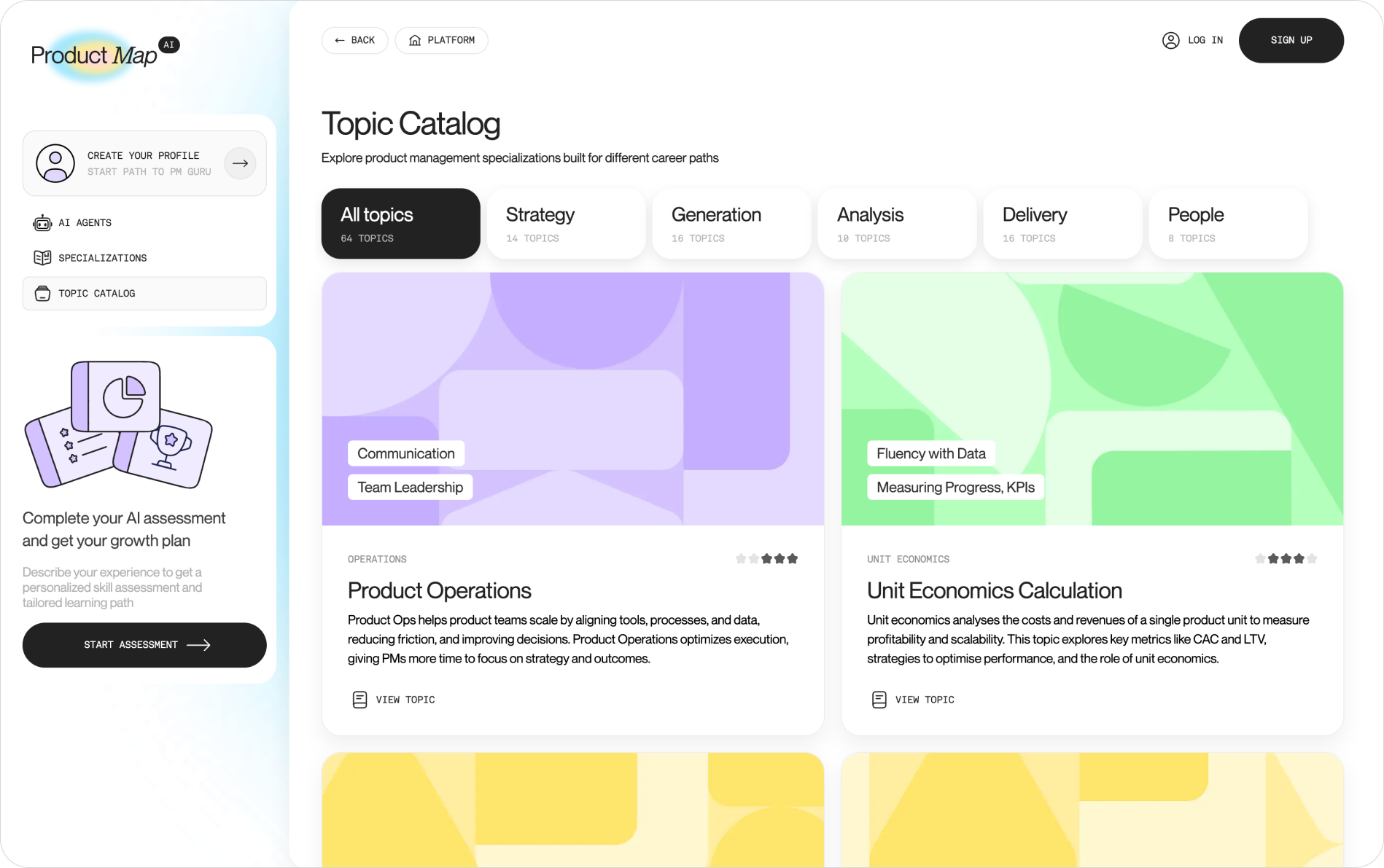
The second habit needs a reference point. Knowing what a strong opportunity assessment or a well-formed KPI tree looks like is what lets you spot a weak one in an AI draft. The Product Map topic catalog maps the PM craft topic by topic, from discovery methods to unit economics, so you have a standard to hold the output against.
A checklist before you ship
Speed is worthless if it ships a wrong decision faster. Run every AI-assisted output through this check before it leaves your hands.
- Trace the claim. Every fact, quote, or number the model produced traces to a real source you can point to. If it can't, assume it's invented.
- Name what it doesn't know. The model has no access to last week's exec conversation or the constraint no one wrote down. Fill those gaps yourself.
- Read for your team's voice. A spec that sounds like a stranger wrote it will read that way to your engineers. Rewrite until it sounds like you.
- Check the tradeoff it skipped. AI optimizes for the obvious answer. The decision that matters is usually the one it glossed over.
- Own the outcome. If the feature fails, "the AI suggested it" is not a sentence you get to say. The judgment is yours whether or not the draft was.
Chasing AI ideas for growth is worth the time. Shipping them without this check is how a metric that looks strong in the demo turns into a margin problem three months later.
AI for product managers: FAQ
Do product managers need coding skills to use AI tools?
No. Every workflow above runs through prompts or a visual interface. The skill to build is writing a clear brief with context and constraints, which is closer to writing a good spec than to writing code.
Is using AI as a PM the same as building AI products?
No. Using AI as a PM means applying AI tools to your own workflow: research, specs, prioritization. Building AI-powered products means shipping AI features to your users, which adds model evaluation, guardrails, and ongoing quality work to the job. This guide covers the first. The second is a separate discipline.
How many hours a week can AI save a product manager?
Four to eight for a PM who routes drafting, synthesis, and grooming through AI. The gain isn't only hours saved; it's hours moved from mechanical work to customer conversations and decisions.
What are the biggest risks of relying on AI too heavily?
Two stand out. Invented evidence, where the model fabricates a customer quote or a data point that reads as real. And skipped judgment, where the speed tempts you to ship the draft without pressure-testing the decision inside it. Both are managed by verification, not avoidance.
Which AI tool should a product manager start with?
A general assistant like Claude or ChatGPT, pointed at a workflow you run weekly. It's free to try, covers drafting and synthesis, and teaches you how to brief a model before you commit to a specialized tool. Add a dedicated tool only when one workflow repeats often enough to deserve it.
Start with one job this week
Product teams use AI best when they treat it like a hire, not a gadget. You wouldn't drop a new team member into every workflow at once. Pick the role with the biggest backlog and start there.
If feedback is drowning you, start with research synthesis. If specs eat your evenings, start with PRD drafting. One job, two weeks, measured in hours returned. Then expand. The product managers winning with AI in 2026 aren't the ones using the most tools. They're the ones who moved the mechanical work off their plate and spent the reclaimed time deciding what to build. Product Map is built to be that grounding layer: agents, frameworks, and your product context in one place.