




The best AI setup a product manager can build doesn't write a single document. It sits beside you like a chief product officer who has read everything your team ever decided, and it argues back.
That's the shift worth making in 2026. Point AI at your reasoning, not your artifacts. Most PMs do the opposite. They use it to generate more PRDs, more strategy decks, and more research summaries, faster than anyone can read them. The output looks like productivity. The decisions behind it get no better.
A co-pilot that brings CPO-level judgment to every call is worth more than a faster typist. It pressure-tests your strategy before you commit, flags where today's plan contradicts last quarter's, and asks the question your team is too polite or too busy to raise. You still decide. It makes sure you decided for a reason you can defend.
Two ways to point AI at your work
There are two habits, and they pull in opposite directions.
The first is generation: draft this PRD, summarize these interviews, rewrite this update for the exec audience. It saves time on production. It also multiplies the volume of documents your team has to read, review, and reconcile. When everyone drafts three times faster, the bottleneck moves from writing to deciding, and the flood makes deciding harder.
The second is adversarial: attack this roadmap, find the weak assumption in this launch plan, tell me why this bet fails. This use is rare. It's also where the leverage is. A model that challenges your logic before a decision ships catches the expensive mistakes while they're still cheap to fix.
Generation makes you faster at producing artifacts nobody asked for. Adversarial use makes you slower to ship a bad decision. Only one of those changes the outcome.
The two habits need different inputs. Generation runs on a prompt and a blank page. Adversarial use runs on context: what you've already decided, why, and what you believe about your users. Without that, the model pushes back with generic objections that sound smart and help nothing.
Give the sparring partner real context
An AI sparring partner is only as sharp as the context you feed it. Point it at a blank chat and it argues from training data. Point it at your actual product history and it argues from your reality.
Feed it four things:
- Strategy and goals: the current bets, the OKRs, and what you're deliberately not doing this quarter.
- Decision log: the calls already made and the reasoning behind them, so it can catch contradictions later.
- Customer evidence: interview notes, support themes, and the insights driving your priorities.
- Terminology: how your team defines activation, a qualified lead, or a healthy retention curve, so it doesn't argue past you on definitions.
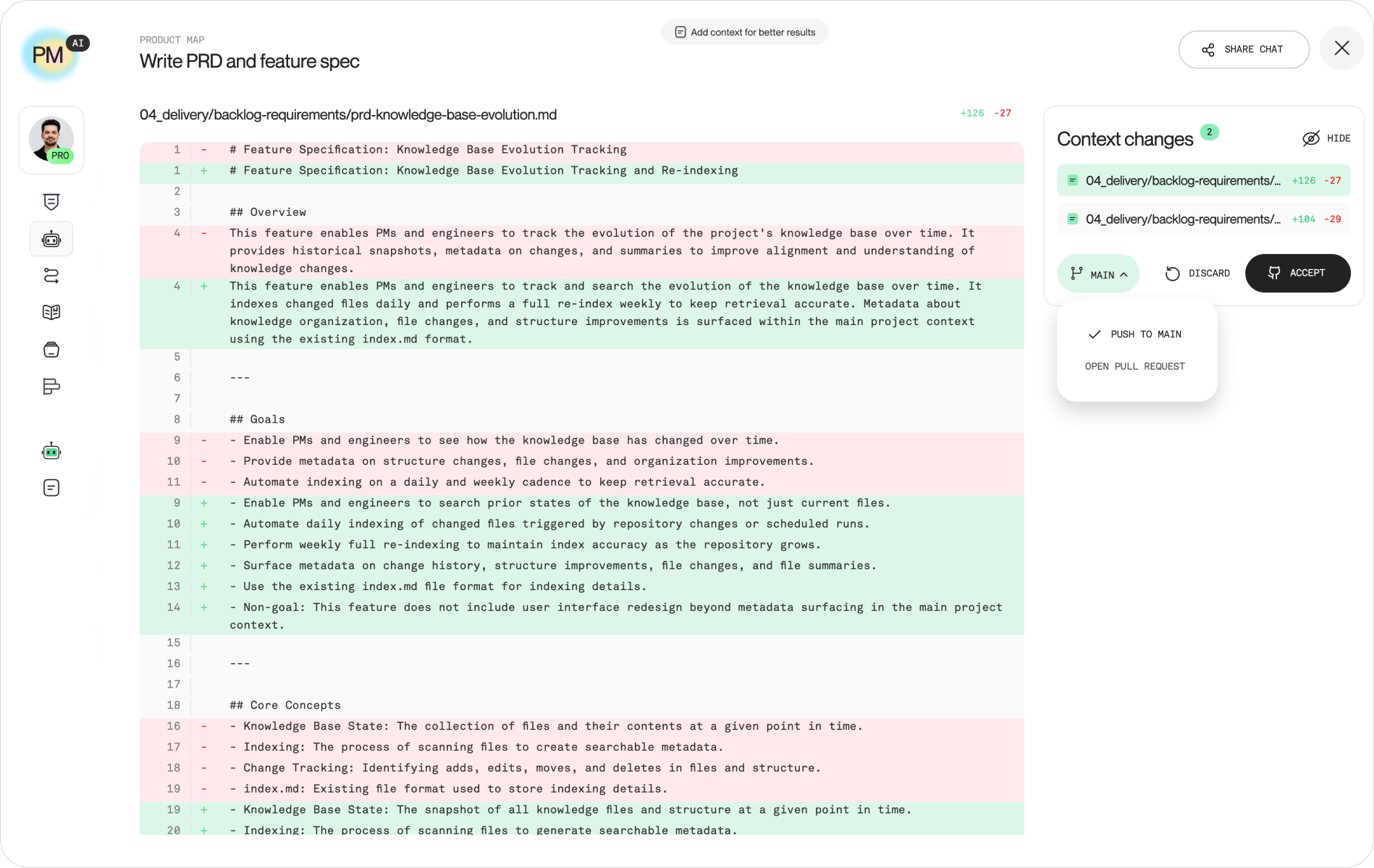
The practical way to keep that context current is a shared, version-controlled context layer your agents read on every run, instead of pasting it by hand each session. A sparring partner reading stale strategy will confidently defend a plan you abandoned in March. Keep the source of truth updated, and the pushback stays grounded in where the product is now.
.png)
Red-team the decision before it ships
The highest-value moment for adversarial AI is the hour before you commit. You've written the PRD, picked the metric, and sized the bet. Now try to break it on purpose.
.png)
Run the model as a red team. Give it the decision and the reasoning, then ask it to argue the other side:
- What has to be true for this to work, and which of those is weakest?
- Where does this plan assume users behave in a way our own data doesn't support?
- If this ships and fails in six months, what's the most likely reason?
- What would a skeptical CPO ask in review that we haven't answered?
The goal isn't a polished counter-essay. It's a short list of the assumptions you can't yet defend. Some you'll dismiss in a sentence. One or two will send you back to the data before you commit, which is the entire point. A pre-mortem you run in ten minutes with a model beats a post-mortem you run for a quarter with your whole team.
This is where a senior operator earns the seat. Junior PMs use the pushback to feel more confident. Strong ones use it to find the one objection that changes the plan, then act on it. The model surfaces the question. Answering it is still your job.
Catch the contradictions in real time
Teams don't usually make one bad decision. They make a good one, then quietly contradict it three weeks later without noticing.
A sparring partner with your decision log catches that drift. When a new PRD reintroduces a flow you cut for complexity, or a roadmap slots a feature you agreed was out of scope, the model that read both can say so: this contradicts what you decided in March, and here's the reasoning you gave then. No human on the team holds every past call in memory. A model with the full history does.
That's the compounding benefit of feeding it context over time. Month one, it argues from general product sense. Month six, it argues from your product's own record: the OKRs you dropped, the experiments that failed, the positioning you tried and killed. Consistency stops depending on who happened to be in the room.
Run different agents against the same artifact
You don't need one generic assistant for this. You need a few specialized ones, each pointed at a different job, run against the same artifact.
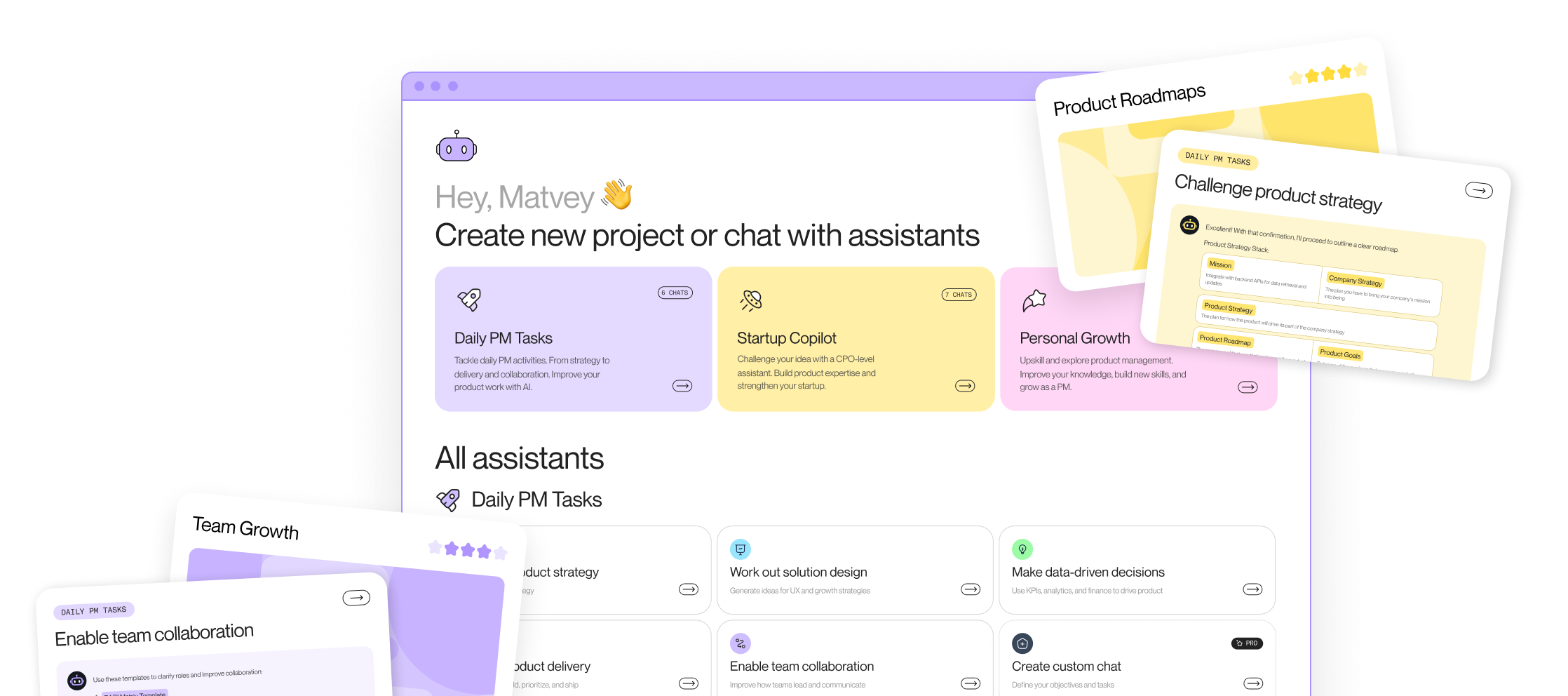
On the Product Map AI platform you spin up agents that do exactly this. One agent will challenge and improve your product strategy and roadmap, stress-testing the plan against your goals and tightening the sequencing once the weak spots are named. Another will turn a feature into a spec ready for engineering, then read it back for what's missing. A third will challenge your startup idea and shape the vision, poking holes in the problem, the market, and the wedge before you build.
The pattern that works: draft the artifact yourself, then run it past two agents with opposite jobs. Send your PRD to a challenger agent to find what's missing, then to an improver agent to tighten what survives. You get a critique and a rewrite from the same source of truth, without pasting your context into a fresh chat twice. The artifact stays yours. The agents give it the second and third read a small team can't spare.
Keep the judgment yours
The failure mode here isn't using AI too little. It's handing it the decision.
A sparring partner that's always available and always confident is easy to over-trust. It will argue any side you ask it to, including a wrong one, with the same fluent tone. Treat its pushback as input, not a verdict. The model's job is to make sure you considered the strongest objection. Your job is to weigh it against evidence, context, and the parts of the problem no document captures.
Use AI to attack your decisions and you get sharper calls made faster. Use it to write your docs and you get more documents. Pick the habit that changes the outcome, keep your context current, and let the machine argue while you decide.