




Tim Simmons, chief product officer at Walmart International, answered the replacement question without waiting for it to be asked. "Product managers are shifting from pure problem solvers to AI orchestrators," he said. "Our job now is to harness fleets of agents and all of our complexity so that scale becomes a competitive advantage instead of something that slows us down."
That's a CPO responsible for product across one of the largest retailers on earth describing the job in 2026. Not a smaller job. A different one.
Still, "will AI replace product managers" keeps trending. It resurfaces in r/ProductManagement every few weeks, fills LinkedIn comment sections, and drives career panic for people two years into the role. So instead of another opinion piece, here's what the people doing the job say across social media, what the data shows, and a case study from inside Product Map, where product managers already run fleets of AI agents every day.
What working PMs say online
Read enough threads and the same three camps appear.
The first camp says parts of the job are already gone. Marty Cagan has argued for two years that the product owner role, the delivery-process slice of product work, is being absorbed by AI plus engineers running more of their own discovery. Backlog grooming, ticket writing, and status reporting were the first tasks to fall, and few PMs online mourn them.
The second camp, the largest by far, repeats one line so often it has become the consensus position of PM social media:
You are not going to lose your job to AI. You are going to lose it to a product manager who uses AI better than you.
Lenny Rachitsky's shorter version, "PMs who use AI will replace those who don't," circulates in the same threads. The sentiment holds across Reddit, LinkedIn, and Substack comment sections: the threat is relative, not absolute.
The third camp goes further than "you're safe." Cagan's own conclusion after two years of watching AI product work is blunt:
The PM role becomes more essential but also more difficult with generative AI-powered products, not less.
More essential and more difficult is not the profile of a role about to disappear. It's the profile of a role being repriced.
The tasks AI already owns
The honest answer to "can AI replace product managers" starts with what it has replaced. Inside most product teams using agents daily, four workflows moved from human hours to agent minutes:
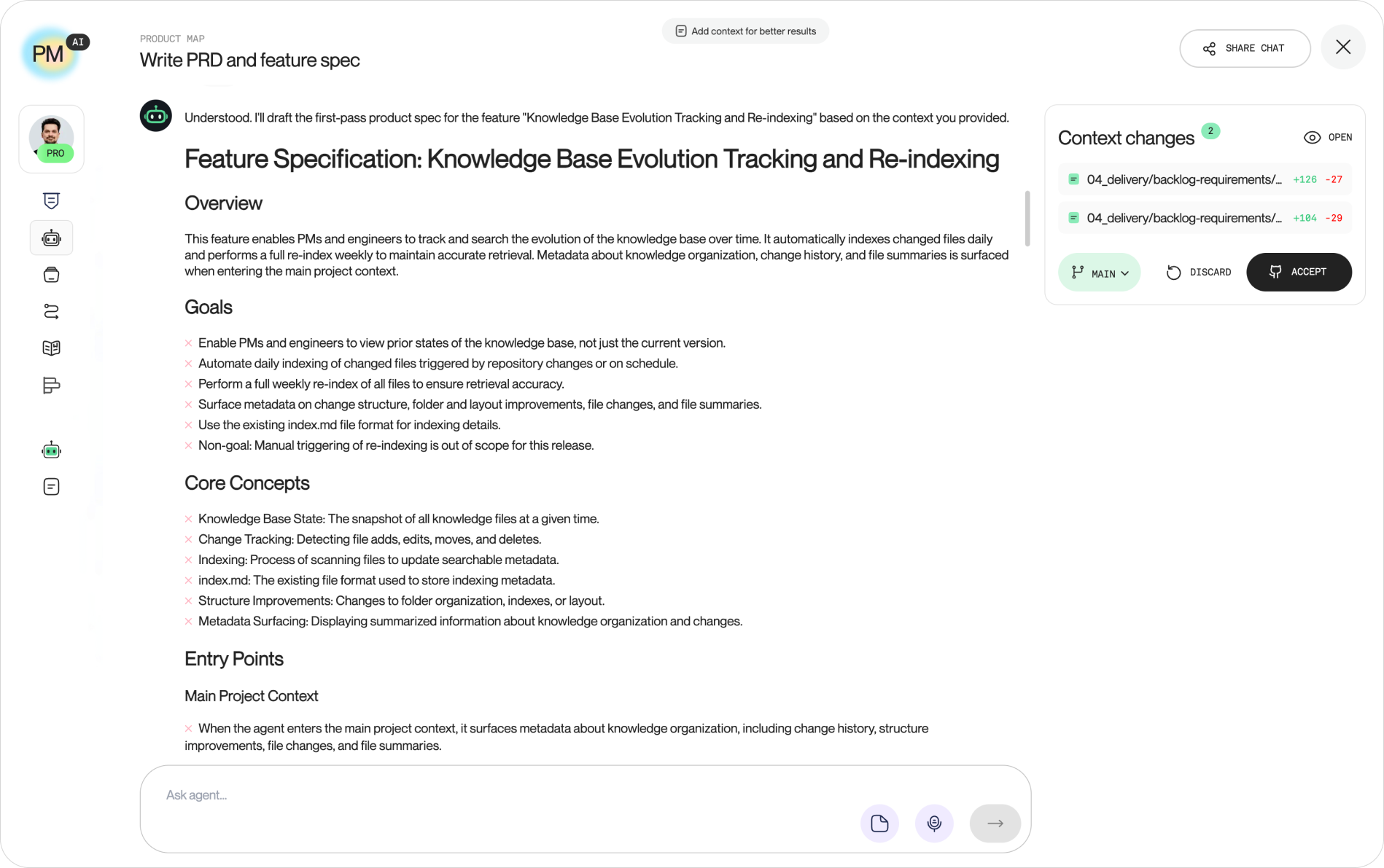
- PRD and documentation drafting. An agent grounded in your product context produces a reviewable spec draft in minutes. The PM edits guardrails and acceptance criteria instead of typing sections from scratch.
- Customer research synthesis. Transcript analysis, sentiment tagging, and theme extraction across hundreds of feedback items now run overnight. Reading ten interviews used to be a week of work.
- Data analysis and reporting. Funnel pulls, cohort summaries, and the weekly stakeholder update are assembly work, and assembly work is what agents do best.
- Feature ideation. Generating twenty solution directions against a well-framed problem takes one prompt. The scarce skill moved to framing the problem and killing nineteen of the twenty.
.png)
Notice the pattern. Every task on the list is production: turning known inputs into a known artifact format. None of them is a decision about what to build or for whom.
What AI still can't carry
The limitations show up fast once the stakes rise past a draft.
Strategic decision-making under uncertainty is the clearest gap. An agent optimizes against the context you give it. It can't know your CEO is quietly renegotiating the company's biggest contract, or a competitor's roadmap leaked at a dinner last week. Product decisions run on information nobody wrote down, and models only read what's written.
Cross-functional leadership is the second gap. Getting engineering, design, sales, and legal to commit to the same bet is trust-building, and trust accrues to people. Nobody follows a model into a hard quarter.
The third is accountability. When the launch fails, someone owns the miss in front of leadership. MIT's finding that 95% of enterprise generative AI pilots fail to reach production says less about model quality and more about this: tools without an accountable owner die in the org chart. The failure rate is an argument for product judgment, not against it.
.png)
Case study: how Product Map PMs run a fleet of agents
Product Map builds an AI copilot for product managers, and our own product team is the heaviest user. Here's what "AI product manager" means in practice for us, because it looks nothing like replacement.
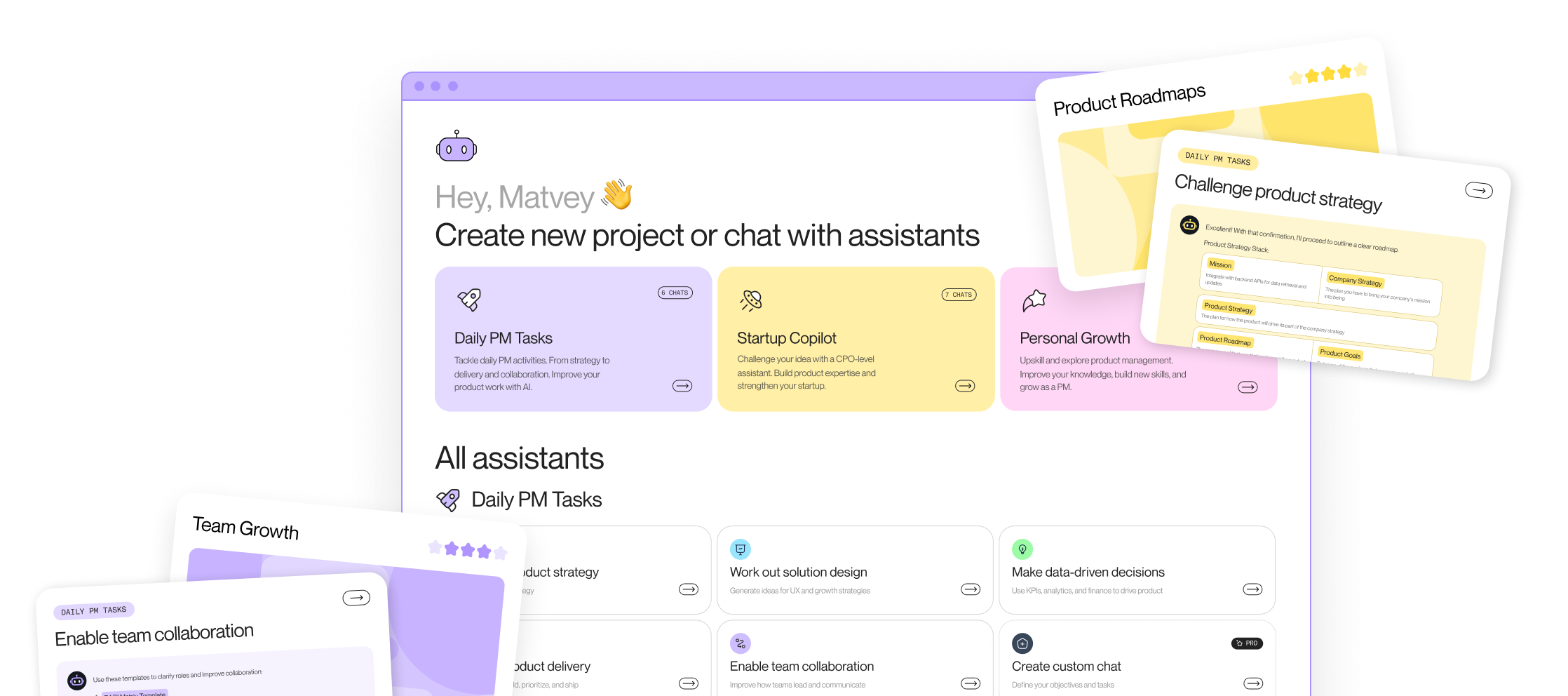
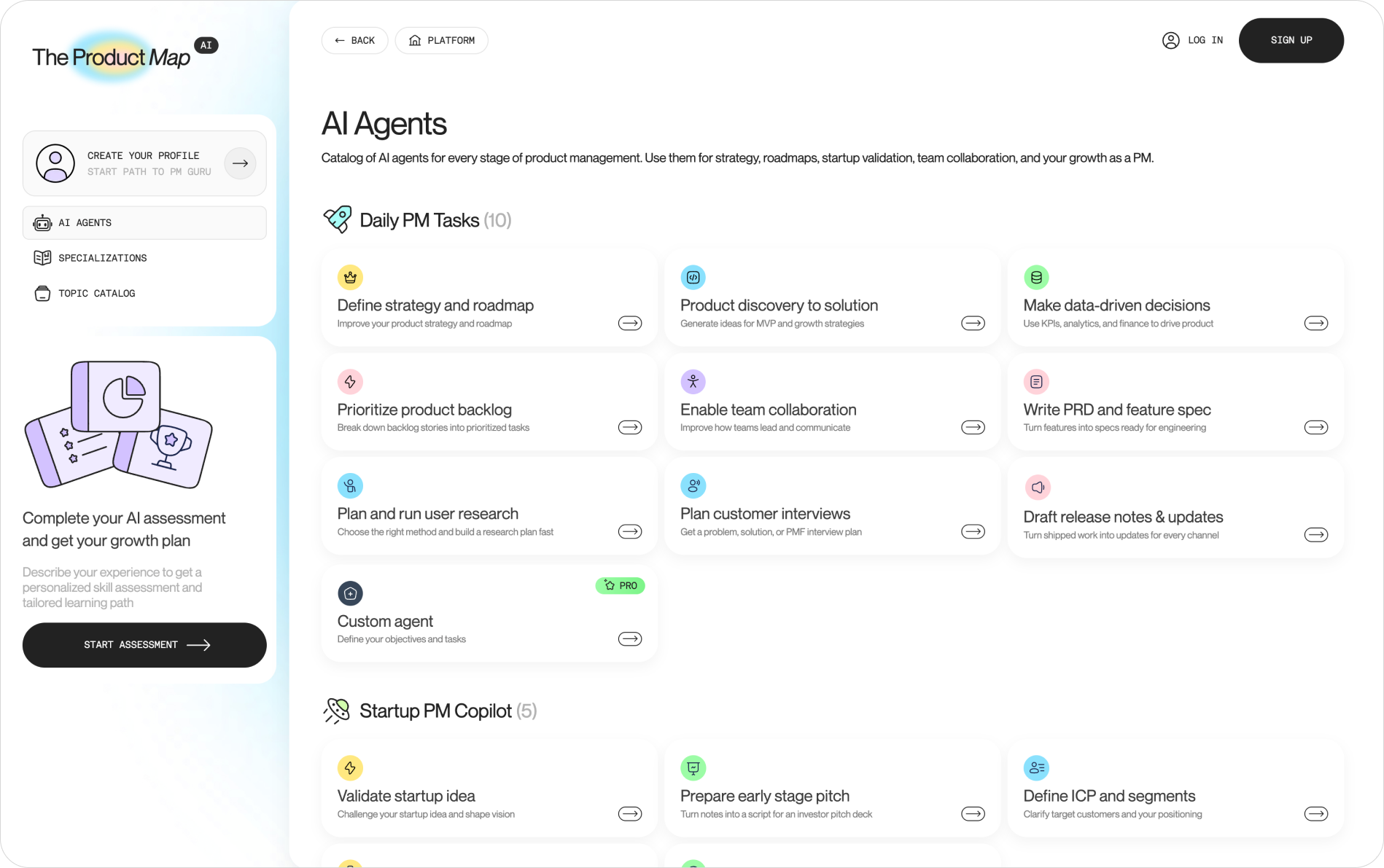
Each PM operates a fleet of specialized AI agents mapped to the product lifecycle: a strategy and roadmap agent, a discovery agent, a user research agent, a PRD agent, a release notes agent, and analytics agents for KPIs and unit economics. Every one is a scenario chat grounded in product context, not a blank prompt. The PM's morning starts by reviewing what the fleet produced overnight, approving what's good, and rerouting what isn't.
The work itself lives where engineering lives. Our PM artifacts, context files, PRD templates, and agent instructions sit in Git repositories, and agents read them on every run. A PM opens a pull request to change positioning the same way an engineer opens one to change code. Blog drafts, partnership pipelines, and spec reviews run as agent skills the PM triggers, reviews, and ships.
That changed the relationship with engineering more than any process framework we tried. When the PM drafts a working prototype instead of a static spec, and the spec itself defines eval criteria an agent is tested against, the PM stops being a requirements courier and becomes a participant in the software development lifecycle: present in the repo, in the review, and in the release.
The numbers explain why this matters now. Anthropic reported that coding agents roughly tripled its engineering output while product management throughput stayed flat. Engineering everywhere got faster; decision-making didn't. A PM who still works at 2023 speed becomes the constraint the whole team queues behind.
And here's the blind spot the replacement debate misses. AI won't walk into your office and take the PM job. But an organization that triples engineering speed will route around a slow decision-maker, and once engineers with agents make product calls by default, the role dissolves without anyone announcing it. The PMs in trouble aren't the ones automation targets. They're the ones who stayed manual while everyone around them compounded.
Will there be fewer PM jobs?
The data says the market is splitting, not shrinking. LinkedIn lists over 140,000 open product manager roles in the US alone. Gartner projects up to 80% of traditional project management tasks will be automated by 2030, and the coordination-heavy slice of product work follows the same curve.
Our own evidence points the same direction. Product Map has published more than 1,800 skills assessments in our State of the Product Management 2025 report, and the demand signal inside them is lopsided: agent operations, AI evaluation, and prototype-driven discovery climb while ticket administration flatlines. Junior roles built on assembly work are contracting. Senior roles built on judgment, orchestration, and cross-functional leadership are growing and paying more.
So the count of people titled "product manager" holds roughly steady while the composition changes underneath. Fewer coordinators. More operators of systems that produce product work.
Future-proof your PM career
Everything above compresses into three moves you can start this quarter:
- Operate agents, don't sample them. The difference between a PM who tried ChatGPT and one who runs a reviewed fleet across discovery, specs, and analytics is the difference the hiring market now prices. Start with one lifecycle agent and add a review cadence.
- Move into the engineering loop. Learn Git basics, keep your context and PRDs in a repository, and ship a prototype where you used to ship a document. Proximity to the build is the new stakeholder management.
- Invest in the judgment layer. Decision-making under uncertainty, evaluation criteria for AI outputs, and trust with your engineers are the skills agents amplify instead of erode. The Product Management Map lays these out as a structured path if you want a map for the transition.
The question will keep trending, and the answer from inside the work stays the same. AI didn't replace our product managers. It handed each of them a team that never sleeps, and made the human at the center of it more consequential than before.
FAQ
Can AI replace PM decisions?
It replaces the preparation for decisions: the data pulls, option generation, and summaries. The decision itself needs unwritten context, risk ownership, and accountability, and those stay human.
Is the PM role safe from AI?
The title is safer than the task list. Assembly work is being automated now; judgment, orchestration, and leadership are rising in value. Safety depends on which half of the job you spend your time in.
What is the future of product managers in the age of AI?
Orchestration. The PM defines outcomes, runs a fleet of agents producing drafts and analysis, reviews the output, and drives decisions inside the engineering loop rather than upstream of it.
Will AI reduce the number of product manager jobs?
Entry-level coordination roles are contracting while senior operator roles grow. The overall count holds; the bar and the pay move up together.