




A competitor analysis starts expiring the moment it's finished. A pricing page changes, a plan limit moves, and the deck you presented in March describes a market from January. AI made the deck cheap to produce and did nothing about the expiry date.
42% of product marketers now use AI for competitive monitoring, according to the Product Marketing Alliance's State of PMM 2026 survey, and most of them ran the same prompt you did: "analyze my competitors."
The output looks like research. It's a draft with an unknown error rate.
A better model won't fix it. Treat the report as an intermediate artifact and build the loop around it: a spec you can rerun, a verification pass you can defend, and a refresh date on the calendar. Product Map runs this loop on its own market, so the examples below come from a live file, not a template.
Where the chat-window competitor deck is wrong on price
Three failure modes show up in every AI-generated competitor report, and they're the same across ChatGPT, Claude, Perplexity, and Gemini.
- Confident on facts it never checked. "ChatPRD offers a free tier" and "ChatPRD is a PM-specific copilot" arrive in the same tone. One is a stable description. The other was true on a date the model doesn't know.
- Stale where it matters. Competely's August 2026 guide on deep research for competitor analysis puts it plainly: pricing and recent changes are where any model is most likely to be stale or wrong. Those are the two rows the CEO reads first.
- Unsourced where it counts. Deep research tools cite sources and still miss. A Stanford RegLab study of purpose-built legal research tools found hallucination rates of 17 to 33 percent, and legal tools are held to a stricter bar than market research.
Treat the report as a draft. The deliverable is a spec you can rerun, a check you can defend, and a date when the numbers stop being trusted.
The fourth failure is structural: nothing watches the competitors after the run. Every tool in Competely's comparison produces a snapshot, and none of them says when the snapshot went out of date.
.png)
Write the spec before you run the first competitor prompt
"Analyze my competitors" leaves every important decision to the model: who counts as a competitor, what to compare, and what a good answer looks like. A spec makes those decisions yours. Product Map's own spec lives in 01_strategy/product-market-fit/competitive-analysis.md inside the product context repository, and it has four parts.
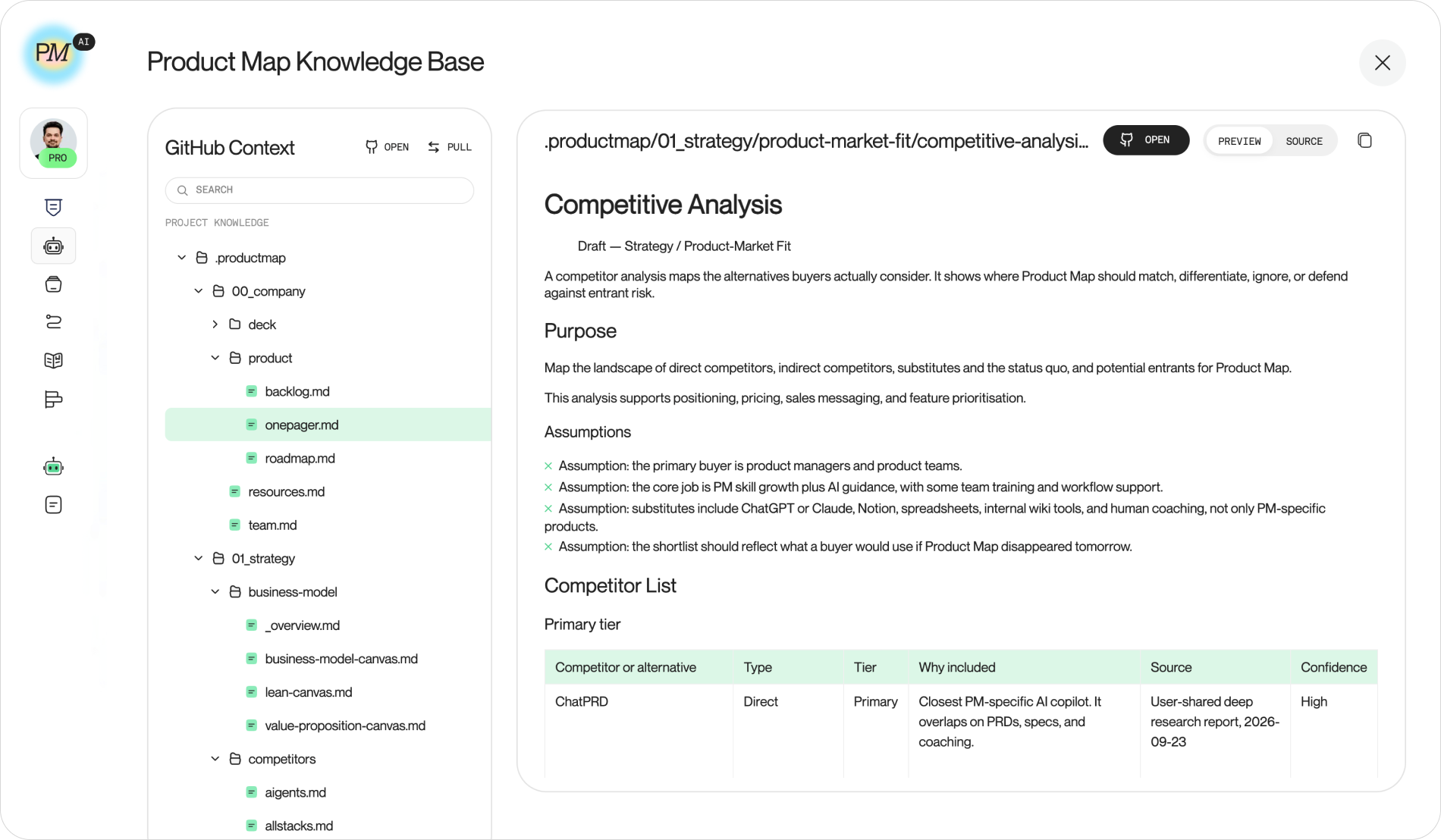
Assumptions, written down
Who the buyer is. What the core job is. What counts as a substitute (a general model plus Notion plus a spreadsheet counts, and so does human coaching). And the tie-breaker for the list: what would a buyer use if the product disappeared tomorrow.
Three tiers, not one list
- Primary: strongest overlap with the buyer, the job, or the workflow. For Product Map: ChatPRD, Reforge, Productside, Mind the Product training, Productboard Spark, and the DIY stack of a general model plus a wiki.
- Secondary: meaningful but narrower overlap. Aha!, Atlassian Rovo, Dovetail, Zeda.io, and the human coaching marketplaces.
- Emerging: low scale today, credible pressure tomorrow. Open-source PM skill packs and AI research tools.
Tiering decides where verification effort goes: every claim on primary rows, a name and a source on emerging ones.
Same dimensions, every row
Product Map compares six capability areas: AI copilot for PM tasks, skills assessment and growth plan, curated knowledge hub, certification, team training and enterprise readiness, and workflow integration. Pick yours from what the buyer evaluates, not from what your product does well. Six to fifteen dimensions is the working range.
One prompt per competitor
Deep research on "my six competitors" produces one shallow report. The same prompt run six times, one competitor per run, produces six deep ones. The prompt names the competitor, lists the dimensions, asks for a source URL and a date next to every factual claim, and tells the model to mark anything it couldn't source as unknown. That last instruction does more for accuracy than any model choice.
Verify pricing, limits, launches, and funding by hand
Split the report into two kinds of statement. Descriptions ("Reforge sells cohort-based courses to senior PMs") are stable, low-stakes, and safe to accept. Facts with a date attached (Reforge's annual membership price) are the ones to open the source for. Four categories earn a manual check every time:
- Pricing and packaging: the plan names, the per-seat number, the annual discount. Open the pricing page. Screenshot it with the date.
- Plan limits: seats, projects, API calls, model access. These change without announcement and get copied wrong most often.
- Launches in the last quarter: read the changelog or release notes, not the model's summary of them.
- Funding and headcount: Crunchbase or the press release for funding; the careers page for what they're building next.
Every verified claim gets a source and a confidence level. Product Map's table carries both: a Source column and a Confidence column. When the source is the model's own output, confidence is Medium at best until someone opens the page.
A competitor claim without a URL and a date is an opinion the model had. It goes in the table as unknown, not as a fact.
One template per competitor
A matrix needs like against like, so every competitor gets pasted into the same block: tier, type (direct, indirect, substitute, potential entrant), why included, source, confidence, then one score per dimension.
Product Map scores each cell from 0 to 3. Three means best in class for the segment, two means complete for the typical buyer, one means present but shallow, zero means absent, and a question mark means not verified yet. The question mark is the most important value on the scale. A matrix with no unknowns was filled in by a model, not by a person who checked.
Run the loop on Product Map
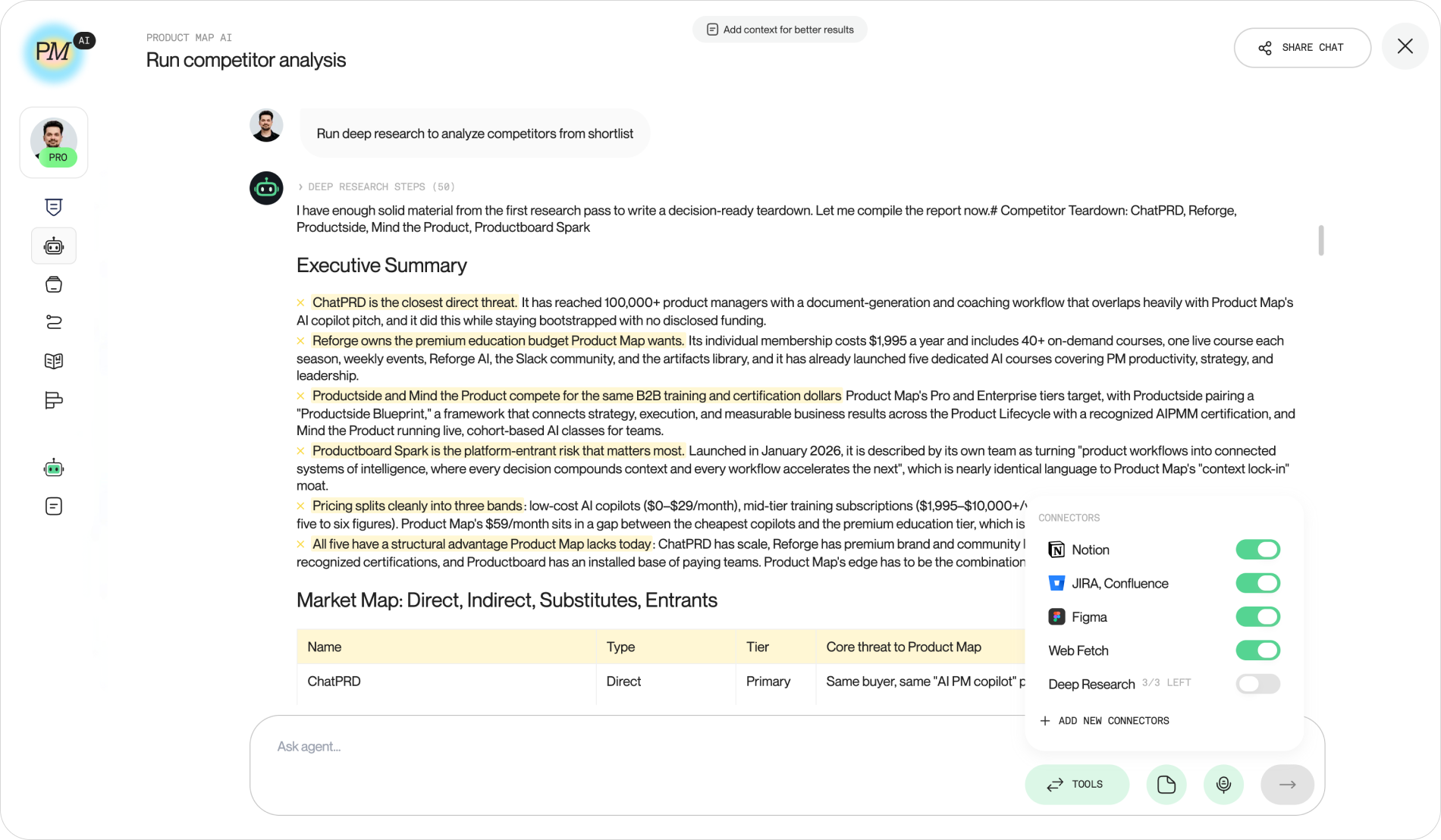
Product Map's competitor analysis agent runs the spec-first version of this loop against your own product context. It maps direct, indirect, and substitute competitors, reads public pages to tear down product, pricing, and positioning, and scores a competitor matrix from 0 to 3 across the capabilities you name. Facts stay apart from interpretation in the output, and PRO users can switch on Deep Research for a wider market scan.
The agent writes three files into the connected product context repository: competitor-list.md, competitor-matrix.md, and competitive-decisions.md. Under version control the refresh is a diff: rerun the agent next quarter and the pull request shows which cells moved. The framework is on the Competitor Analysis topic, inside the wider Market Research topic.
From a quarterly deck to a weekly feed an agent watches
The quarterly refresh is the floor. The 2026 data says teams above the floor get more out of the work: battlecards reach 67% of sales reps within 30 days, and teams with a quarterly refresh in place see that number climb to 78%, per the same PMA survey. The step after quarterly is a monitoring agent. The design question is what it watches.
Watch:
- Pricing pages and plan tables. A page monitor catches the diff. The agent summarizes it against your positioning file and flags whether it touches a roadmap item.
- Changelogs and release notes. The launch itself, not the launch blog post.
- Careers pages. A competitor hiring three engineers for the feature you're scoping is the highest-signal alert you'll get.
Ignore:
- Social posts and marketing campaigns. High volume, low information, and they train the team to mute the channel.
- Review-site sentiment shifts under a few points. Noise until it persists for a quarter.
The agent's output is a proposed edit to the matrix, not a Slack message. It opens a change to competitor-matrix.md with the source URL, and a person merges it or closes it. Nine alerts in ten will be noise. The tenth is the one you'd otherwise have found in a lost deal.
Two risks sit outside the checklist. One: a monitoring agent makes the team feel informed while nobody has used a competitor's product in a year. Keep one hands-on teardown per quarter, primary tier only, and don't automate it. The other is ownership decay. The spec was written by the PM who cared and inherited by the one who didn't, and the agent keeps scoring against dimensions from two strategies ago. Put the owner's name and the last review date at the top of the spec file.
From matrix to one decision
A feature table is the input. The output of a competitor analysis is a small number of decisions, and the fastest way there is a positioning map with two axes chosen so the competitors spread out. Product Map's axes: personal growth and learning versus workflow execution, and AI copilot depth versus education and certification. The crowded area is PM guidance without a growth mechanism. The white space is the combination nobody else has.
.png)
From the map, three decisions, each with a name attached:
- Hardest direct competitor: the one already owning the same mindset in the buyer's head. For Product Map, ChatPRD, because it sells "help me do PM work faster" to the same person.
- Platform risk: the incumbent able to bundle your category into a product the buyer already pays for. Productboard Spark first, Aha! and Atlassian Rovo behind it.
- Teardown shortlist: the four or five names worth a full hands-on review this quarter, each with a one-line reason.
The competitor analysis feeds the product strategy, and a strategy is measured by what it rules out. If the analysis doesn't rule out matching at least one competitor on at least one dimension, it isn't finished. Mark the row "ignore" and write why.
Book the refresh date now
Open the spec file, add a line with today's date and the date the numbers stop being trusted, and put the second one on the calendar. Ninety days for the full loop, weekly for the monitoring feed on the primary tier. When the date arrives, rerun the same prompt per competitor, verify the same four categories, and read the diff. The diff is the analysis. The first run tells you where the market was. The second run tells you where it's going, and no chat window produces that on its own.