




Launch is in four weeks. The document called "GTM plan" has seven headings and one of them filled in. Nobody at the company has marketing in their title, and the CEO wants the plan by Friday. That is the normal case for an early-stage PM. The median software company reaches four product marketers at $50 million in ARR, and in the years before that the product manager covers the gap.
In 2026 the gap has a different shape. The mechanical part of product marketing is now the part a model does well: 73% of PMMs draft launch copy with AI, 64% generate FAQs with it, and 42% run competitive monitoring through it.
What's left is a short list of decisions a PMM would have owned. And the pattern in lean teams runs the wrong way. The PM asks the model to pick the segment and write the positioning, then spends the weekend formatting the FAQ. This playbook inverts it: the decisions stay with you, the grind goes to the agent, and the whole plan fits on one page. Teams with a marketing and sales function should read run GTM as a system instead. This is the single-owner version.
,
Five GTM questions a product marketer would have answered
Mind the Product's guide for solo PMs frames go-to-market as five questions. Companies with a defined GTM process report a 63% launch success rate against 53% without one, and 40% of launches hit a misalignment where sales talks about a feature before it's ready. Every one of those failures traces to an unanswered question on this list.
- Audience: which segment you win first, what they use today, and why they'd switch this quarter.
- Message: the one sentence a feature becomes a reason to care through, tested against the alternative the buyer already has.
- Internal alignment: what sales, support, and the founder say about the product on launch day, and what they don't promise.
- Launch plan: the internal preparation timeline behind the external date, sized to how much the release matters.
- Feedback loop: which three numbers tell you the message landed, and when you look at them.
A PMM answers all five as a job. The solo PM answers them in the evenings between sprint planning and a customer escalation.

What a model drafts well in 2026, and what it gets wrong
Run the five questions past a model and the output splits cleanly.
The drafting layer is safe to delegate. Competitive synthesis from public pages. A first pass at launch copy in three lengths. An FAQ built from your support tickets and the spec. Objection lists pulled from lost-deal notes. Variants of the same announcement for users, buyers, and the technical evaluator. This is the work a PMM spent the bulk of a launch week on, and a model with your product context loaded does it in minutes. Div Manickam, who writes about the agentic PMM, puts the division in one line: the agent drafts the change and alerts the PMM, and the PMM is the final editor.
The decision layer is where the model fails in ways a reader can't spot. Ask it which segment to go after first and it picks the biggest one, because the training data rewards market size over reachability. Ask for a value proposition and you get an adjective stack ("an AI-powered platform for teams of every size") with no alternative named. Ask for pricing and it averages the competitors it knows about, including the two who changed plans last quarter. And why now? It invents a trend. None of these are hallucinations in the technical sense. They're plausible answers to questions where plausible is the wrong standard.
A model can write ten value propositions in a minute. It can't tell you which one your customer said out loud last Tuesday.
So the rule for a solo PM is simple. Every field on the GTM page gets one of two marks: DRAFT, which the agent fills and you edit, or HUMAN, which you fill from evidence and the agent never touches. The next section is the page.
The one-page GTM plan with the human-only fields marked
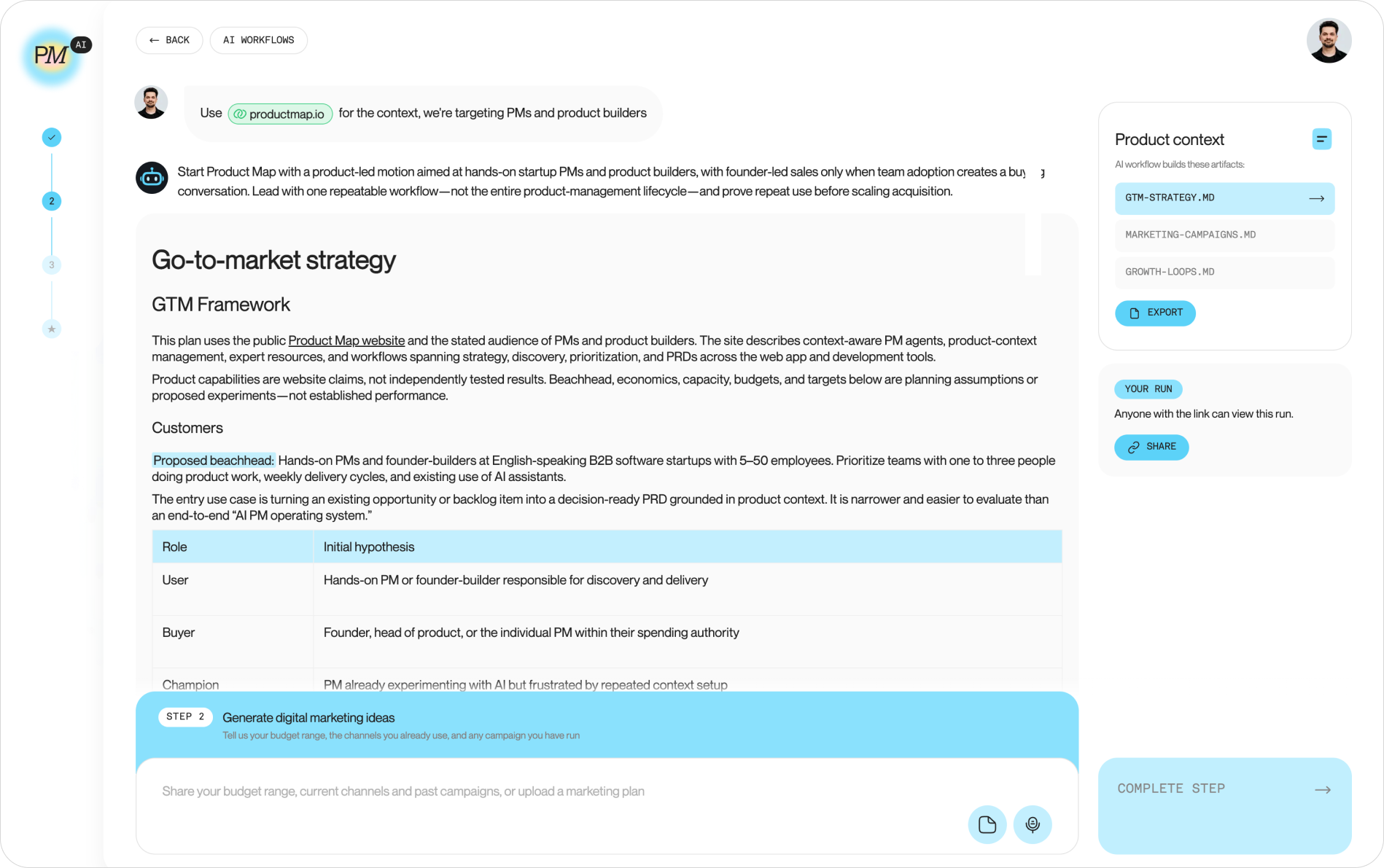
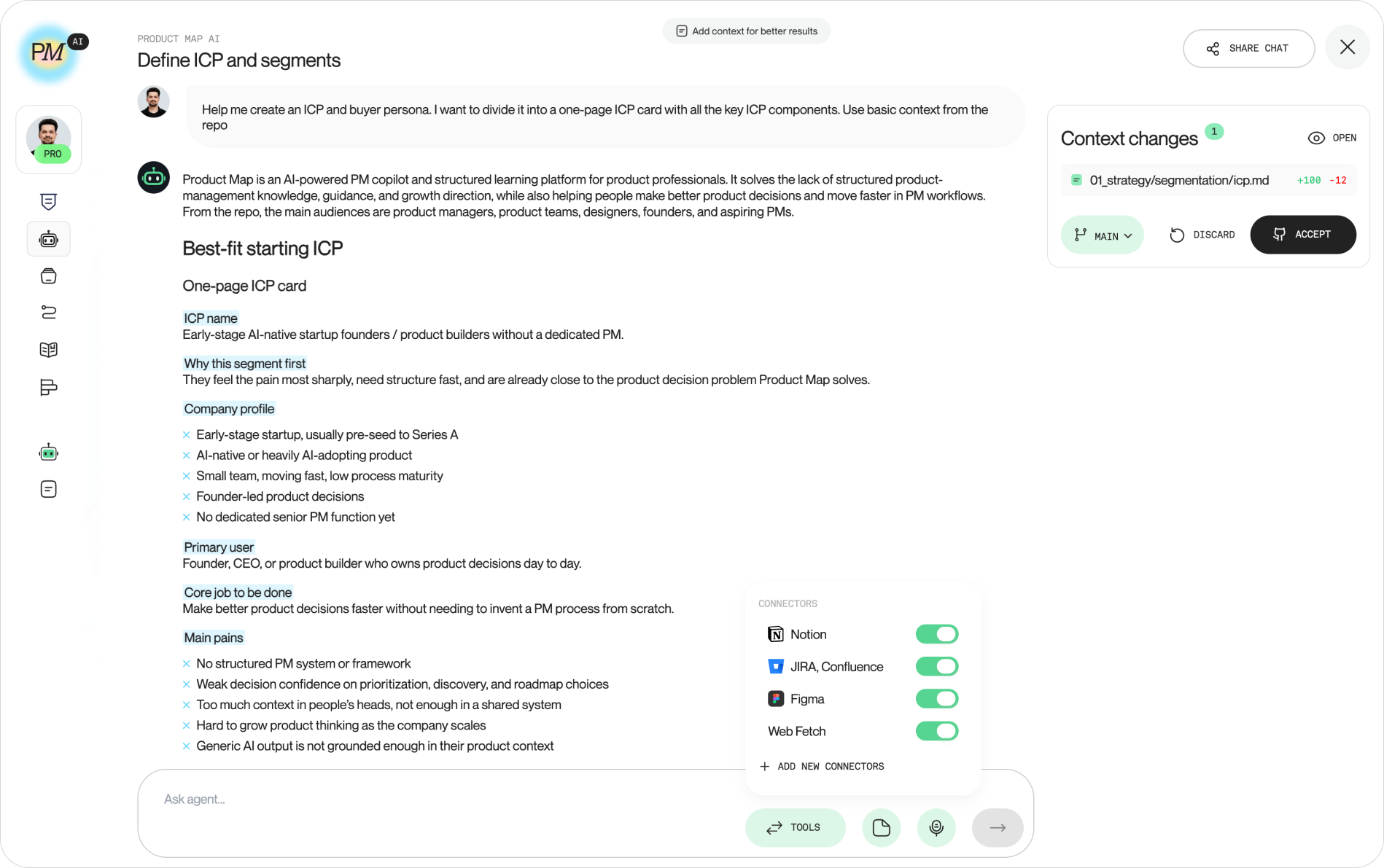
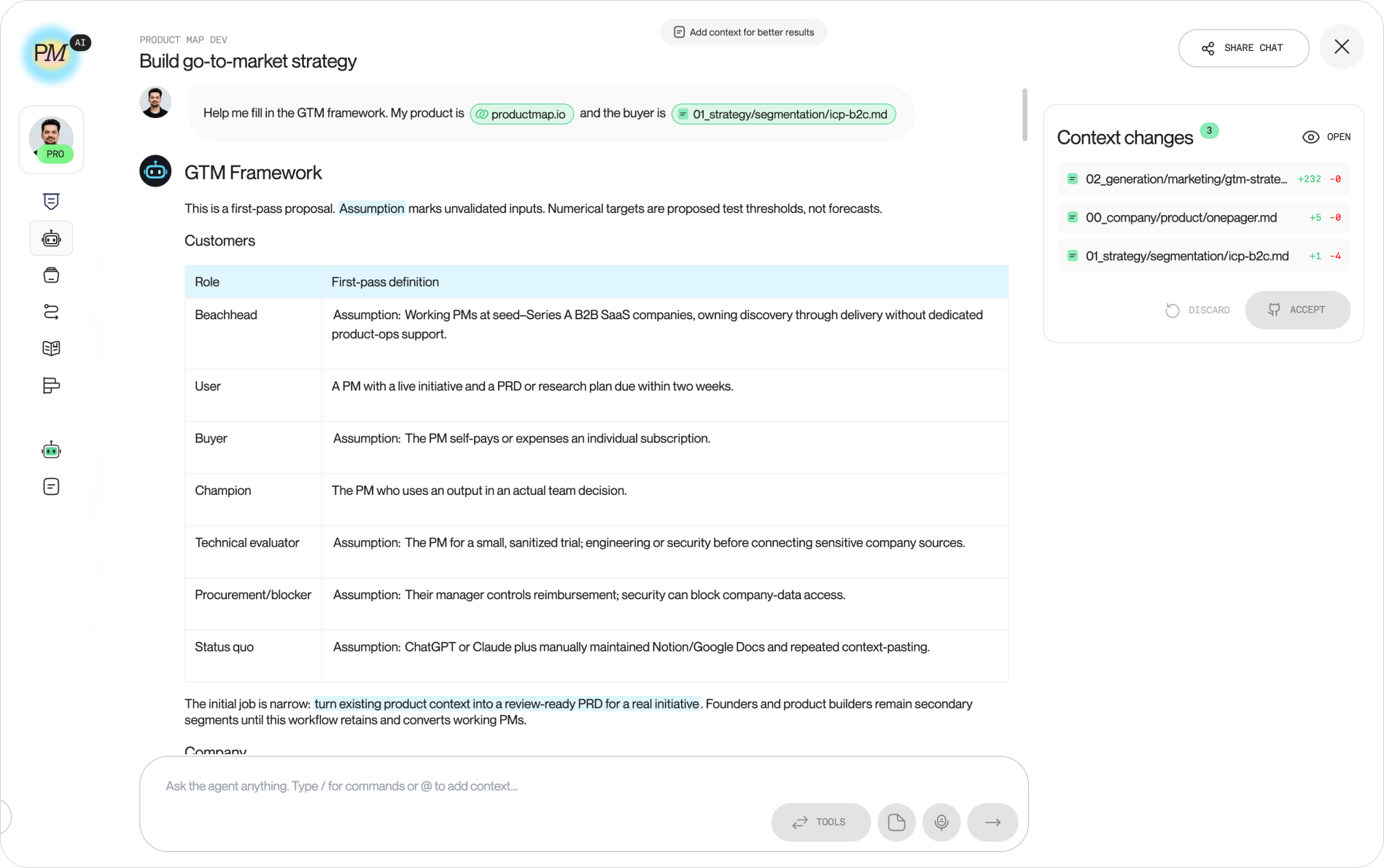
Product Map's GTM strategy template has six sections. The one-page version keeps them all and adds a mark to each. Copy it into gtm.md next to your ICP and strategy files, so every agent you run reads the decisions you've already made instead of re-inventing them.
- Segment (HUMAN): one beachhead, written as an ideal customer profile with disqualifiers. The agent can list candidate segments from your closed-won deals. You pick one and write down who you're saying no to.
- Value proposition (HUMAN): for [segment] who [struggle with alternative], [product] is the [category] that [outcome], and the proof is [metric or quote]. The agent drafts ten variants after the interviews. You choose the one a customer said.
- Pricing (HUMAN): the value metric, the plan you'll launch with, and the rationale in two sentences. The agent benchmarks competitors and flags the friction in each model. You set the number. The monetization and pricing topic covers the value-metric choice.
- Channels (DRAFT): the agent ranks channels for your ICP with a 30-day test for each. You approve one primary channel and one experiment.
- Timeline (DRAFT): the internal timeline, working back from the external date. The agent builds it from the launch checklist. You mark the tier and the go/no-go gates.
- Success metrics (HUMAN): three numbers, defined before launch, with the date you'll read them.
Four HUMAN fields, two DRAFT fields. A PMM's week was mostly drafting. Your GTM is mostly deciding, and the deciding takes an afternoon once the evidence exists.
Four weeks out: the interviews that write the message
The value proposition is the field PMs most want to delegate and the one the model is worst at. Fixing it is cheap. Four weeks before launch, book five to eight calls with people in the segment who touched the feature in beta or asked for it in a ticket. Ask three questions: what do you do today, what does it cost you, and what would have to be true for you to switch.
Then listen for the sentence. In Mind the Product's example, a team shipped a workflow feature and drafted "automate your reporting pipeline." A customer described the same feature as "it kills the four hours of manual work I do every Monday." The second line is the message. It names a time, a day, and a chore. The first names a feature.
The agent earns its place here after the calls, not instead of them. Feed it the transcripts and ask for every sentence where a customer named a cost, a number, or an alternative. It returns twenty candidates in the customer's words. You pick one, test it against the two runners-up in a subject line or a landing page headline, and write the winner into the HUMAN field. Positioning tests in 2026 show category framing wins 54% of the time and hero copy 31%, so if you only have time to test one line, test the frame, not the headline.
Alignment without a PMM: the one doc everyone reads
The 40% misalignment number has a boring cause. Sales heard about the feature in a demo, support heard about it in a bug thread, and nobody wrote down the same version. A PMM's fix is a launch brief and a training session. A solo PM's fix is one page in the same repository, sent two weeks out, with a reply required.
The page holds seven items and nothing else.
- What ships: one paragraph, in the customer's words from the interviews.
- Who it's for: the segment, and the two segments it isn't for yet.
- What it costs: the plan, the limits, and what happens to existing customers.
- Three objections and the answer to each: pulled from lost deals and beta feedback, drafted by the agent, edited by you.
- What not to promise: the roadmap items which sound adjacent and aren't in this release.
- Two dates: the internal ready date and the external announce date, with a deliberate gap between them.
- Who answers questions: you, in one Slack channel, until the week-one retro.
Send it to the founder, the sales lead, and whoever owns support. Ask each to reply with the one line they'd say to a customer. If the three lines match the value proposition, you're aligned. If they don't, you found the gap two weeks early instead of on a sales call. This is the same one-context-file idea behind a shared product context repository: the humans and the agents read the same page, so nobody improvises a fourth strategy.
Tier the effort too. Most releases are T3: release notes, an in-app message, a line in the newsletter. Running the full page for every ticket burns the attention you'll need when a T1 arrives.
After launch: three numbers and the day to hire the PMM
Three numbers fit in a solo PM's week. Pick them before launch and write the read date next to each.
- ICP match rate: the share of new customers in the first 30 days who fit the segment on the page. Below half means the message reached the wrong room or the segment was wrong.
- Time to first value: signup to the first completed workflow for self-serve, or first call to close for sales-led. If it lengthens after launch, the promise outran the product.
- Message win rate: how often the chosen sentence beats the runner-up in whatever you can test, from subject lines to demo openers. A message which stops winning by month three is telling you the market moved.
Pipeline lift from a launch decays fast: +38% in the launch quarter, +5% three quarters later, across 614 teams in the PMA 2026 data. The three numbers are how a solo PM notices the decay before the quarterly review does.
Then the question founders ask late: when does the PMM get hired? The useful trigger is operational. Hire when two of these are true at once: you're running more than one tier-1 or tier-2 launch a quarter, the monthly message refresh has slipped twice, or sales asked for a battlecard and got a Slack message. The blind spot is hiring earlier than that.
A PMM who arrives before the positioning exists inherits a void and spends the first quarter guessing. A PMM who arrives to a gtm.md with four HUMAN fields filled from evidence has a job description on day one, and the agent drafting the copy already knows the product.

Until that hire, the page is the marketer. Keep the six sections current, keep the four decisions yours, and let the agent carry the drafts. A launch run this way becomes the first version of the GTM system the company still runs at $50 million in ARR.