




Every figure in this report comes from product management skills assessment reports completed on Product Map. An AI grades open answers against 15 skills in five groups: Product, Customer, Analytics, Processes, and People. Seniority is not self-declared, and every response is scored on its own, so the numbers measure demonstrated ability, not self-rating.
This is the Q3 2026 edition of a quarterly series built from 1,800+ reports. Each edition covers who completed the assessment, which skills rank highest and lowest, how total scores cluster, and which topics people opened afterward. This one also maps each finding to a move you can make this quarter, at whatever stage you are in. Your personal report shows where you sit against each figure below. The assessment takes about 20 minutes.
Who took the assessment in Q3
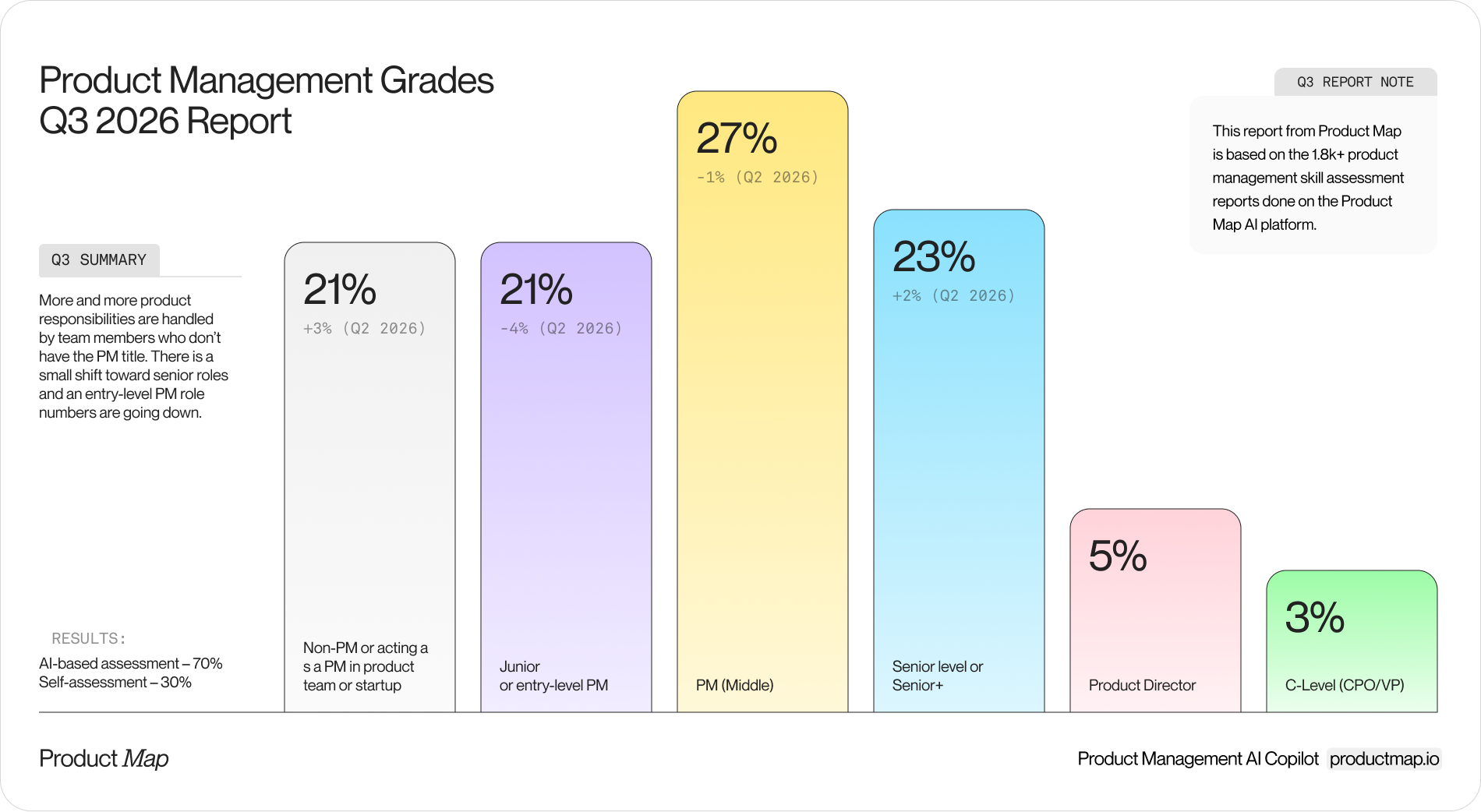
The mix shifted from Q2. Middle PMs still lead at 27% (down 1 point), but senior and senior+ PMs rose to 23% (+2), while junior and entry-level PMs dropped to 21% (−4). Non-PMs or people acting as PMs in a product team or startup now match entry-level PMs at 21% (+3). Product directors represent 5% of reports; C-level product leaders (CPO or VP) account for 3%.
More product responsibilities are landing on people without a PM title, while entry-level PM numbers are going down and senior roles are inching up.
Two of those numbers move together: non-PMs rose 3 points while entry-level PMs dropped 4. Product work keeps landing on people who never had it in their role description, and the entry-level decline lines up with what hiring data has shown all year: companies are cutting the bottom rung of the PM ladder and expecting engineers, designers, or founders to cover the gap.
One note on method: 70% of reports came from the AI-based assessment, which scores open-question answers, and 30% from self-assessment.
Analytics leads the skill groups, people development lags
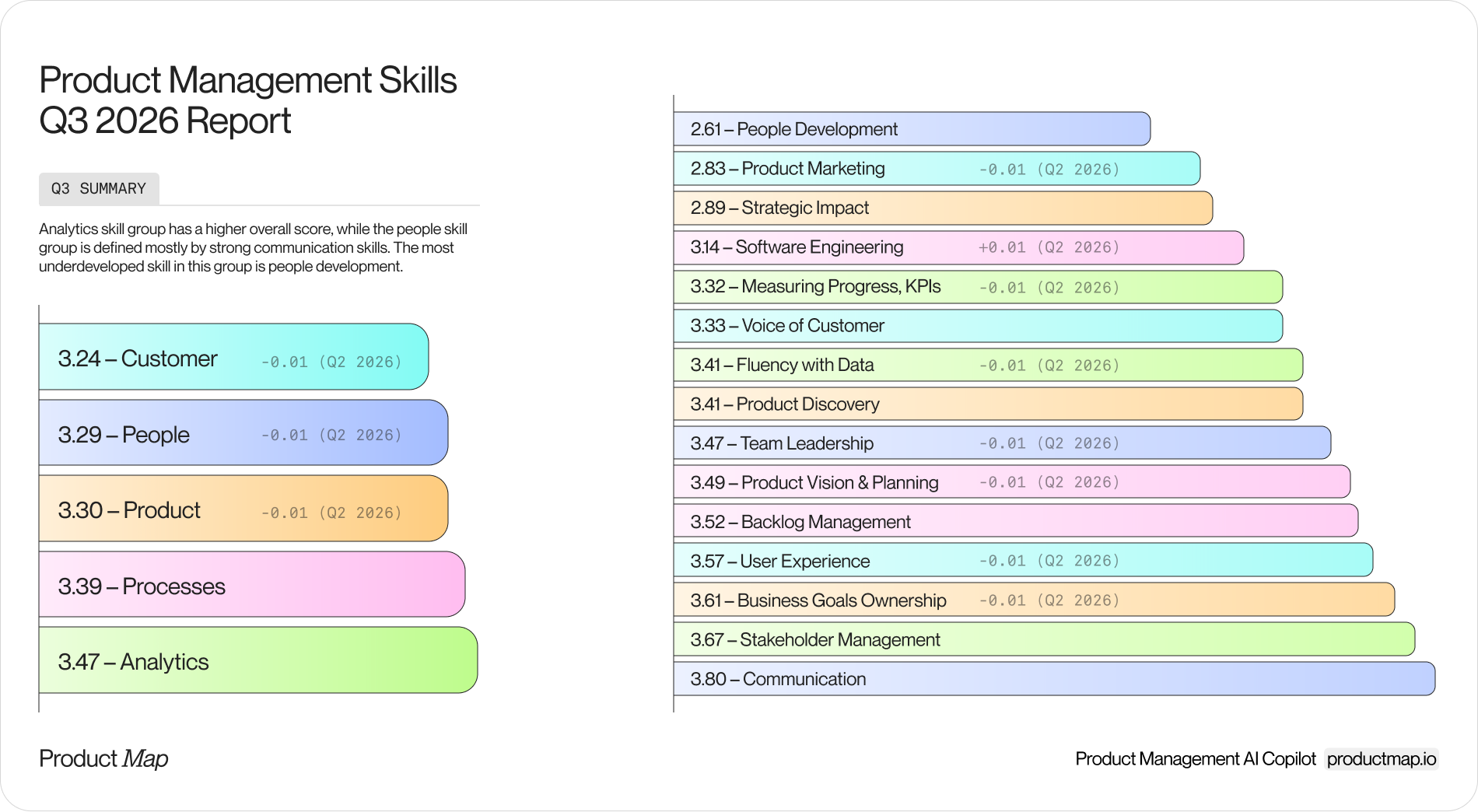
Among the five groups, Analytics averages highest at 3.47 out of 5. Processes sits at 3.39, Product at 3.30, People at 3.29, and Customer last at 3.24. On average, PMs read metrics more confidently than they read customers.
Individual skills stretch the range further. Communication leads at 3.80, then stakeholder management at 3.67 and business goals ownership at 3.61. The bottom three are people development at 2.61, product marketing at 2.83, and strategic impact at 2.89.
Communication (3.80) and people development (2.61) sit more than a full point apart on a five-point scale.
The People group hides the steepest internal gap. Its 3.29 average looks fine because communication (3.80) and team leadership (3.47) carry the weight, while people development sits at 2.61. PMs communicate and align well, and rarely develop others, themselves included. If you manage a product team, put that on the next development cycle.
Mid-table scores cover core craft: backlog management at 3.52 and product vision at 3.49, product discovery and fluency with data at 3.41 each, voice of customer at 3.33, and measuring progress with KPIs at 3.32. Software engineering lands at 3.14, still low but gaining weight (+0.01 vs Q2) as more PMs work directly in repositories.
Where overall PM scores land
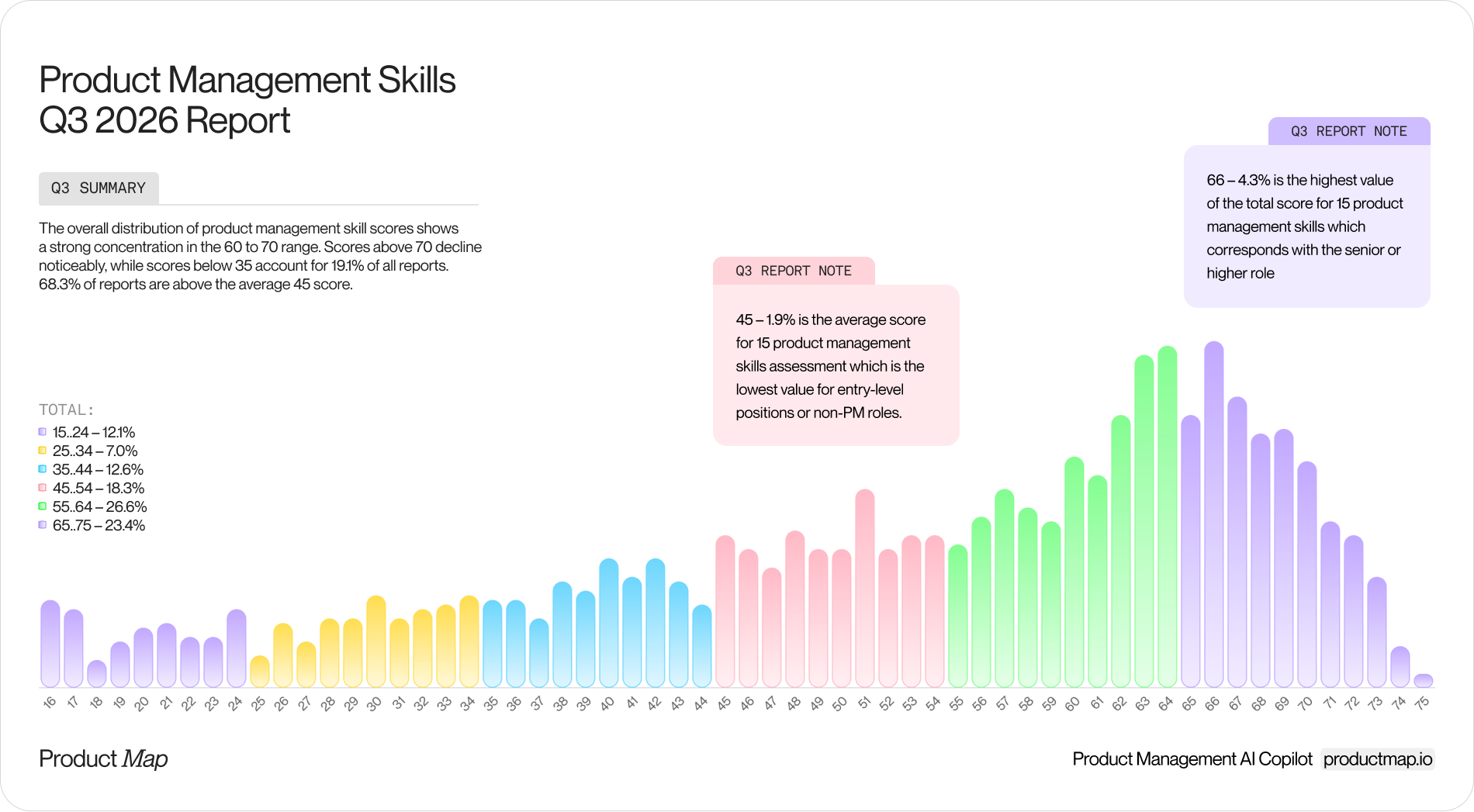
Total scores cluster mainly in the 60 to 70 range out of 100. The 55 to 64 band holds 26.6% of reports; the 65 to 75 band adds another 23.4%. Scores above 70 drop off quickly. The most frequent individual score is 66, at 4.3% of all reports.
The lower tail counts too. Reports below 35 points represent 19.1% of the total, split between the 15 to 24 band (12.1%) and the 25 to 34 band (7.0%). At the same time, 68.3% of reports exceed the 45-point average.
A score of 45 is the floor for entry-level or non-PM roles in this dataset. Above 66 puts you in senior-or-higher territory, where the distribution peaks. For hiring, that lower tail means roughly one in five people doing product work today would score below 35 on a structured assessment, and a job title will not surface it.
The topics PMs studied most
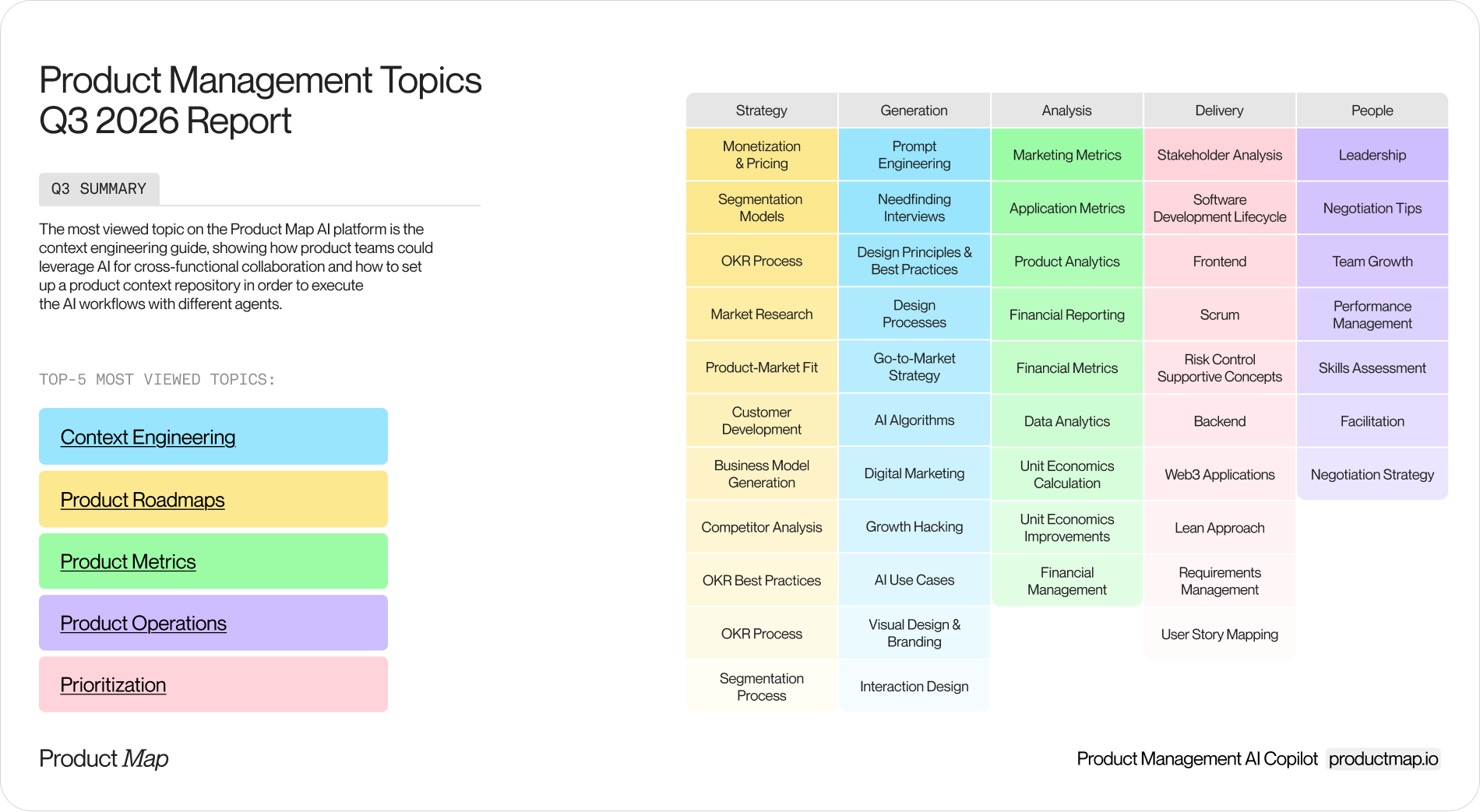
Reports link to the Product Map topic catalog, which shows what people opened after reviewing their results. The five most viewed topics this quarter:
- Context engineering
- Product roadmaps
- Product metrics
- Product operations
- Prioritization
Context engineering at number one is the clearest shift in the dataset. PMs are studying how to set up a product context repository and run AI workflows across agents, and that topic beat every traditional PM subject in the catalog.
The rest of the list is classic on purpose. Roadmaps, metrics, and prioritization are where a weak assessment score shows up fastest in daily work.
Across the full catalog, views spread across strategy (segmentation models, OKR process), generation (needfinding interviews, go-to-market strategy), analysis (product analytics, unit economics), delivery (stakeholder analysis), and people (leadership, negotiation).
Five skill requirements for the 2026 product job
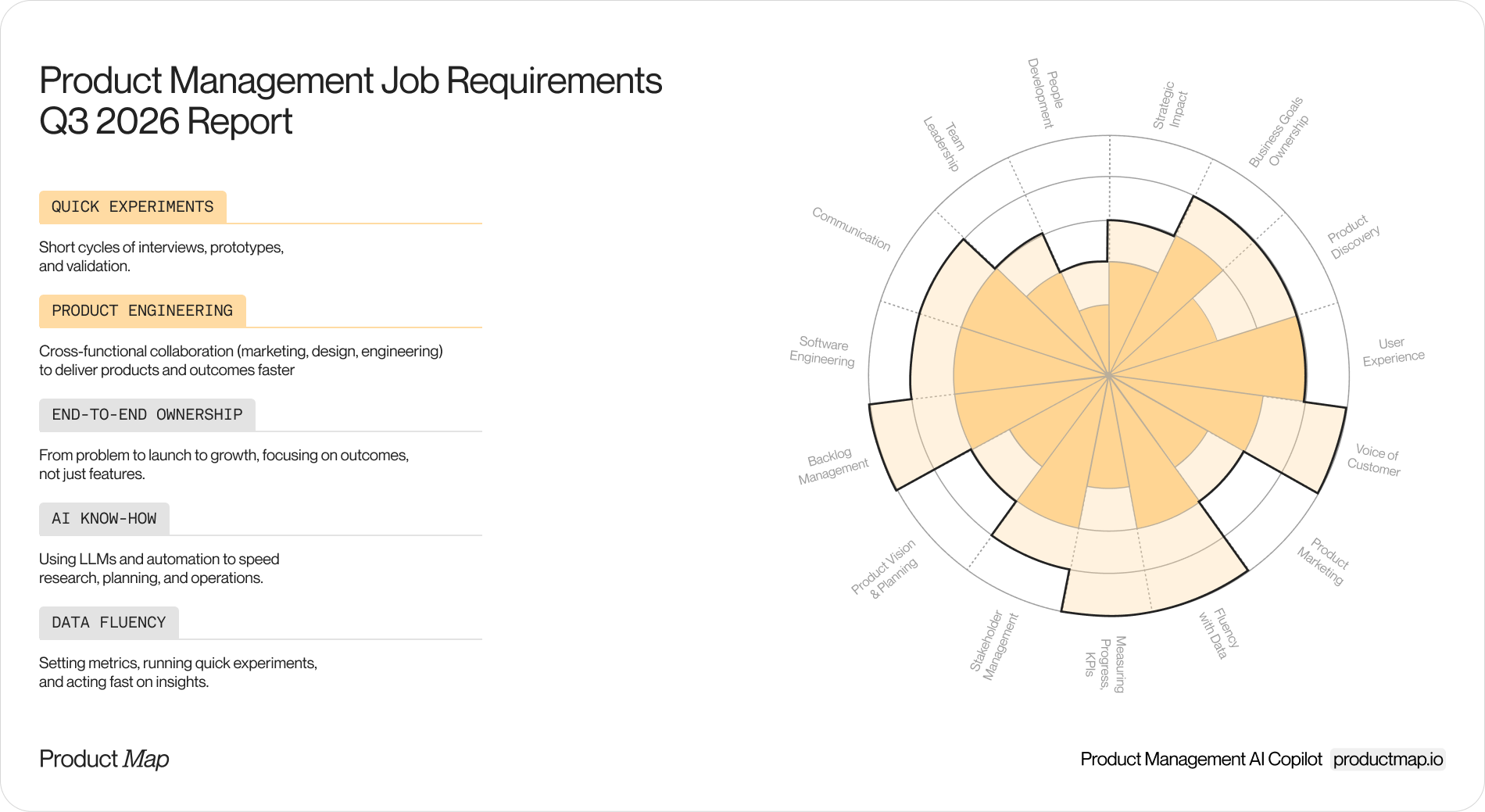
Skill scores and topic demand point to the same five requirements:
- Quick experiments: run interviews and prototypes in short cycles, not as an annual research project.
- Product engineering: work across marketing, design, and engineering to ship outcomes faster.
- End-to-end ownership: take the problem through launch and growth, and treat outcomes as the unit of work.
- AI know-how: use LLMs and automation on research, planning, and ops work. That demand is why context engineering sits at number one.
- Data fluency: set metrics, run the experiment, and act on the result without waiting for an analyst.
The three lowest-scoring skills this quarter (people development, product marketing, and strategic impact) sit furthest from what job postings now ask for. Demand moved toward the capabilities the field scores worst on, which is one reason the PM job market is sorting, not shrinking.
What the data means for the PM role
The PM title is no longer the boundary of product work: a fifth of assessments now come from people doing the job without the title. The middle of the curve is crowded, so a 66 makes you typical.
Communication and stakeholder management no longer differentiate anyone, while strategic impact, product marketing, and people development decide who gets the senior roles the market is adding.
That flips the usual development advice. Polishing communication from 3.8 toward 4.2 moves you inside a crowd. Lifting strategic impact from 2.9 toward 3.5 moves you out of it. The scarce skills stay scarce because daily delivery work does not practice them. Nobody assigns a ticket to develop a person or reposition the product. You have to schedule that work.
A play for each of the three weakest skills:
- Strategic impact (2.89): write a one-page strategy memo for your product area each quarter: the bet, the tradeoff you are accepting, and the metric it should move. Share it with your director and ask where they disagree. Two cycles of this beats any strategy course.
- Product marketing (2.83): own the next launch narrative end to end: positioning, messaging, and the announcement. Do not hand it off to marketing. One real go-to-market cycle teaches segmentation and messaging faster than reading about it.
- People development (2.61): pick one person (a junior PM, a designer moving toward product, or an engineer covering PM work) and run a monthly growth conversation with a written plan. Managers get this on their scorecard; senior ICs rarely do, which is exactly why the score is 2.61.
Moves by career stage
Where you sit changes which of these numbers matters. Find your stage and run that move this quarter.
- Non-PM doing product work (21% of reports): your competition scores 45 or below, so the bar is lower than the title makes it look. Take the assessment, confirm you clear 45, then close the vocabulary gap: prioritization and product metrics turn work you already do into evidence a hiring manager recognizes.
- Junior or entry-level PM (21%): your rung lost 4 points of share this quarter. Aim to move your total score past 55 within two quarters, and build AI know-how now. Context engineering is the one top-five topic where juniors and seniors start from the same line.
- Middle PM (27%): you are the crowd at the 66 peak. Differentiate on a scarce skill, not a strong one: pick strategic impact or product marketing and run the plays above. A middle PM at 3.5 on strategic impact reads as senior in an interview, whatever the title says.
- Senior PM and above (23%): the +2 shift means more competition at your level. People development at 2.61 is the open lane; a senior PM who demonstrably grows others is the profile directors get promoted from.
- Product directors and C-level (8%): assess the team, not yourself. If your team mirrors the benchmark, you have strong communicators who cannot yet own strategy or grow people. A team-level skills matrix will show which gap costs you more this year.
How the AI PM assessment works
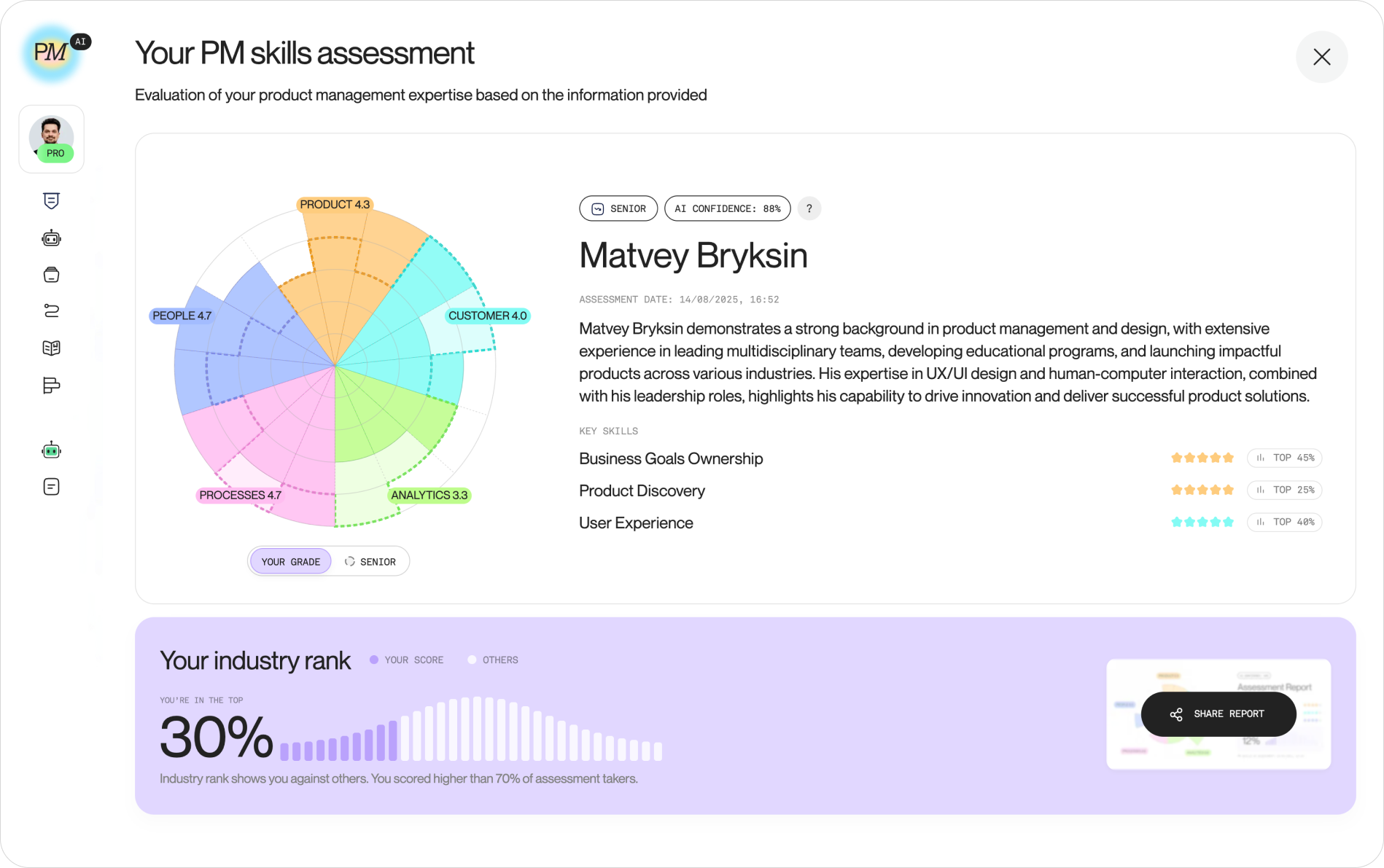
On Product Map AI platform you upload your product management experience and the AI scores you against topics for all 15 product management skills. You receive a personal report: a total score out of 100, per-skill ratings on the same five-point scale used here, and catalog topics matched to your weakest areas.
That recommendation step feeds the topic data in this report. Someone finishes, sees people development at 2.4 or product marketing at 2.7, and opens a topic. Next quarter, a retake shifts the benchmark.
What to do with these numbers
Take the assessment, put your per-skill scores beside the benchmarks above, and pick the skill where you lag the average by the widest gap. Work that one skill this quarter, then retake in Q4 to see whether it moved.
Product leaders can run the same play at team scale. Assess the group, compare the profile to the five requirements above, and put development budget on the skills the market is hiring for. The next edition publishes after Q4 closes, with a new set of benchmarks to compare against.
Compare with the 2025 report
The annual edition, Product Management 2025 in Review, analyzes 1,500+ Product Map assessments from 2025 and tracks how PM skills and trends moved across that year. Read it beside the numbers above to separate the gaps that are a year old from the ones that opened this quarter.
The rest of the Product Map library, including the 15 PM skills guide, sits in the resource hub.