




Strip away the pitch deck, the Notion workspace, and the founder Slack thread. After two months, what actually remains? Code sticks around because Git holds it. Strategy does not. Who you sell to, why you passed on the larger market, what your pricing experiment proved: that knowledge sits in people's heads, splintered across tools, or vanishes entirely.
Startups at the earliest stage deliver two products, though founders usually track only one. The visible product is the application. The other is context: a durable written record of what you are building, who it serves, what you charge, and the reasoning behind those choices.
Context has its own audience. Agents consult it before generating drafts. Investors pull it during diligence. Co-founders read it instead of breaking your focus. Like software, it either ships on purpose, with a backlog and release cadence, or grows into documentation no one trusts.
This playbook frames startup context as a product from day one. It gives you the full stack: a 12-step checklist that accumulates context from idea through go-to-market, the TASK framework for agent workflows on top of it, a free repo template you can clone in minutes, and the agent set founders run inside Product Map.
A product whose users are agents, investors, and you
Treating context as a product is not rhetorical. It clears the same bar you would use for the app.
It has users. Before drafting a go-to-market plan, an agent loads icp-b2b.md and positioning.md. Diligence investors want vision, market sizing, unit economics, and interview proof: the same file set. A first hire ramps from the repo rather than three weeks of sync meetings.
It has a backlog. Each unanswered business question is a missing artifact: payer, cost structure, converting channel. The backlog closes one resolved question at a time.
It has releases. Every committed artifact is a shipped increment: versioned in Git, reviewable as a diff. The TASK framework's Knowledge pillar defines the shape: plain-text Markdown and CSV, version-controlled, grouped by product domain, so any LLM can read it and extend it in the next pass. Repo mechanics appear in the Git knowledge repository guide; here the focus is what goes inside a startup repo and in which sequence.
The uncertainty backlog
A day-zero startup is a logo on a pile of open questions. Who feels the pain? How frequently? What do they spend on workarounds today? Which segment converts first? What price survives contact with buyers? Which channel actually works? Each question is risk, and code does not answer any of them.
Writing the answers down serves two purposes. First, de-risking: a validated problem statement or bottom-up market size swaps speculation for evidence. Second, locking decisions in place. A written vision stops the same debate from reopening. An ICP with explicit disqualifiers keeps a bad-fit customer from hijacking the roadmap in month three. Unwritten answers get rehashed weekly; written ones change only when new data arrives.
Picture an uncertainty burn-down. You begin at peak unknowns. Each artifact removes one. By launch, what remains is risk you knowingly accepted, not risk you never surfaced.
.png)
Follow the 12-step checklist from idea to go to market
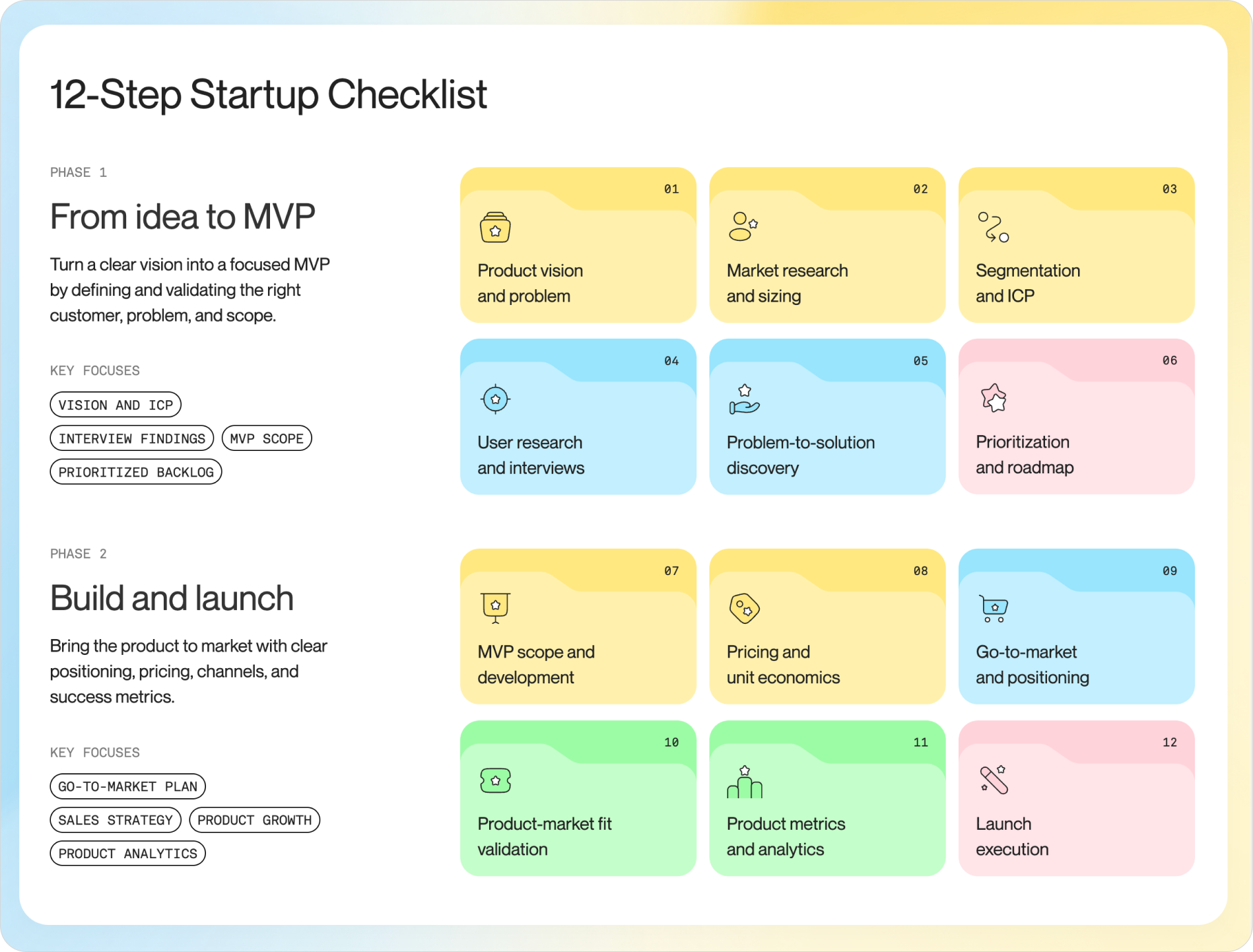
Sequence matters. Segmentation precedes ICP work. Pricing follows once you know the ICP's alternatives. Launch metrics depend on what the MVP is meant to test. The startup product launch checklist orders those dependencies into 12 steps across two phases; each step lists the artifacts it produces.
Phase one spans idea to MVP. Vision and problem hypothesis yield product-vision.md and problem-statement.md. Market research adds market-sizing.md and competitor-matrix.md. Segmentation picks a beachhead and an icp-card.md with hard disqualifiers. Ten to fifteen interviews in that segment become evidence-backed problem-statements.md; prioritization ends the phase with a scored backlog.md and a Now/Next/Later roadmap.md.
Phase two moves from build to market. MVP scope with explicit exclusions, pricing.md plus a unit-economics-model.md targeting LTV:CAC above 3:1, positioning.md and a single-channel gtm-strategy.md, instrumented metrics with pre-set launch criteria, then launch-plan.md and a launch-report.md after fourteen days of daily monitoring.
Run end to end, the checklist needs one to two weeks of full-time focus and delivers a launched product, first paying customers, and roughly 30 artifacts. Nothing is speculative documentation. Each file answers the question its step forces you to confront, which keeps the work incremental rather than a blanket docs push.
The TASK loop for founders
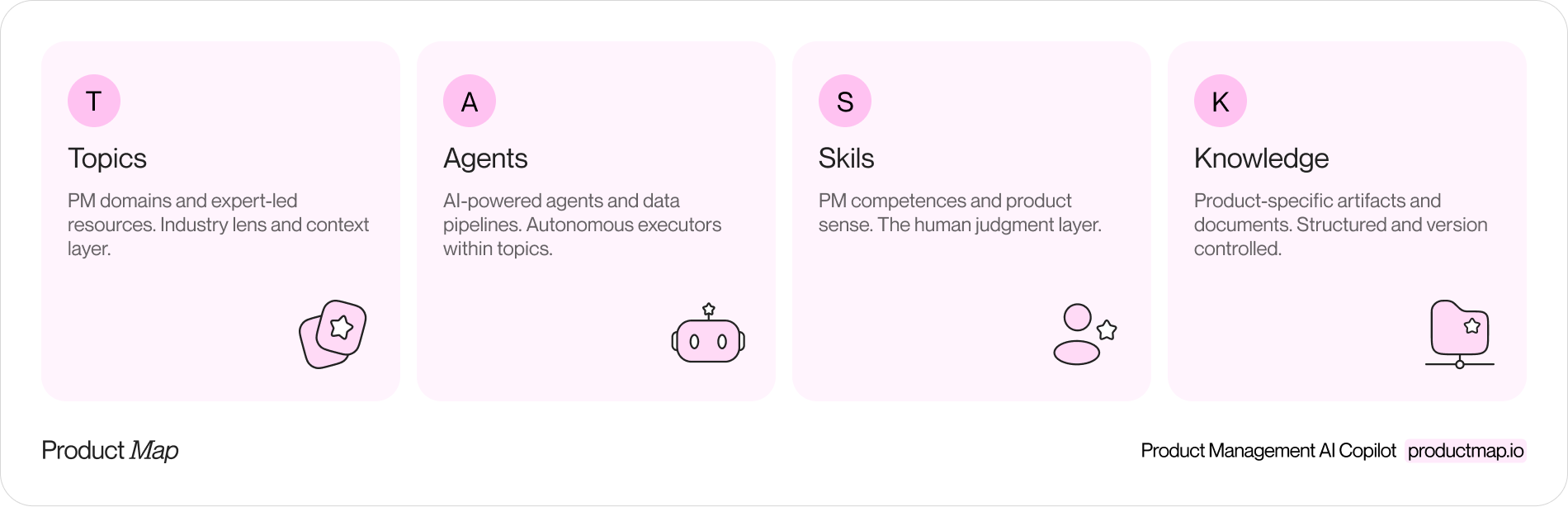
Thirty artifacts sounds heavy for a one- or two-person team. It is not, because you are not the sole author. The TASK framework splits roles: Topics bound the domain an agent works in, Agents produce drafts and analysis, Skills carry human judgment, and Knowledge is the version-controlled output that feeds the next cycle.
The loop looks the same at any scale: pick the topic, assign an agent, apply your judgment to the output, commit the result to the knowledge base. Four TASK ideas matter most early on:
- Founders wear every PM hat without headcount. TASK explicitly targets founders and solo builders for that reason. Agents take research, drafting, and scoring; you hold strategy and taste.
- Structured context unlocks autonomous runs. When topic and knowledge layers are populated, agents need fewer step-by-step prompts. A richer repo means shorter instructions.
- Begin with a single topic. The framework warns against standing up everything at once. Choose this week's domain, seed its folder, run one loop, then expand.
- Speed compounds per cycle. Knowledge stacks. The ICP from step 3 sharpens the interview plan in step 4; both make the step-9 positioning draft almost self-serve.
Start from the template repo
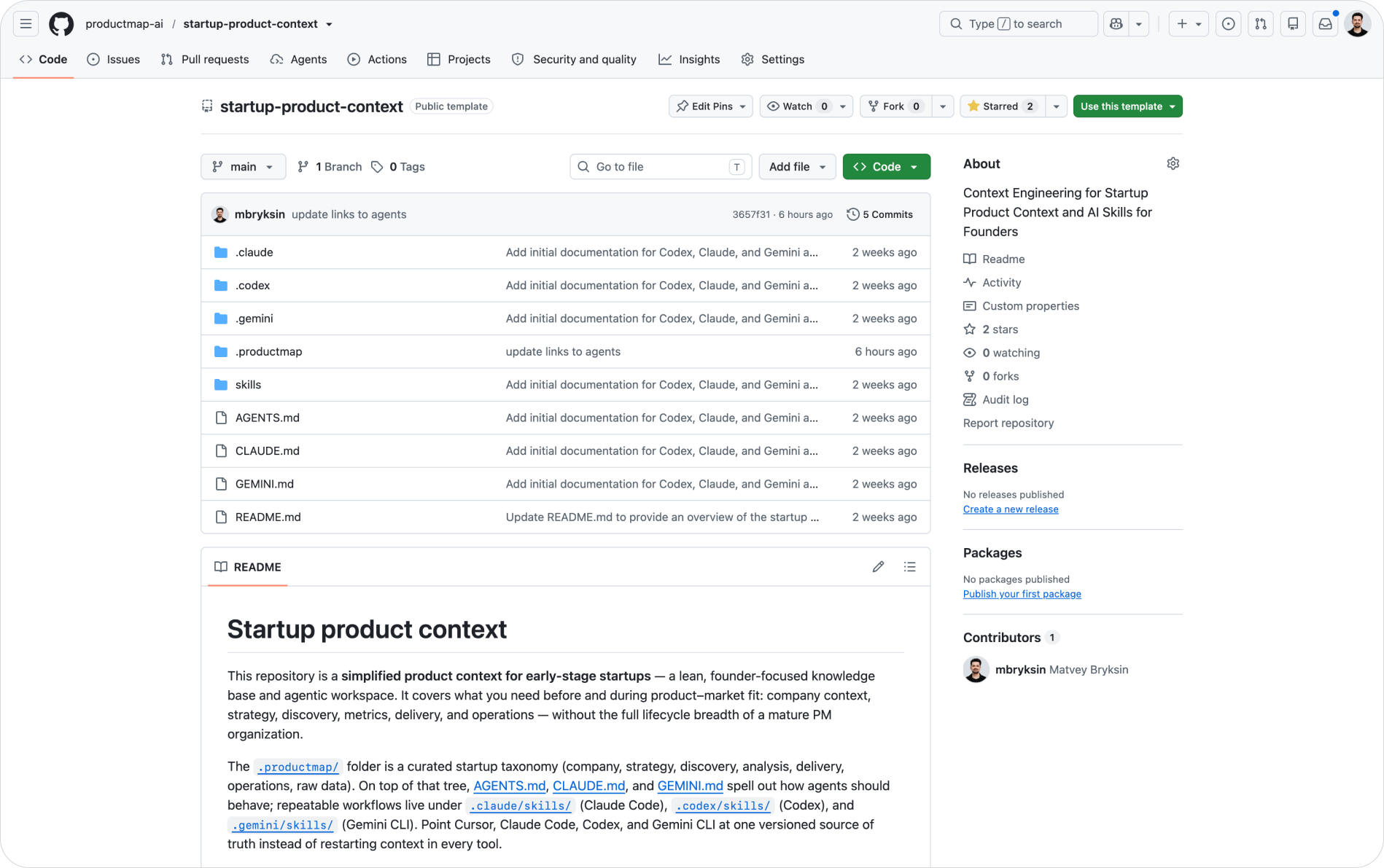
You do not need to invent folder layout. The startup-product-context template on GitHub is a founder-scoped knowledge base: slimmer than enterprise PM taxonomies, with fundraising, legal, and runway tracking baked in where mature orgs store that elsewhere. Hit "Use this template" and the structure is yours:
.productmap/
├── INDEX.md                          # agents read this first
├── 00_company/
│   ├── team.md
│   ├── resources.md
│   ├── product/
│   │   ├── onepager.md
│   │   ├── product-vision.md
│   │   └── value-proposition.md
│   └── fundraising/
│       ├── fundraising-strategy.md
│       ├── pitch-deck.md
│       └── investor-pipeline.md
├── 01_strategy/
│   ├── business-model/business-model.md
│   ├── product-market-fit/
│   │   ├── product-market-fit.md
│   │   ├── pmf-signals.md
│   │   └── opportunity-assessment.md
│   ├── competitors/competitor-matrix.md
│   ├── segmentation/
│   │   ├── segmentation.md
│   │   ├── icp-b2b.md
│   │   └── icp-b2c.md
│   └── mvp-roadmap/roadmap.md
├── 02_discovery/
│   ├── user-research/
│   │   ├── user-research.md
│   │   ├── problem-framing.md
│   │   └── interview-guide.md
│   ├── experiments/experiments.md
│   ├── design-ux/design-ux.md
│   ├── marketing/
│   │   ├── marketing.md
│   │   └── gtm-launch.md
│   └── growth-sales/
│       ├── growth-sales.md
│       └── founder-led-sales.md
├── 03_analysis/
│   ├── kpis-metrics/
│   │   ├── kpis-metrics.md
│   │   └── metrics-tracking.md
│   ├── analytics/analytics.md
│   └── unit-economics/unit-economics.md
├── 04_delivery/
│   ├── backlog-requirements/
│   │   ├── backlog.md
│   │   └── prioritization.md
│   └── development/development.md
├── 05_operations/
│   ├── finance/
│   │   ├── finance.md
│   │   ├── runway-burn.md
│   │   └── financial-model.md
│   └── legal/
│       ├── incorporation.md
│       ├── founder-agreements.md
│       ├── ip-and-contracts.md
│       └── privacy-compliance.md
└── 06_data/
    ├── analytics/
    ├── interviews/
    ├── feedback/
    └── research/
Three template choices carry most of the load. INDEX.md routes traffic: a "For agents" preamble tells models where each answer type lives, so an agent reaches runway-burn.md without scanning the tree. Numbered folders follow the product lifecycle, mapping almost one-to-one onto the 12 checklist steps. 06_data/ holds raw inputs (interview transcripts, survey exports, metric dumps), separate from curated knowledge, so agents default to synthesized files and pull sources only when needed.
Each file arrives as a structured template with placeholders and a suggested agent to fill it. Even an empty file with correct headings has value: it flags the open question for you and your agents.
Open the repo in Product Map and put agents to work
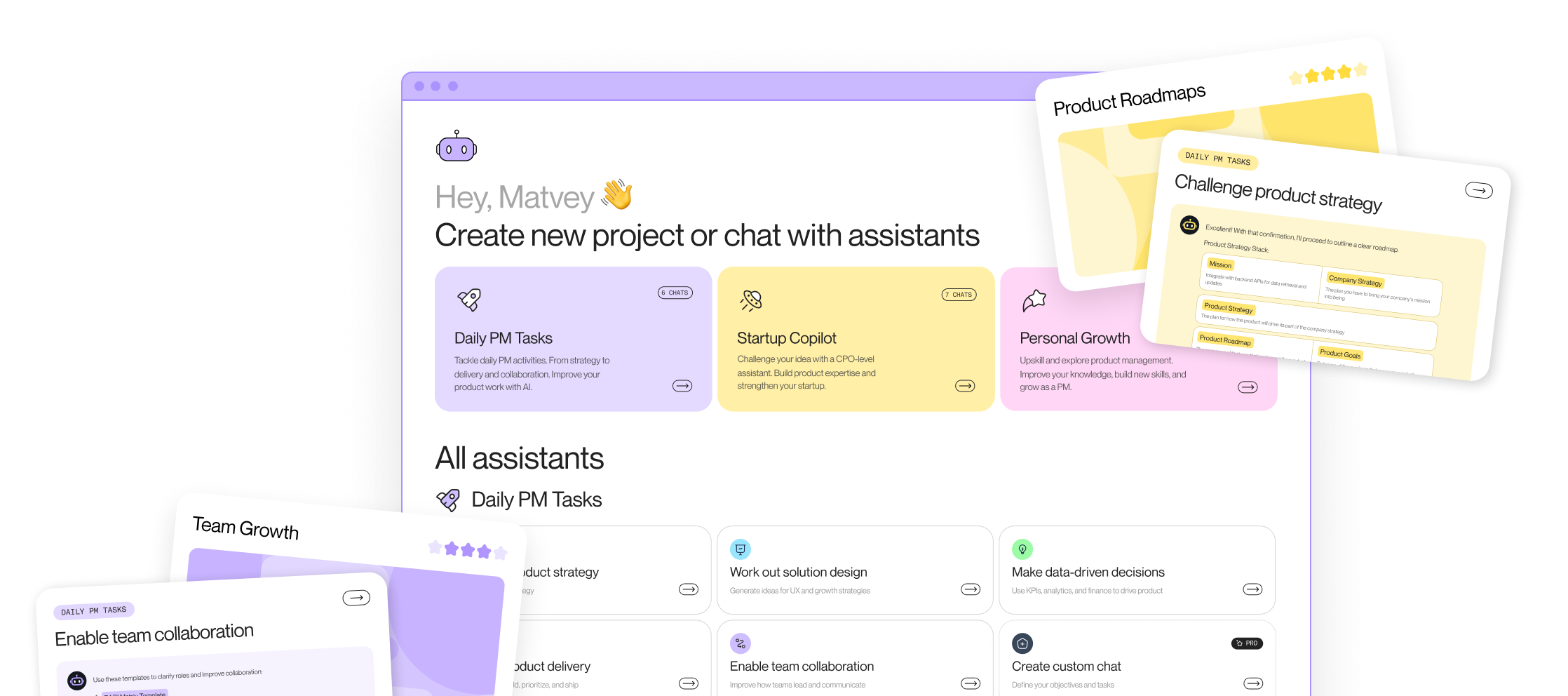
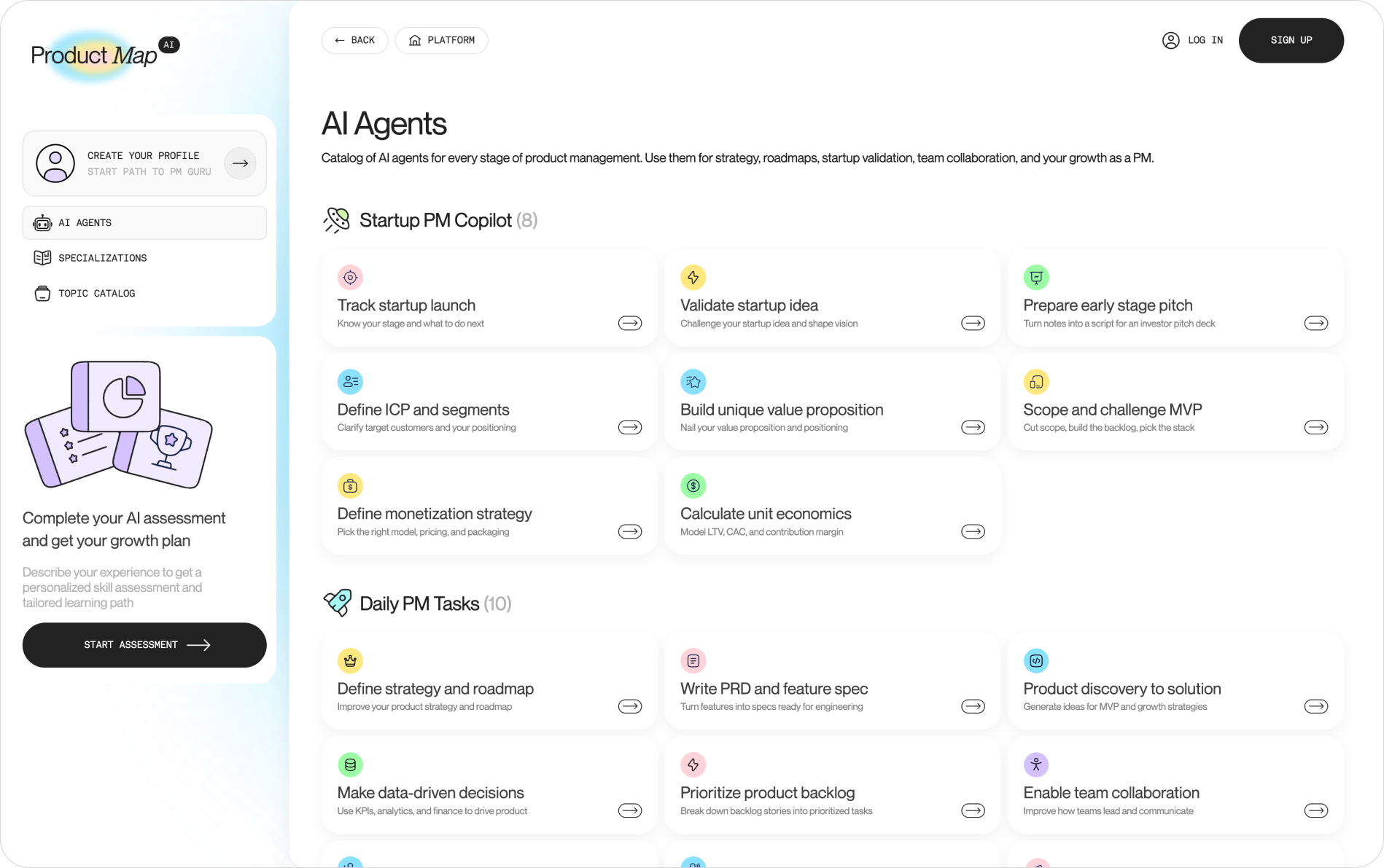
Once agents can read and write the repo, it becomes an operating system. Create a project in Product Map, choose the Startup Copilot workspace, and connect GitHub; the screen-by-screen setup guide covers the flow. After that, every run is grounded in your files: the interview planner pulls your ICP, the pricing agent reads your competitor matrix, and proposed edits arrive as diffs you approve before they hit main.
That review gate is where treating context as a product pays off. Nothing lands in the knowledge base without review, which mirrors production discipline. Solo founders can accept commits directly on the branch; add a co-founder and the same path opens pull requests.
The founder agent stack
The agent catalog spans the full PM lifecycle, but idea-to-launch startups rely on a narrower set. Run them in checklist order; each agent writes back into the repo so the next one starts with more context:
- Pressure-test the idea: Validate startup idea stress-tests assumptions and risks before build, updating
problem-framing.mdand your riskiest-assumptions list. - Pick the beachhead: Define ICP and segments builds the ideal customer profile and populates
segmentation.mdplus the ICP files. - Plan discovery: Plan customer interviews produces a question plan with follow-ups in
interview-guide.md. - Move from problem to solution: Product discovery to solution generates and ranks solution ideas against the core job.
- Rank the work: Prioritize product backlog scores items into
backlog.mdandprioritization.md. - Check the business works: Calculate unit economics models LTV, CAC, and margin from minimal inputs into
unit-economics.md. - Set launch metrics: Make data-driven decisions defines a north star and builds the KPI tree in
kpis-metrics.md. - Raise on evidence: Pre-seed investor pitch assembles an early-stage fundraising narrative in
pitch-deck.mdfrom artifacts you already wrote.
The final agent is the quiet win. Checklist artifacts map directly to investor asks: vision, ICP, interview findings, unit economics, launch metrics. You do not block time to "write the deck." You compile it from evidence already in Git.
The blind spot: stale context is worse than no context
Here is the failure mode founders rarely hear about. Empty context makes an agent ask clarifying questions. Outdated context makes it wrong with confidence.
Imagine pivoting the beachhead from agencies to in-house teams after a rough interview week. You revise segmentation.md and keep building. Meanwhile icp-b2b.md, positioning.md, and founder-led-sales.md still describe agencies. Next week the GTM agent drafts outreach for a segment you left, and cites your repo as proof. The copy reads rigorous; the substance is obsolete.
Three habits stop context rot and take minutes:
- Update in the same session as the decision. A pivot finishes when every affected file reflects it, not when the decision is made. Grep for the old segment name before you shut the laptop.
- Route every change through a diff. Reviewing agent proposals catches cases where an older file silently overrules a newer pivot.
- Delete what is dead. A rejected market, abandoned pricing model, or killed feature: capture reasoning in a decision note if needed, then remove the stale file. Pruned context cannot mislead agents.
Product discipline applies here too. Products get maintained, deprecated, and versioned. Docs often get written once and abandoned. These habits decide which fate your context meets, not good intentions alone.
Write it while it's fresh
Building product context from day one is far easier than assembling it later. Each artifact takes minutes to write while the decision is fresh. Reconstructing the same context months later means digging through old docs, chats, and memory.
That checklist closing line states the thesis in three sentences. Capture pricing.md the night a price test ends: ten minutes. Rebuild pricing logic six months later for diligence: a weekend, and still half wrong.
Start smaller than pride allows. Clone the template, open step one of the checklist, and draft the vision one-pager tonight. Tomorrow an agent reads it and proposes your interview plan. By launch you will have shipped two products, and the second is what made the first coherent.