




49 buys a PM operating system in 2026. The listing promises a hub file revised more than 100 times, 41 skills, seven reviewer sub-agents, and templates for launches, roadmaps, OKRs, and retros. A second vendor claims 231 skills. Four open GitHub repositories give the same category away.
Put them side by side, and the surprise is how alike they are. Every one ships the same five parts: a hub file the agent reads first, a context library about the product, templates for recurring documents, a decision log, and routines the agent runs unprompted.
The file names change. SOUL.md here, CLAUDE.md there. The anatomy stays.
Product Map runs on the same five parts. The difference is where they come from. The files in the public product-management-context repository were generated from a product, not written for sale. This article takes the anatomy apart and ends with the call every head of product faces this year: buy the kit, build your own, or generate the folder.
Five parts every kit ships
The kits compared here are Aakash Gupta's PM OS (paid, February 2026), agentmart/pm-os, satyapavan1/ai-pm-os, aakashg/pm-claude-code-setup, and prodmgmt.world's AI PM OS, plus the Product Map repository.
- Hub file: the file the agent reads at the start of every session. It's
CLAUDE.mdin Aakash Gupta's kit and in pm-claude-code-setup, aCLAUDE.mdplusSOUL.mdpair in agentmart/pm-os, andAGENTS.mdat prodmgmt.world. The Product Map repo carries three:CLAUDE.md,AGENTS.md, andGEMINI.md, each a page long and pointing at the same index. - Context library: what the product is, who buys it, what the strategy rules out. agentmart/pm-os keeps six files. Product Map keeps 66 Markdown files in 11 numbered folders under
.productmap/, with anINDEX.mdthe hub file imports. The state of the art article covers the layout. - Templates: the shape of a PRD, an experiment card, a decision record. Aakash Gupta's kit sells templates for launches, roadmaps, OKRs, and retros. pm-claude-code-setup ships four. Product Map keeps 11 under
09_templates, and every context file in the tree is a template until someone fills it. - Decision log: agentmart/pm-os ships
decision-template.mdand adecision-log/folder. prodmgmt.world's entries carry context, options, decision, evidence, and a revisit trigger. Product Map keeps a log table under05_people/communication/and an ADR template. - Routines: work the agent repeats. Skills in every kit (6, 14, 41, or 231, depending on who is counting), plus hooks and scheduled routines in agentmart/pm-os. The Product Map repo holds 30 skills, ten each for Claude Code, Codex, and Gemini CLI, one
SKILL.mdper recurring PM job.
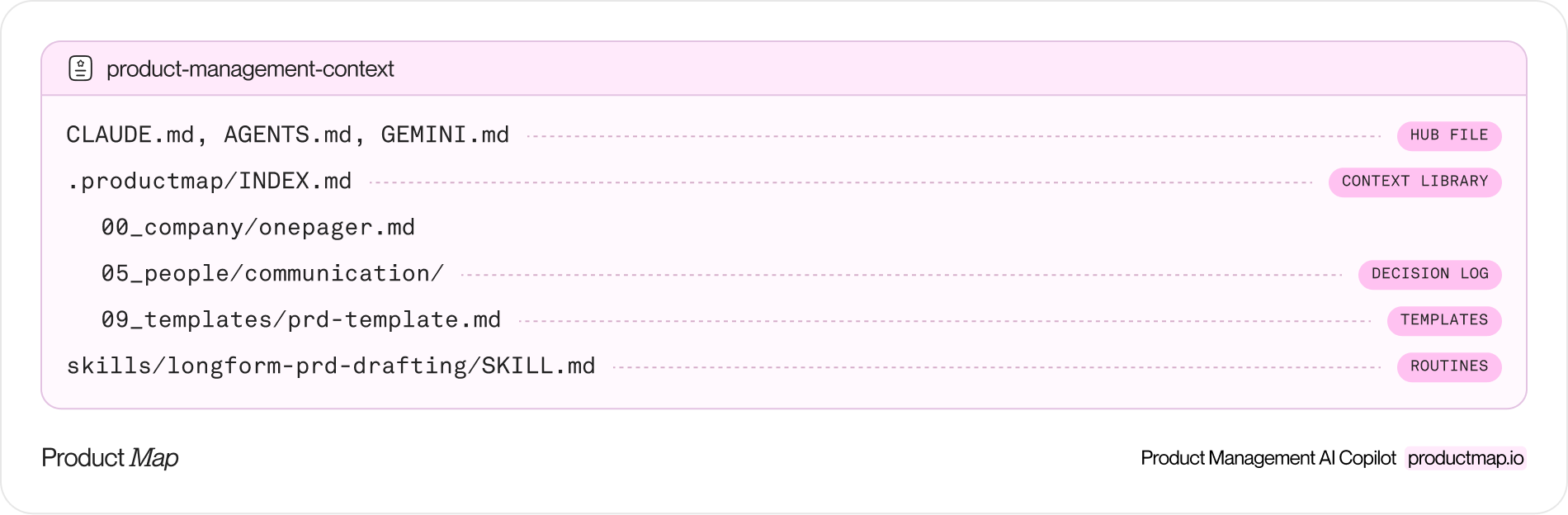
A PM operating system is a folder with five jobs. Every kit on sale in 2026 agrees on the jobs and disagrees on the file names.
What each of the five files does on an ordinary Tuesday
Tuesday, 9:40. A product manager asks the agent for a spec on usage-based alerts.
- The hub file tells the agent how to behave: read
INDEX.mdfirst, use the templates, write the output under04_delivery, use absolute dates. Twenty lines. Zero product facts. - The context library tells it what is true. The agent opens
onepager.mdandicp-b2b.mdand learns the buyer is a head of product at a 200- to 1,000-person SaaS company, and the product stays out of Jira's way. The spec's audience section comes from two files. - The template sets the shape.
prd-template.mdfixes the headings: goals and non-goals, flows, edge cases, analytics, acceptance criteria. Two PMs produce specs with the same sections, so engineers read both the same way. - The decision log tells it what was already decided. The agent proposes per-seat pricing for the alerts add-on. A March entry says per-seat was rejected because the agent collapses seat counts, with a revisit trigger: automated resolution under 30 percent of tickets. The agent cites the entry and drops the proposal. Without the log, the team re-argues pricing every session.
- The routine does the work nobody asked for today. At 10:00, a scheduled skill reruns the competitor diff and appends two pricing changes to
competitor-matrix.md. The next spec reads a file an hour old.
Each part answers one question for the agent: how to behave, what is true, what shape to produce, what was decided, and what to do unprompted. Merge two parts into one file, and both go stale faster, because every edit to one is an edit to the other. The Context Engineering topic covers the split between instructions and knowledge.
Where the kits differ and why it matters less than it looks
Aakash Gupta's kit has seven reviewer sub-agents critiquing a draft from different seats. agentmart/pm-os runs hooks when a file changes. prodmgmt.world routes work between GitHub Copilot and Claude Code.
All of this is the runner layer. It decides how the agent is run, not what it knows. Swap Claude Code for Codex and the sub-agents need rewriting. The five files survive the swap.
The Product Map template set differs in the files themselves, in three ways you can check in the repository.
- Each context file names the agent that fills it. 24 of the 66 files end with a section such as "fill in this file with the Define strategy and roadmap agent," with the link scoped to your project.
- The placeholders teach. The set holds 224 fill-in prompts, and they say what good looks like: "generic 'anyone who...' descriptions are not useful."
- Two families, one version marker. A product company gets 66 files. A startup gets 41, trading the delivery process and tool lists for fundraising, legal, and runway. Every generated file carries a marker naming the template version it came from, so a later upgrade diffs against your edits instead of overwriting them.
Buy, build, or generate: decide by team size and stage
The hub file is the part buyers pay for and the part worth the least. A CLAUDE.md revised 100 times encodes 100 decisions about someone else's product: their definition of a good PRD, their review seats, their tone. Install it, and your agent inherits a stranger's judgment with none of the context behind it. The Meetless stale-context benchmark showed what agents do with confident text they can't check: ten models trusted a stale summary and read zero files.
The decision is which of the five parts you produce yourself and which you take from someone else.
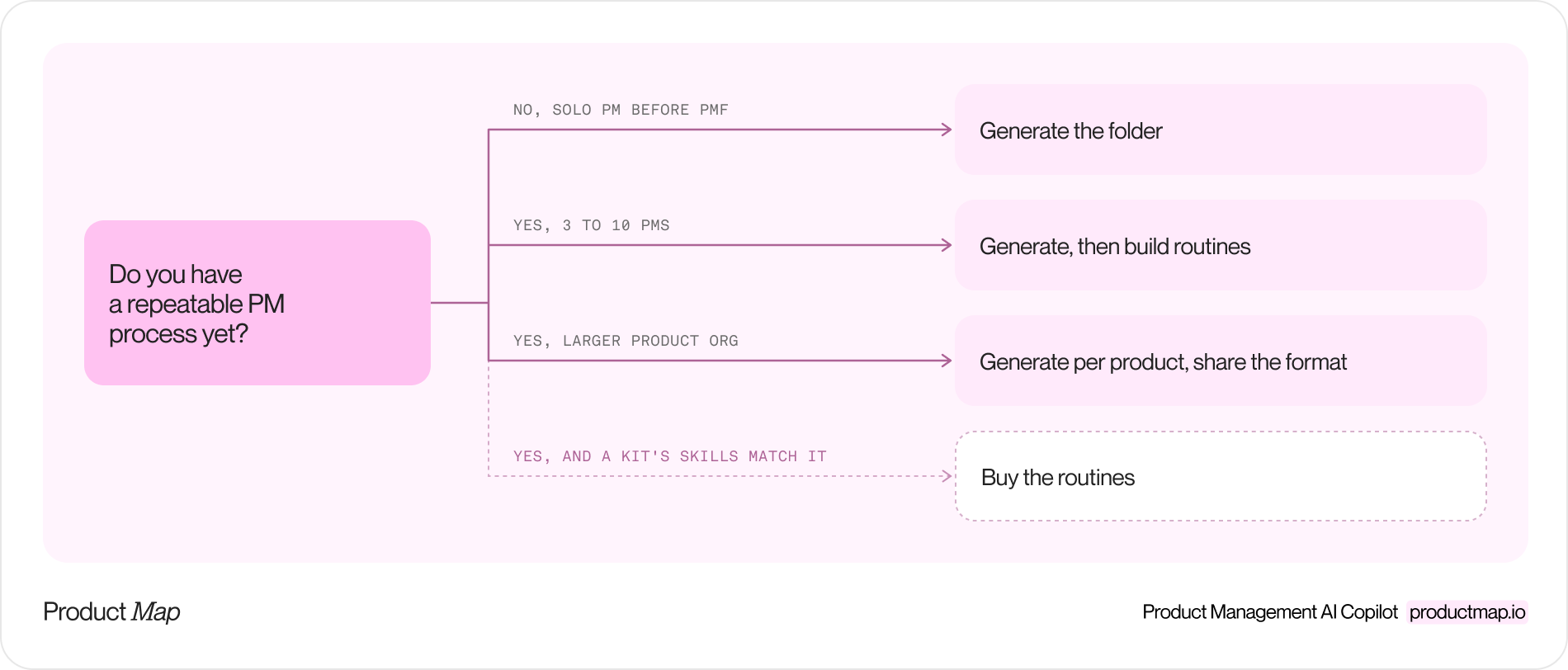
- Solo PM or founder before product-market fit: generate. You don't have a process to encode yet. Point a generator at your website, review the one-pager, and spend the afternoon on the ICP. Pay for nothing until a routine has repeated three weeks running.
- Team of three to ten PMs: generate, then build the routines. The folder comes from the product. The skills come from your review habits. Fork one public skill per recurring job and edit it until its steps cite your files.
- Larger product org: generate per product, share the format. One hub file written by committee for twelve products is the kit problem rebuilt in-house. Generate a folder per product and standardize the decision-record format, the template headings, and the index.
- When to buy: a kit earns its price when its sub-agents or skills match a process you already run, and you will fork them within a week. Buy routines. Never buy context.
The cadence around the folder, reviews, refresh days, and ownership, is the Product Operations topic.
Set it up in one afternoon
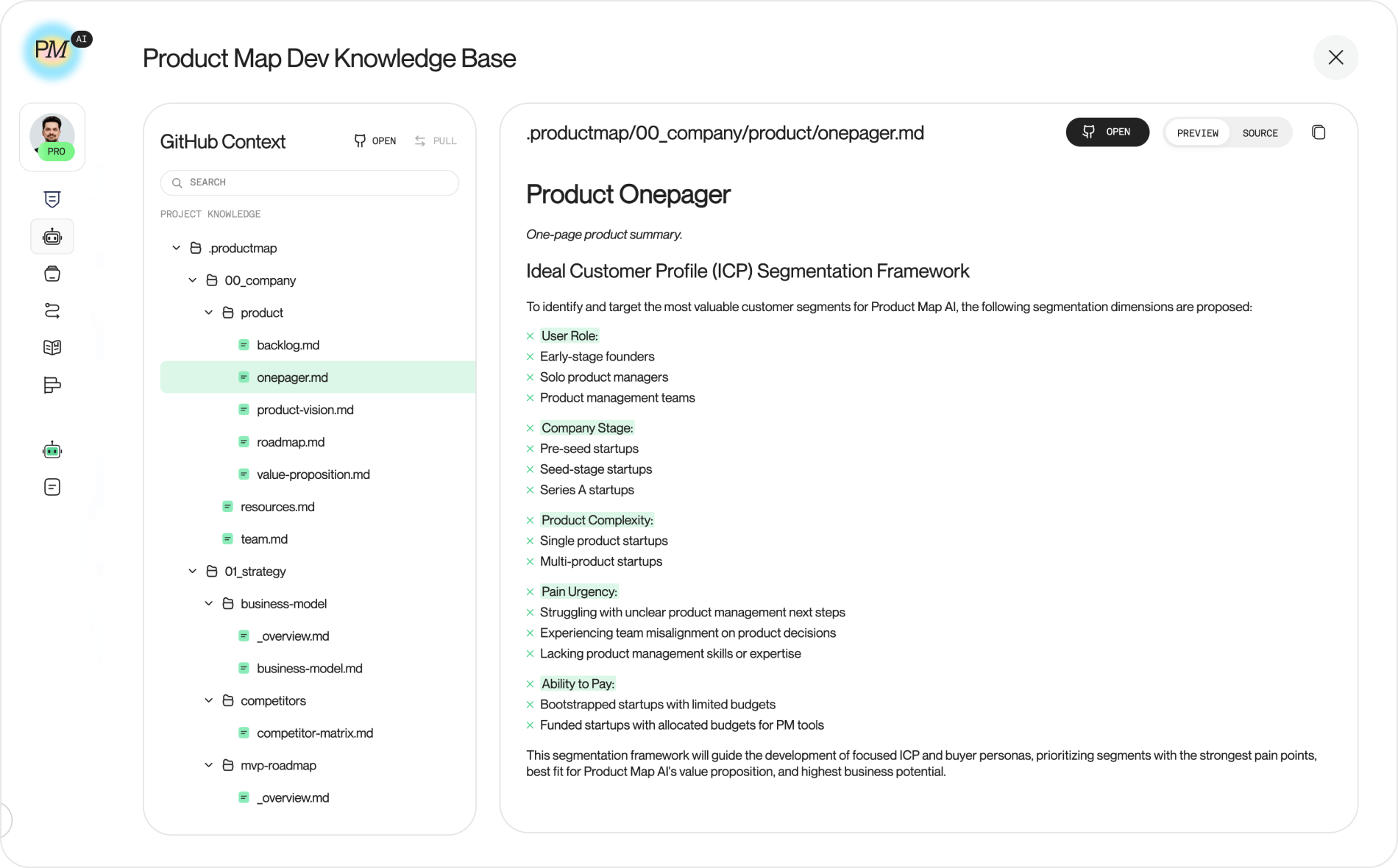
- Generate the context. In Product Map, create a project, type your domain into the generate from website field, and correct the extraction. This is the one point where you fix the AI's read of your product before it seeds everything else. Connect a GitHub, GitLab, Bitbucket, or Azure Repos repository, and the
.productmap/tree lands as a commit. The repo setup guide has the screens. Without the platform, copy the public repository. - Fill in the two files; everything reads.
onepager.mdand the ICP. Every downstream agent opens these first. - Add the two templates you'll use this month. For most teams, the PRD and the decision record. Leave the other nine in place.
- Write one decision record for a call made this month, with its revisit trigger. The agent starts citing it the same day.
- Write one routine. Pick a job you did by hand last week, a competitor diff or feedback clustering, and turn it into a
SKILL.mdwhose steps point at your files. - Trim the hub file to a page. The index pointer, the templates rule, the output folder, absolute dates, and the short list of actions the agent may never take. Everything else belongs in the context library.
Delete what goes stale first
Generated folders arrive complete, and complete is the problem. Four kinds of file decay within weeks.
- Link inventories and tool lists.
resources.mdand the files under07_tools/change monthly. An agent recommending a tool from a file last edited in March is confidently wrong. Keep the five tools you use. - Summaries of other files. A "current state" paragraph in the hub file duplicates the one-pager and loses the race within a month. The hub file points. It never summarizes.
- Decisions without a revisit trigger. A decision nobody can reopen on a condition becomes a permanent accident. Add the trigger or archive the entry.
- Routines that haven't run in 90 days. A skills folder is a dependency list with no owner. If a skill hasn't fired this quarter, remove it. Git remembers.
One rule covers all four. If no agent has read a file and no person has edited it in 90 days, archive it under 10_data or delete it.
Own the folder, rent the rest
The kits will keep multiplying, because the category is real. A PM with these five parts in a repository gets a different agent than a PM with a chat window. But the parts are cheap to produce from your own product and expensive to inherit from someone else's. Generate the folder this week. Fork the one routine you need. Read every hub file on sale as a reading list, and treat your own repository as the product.
FAQ about the PM operating system
What is the Product Map PM OS?
It's the five parts above, generated from your product instead of written for sale. You get a .productmap/ folder of 66 context files for a product company or 41 for a startup, 11 templates, a decision record format, hub files for Claude Code, Codex, and Gemini CLI, and 30 skills. The 26 agents in the Product Map catalog fill the files and write back to the same folder.
What does the Product Map PM operating system cost?
The two public repositories, product-management-context and startup-product-context, cost nothing. Clone one and start filling placeholders. Generating the folder from your website and keeping it in sync with a git repository is part of the Pro plan on the pricing page, with an Enterprise plan for shared, versioned context across a whole team.
How does it differ from the $49 kits sold this year?
A kit ships the author's hub file and routines. Product Map ships your context and keeps the hub file at a page. The three differences you can check in the repository are the agent section at the bottom of 24 context files, the 224 placeholders describing what good looks like, and the version marker in every generated file.
Which coding agents and editors can read the folder?
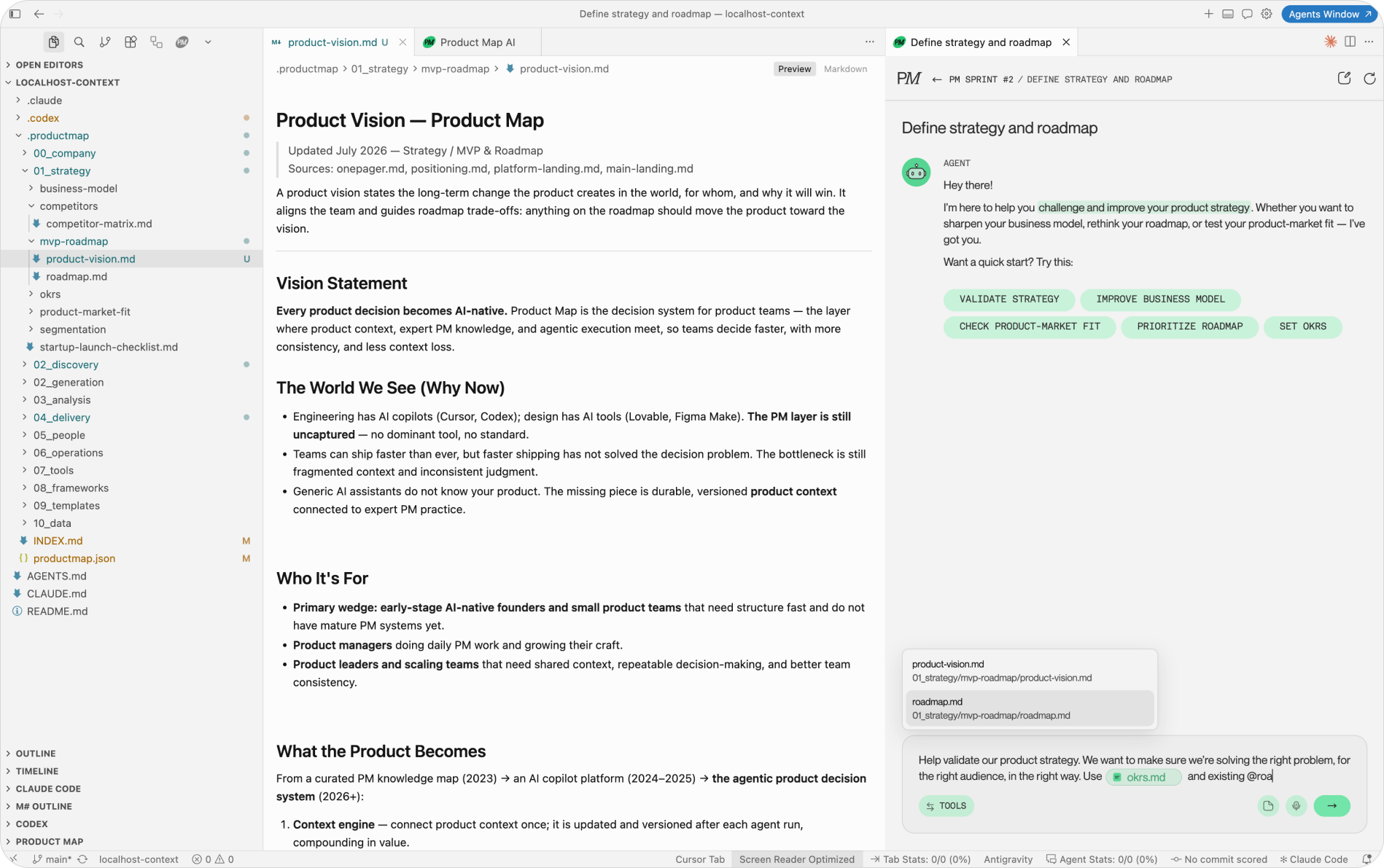
Claude Code, Codex, and Gemini CLI read it through their hub files. Cursor, VS Code, and Antigravity get the agents in the sidebar through the Product Map plugin, next to GitHub Copilot in the same workspace. The repository can live on GitHub, GitLab, Bitbucket, or Azure Repos.
Does the folder work without a Product Map account?
Yes. The files are plain Markdown, so any agent or any person can fill them. Without the platform, you give up three parts: generation from your website, the agent linked at the bottom of each context file, and the upgrade that diffs a new template version against your edits.
What happens to my edits when the templates change?
Every generated file names the template version it came from. An upgrade reads the marker, diffs the new template against your copy, and lands as a commit you review before merging. Your edits stay. Treat the diff like a pull request from a colleague.
Does the PM OS replace Jira, Notion, or Confluence?
No. The folder is the context layer agents read before they propose anything. Tickets stay in Jira, and pages stay in your wiki, and Product Map connects to Jira and Confluence and to Microsoft 365 and Teams so the agents read those sources too.
How long does setup take?
One afternoon, following the six steps above. Generation itself takes minutes. The hours go into correcting the AI's read of your product, the ICP, and your first decision record.