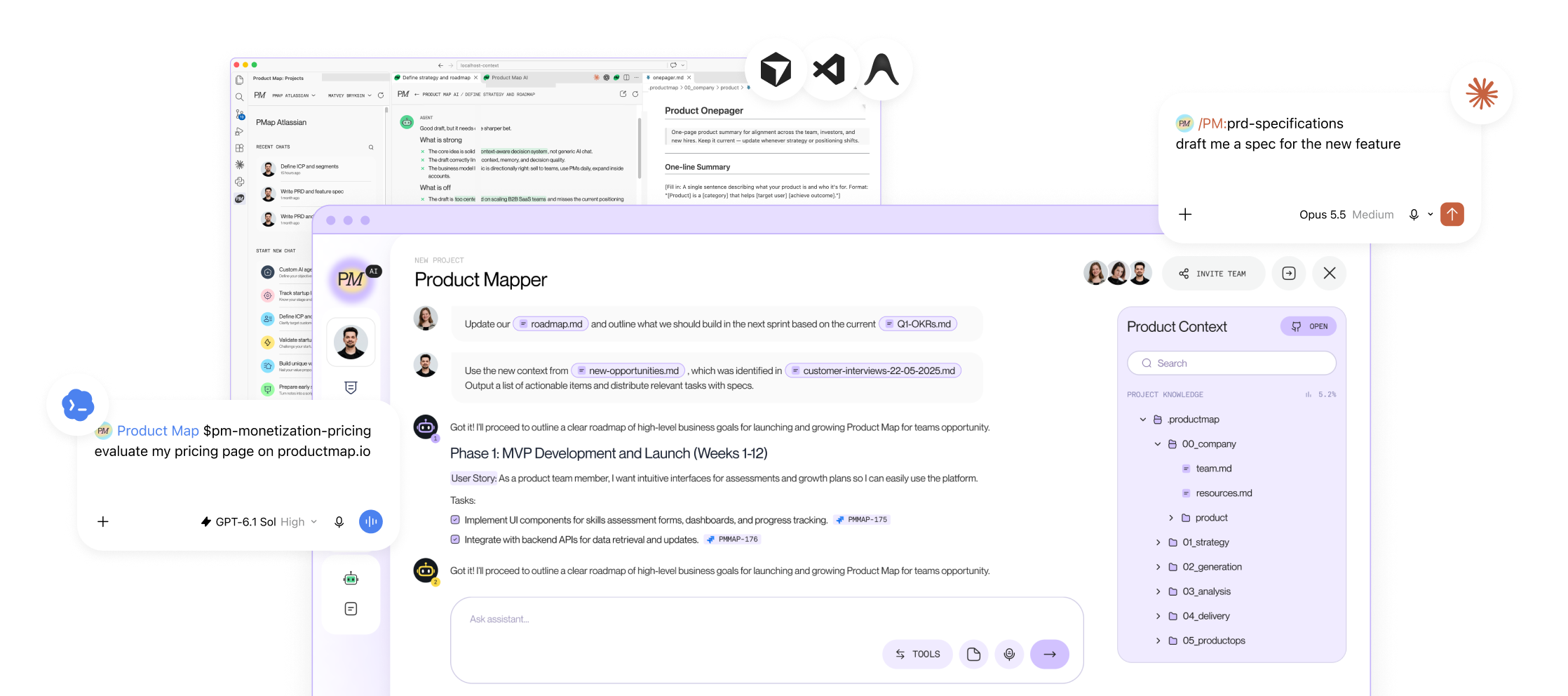


Jess Yan is a product manager on Claude Managed Agents at Anthropic, and her April 2026 account of the job contains one line engineers will recognize: "we build with what we ship." Her API designs used to live in documents and comment threads. Specs read well on paper and broke the moment someone built against them. Now she prototypes an agent against a pre-production spec in Claude Code and has a working version by the end of the afternoon. The API design changed several times before launch, each time because the prototype exposed what a doc review would have missed.
That is the agentic era for product managers in one paragraph. The PM builds, tests, and runs the product they used to describe. This playbook sets out how Product Map sees the shift: where AI fits in PM work, the five practices a builder PM runs, and the week they fit into.
From coordinator to builder: where AI fits in PM work
The old PM job was coordination: write the brief, wait for research, design, engineering, and analytics, then write the status update. When AI tripled engineering output, the queues got longer, and the PM became the bottleneck.
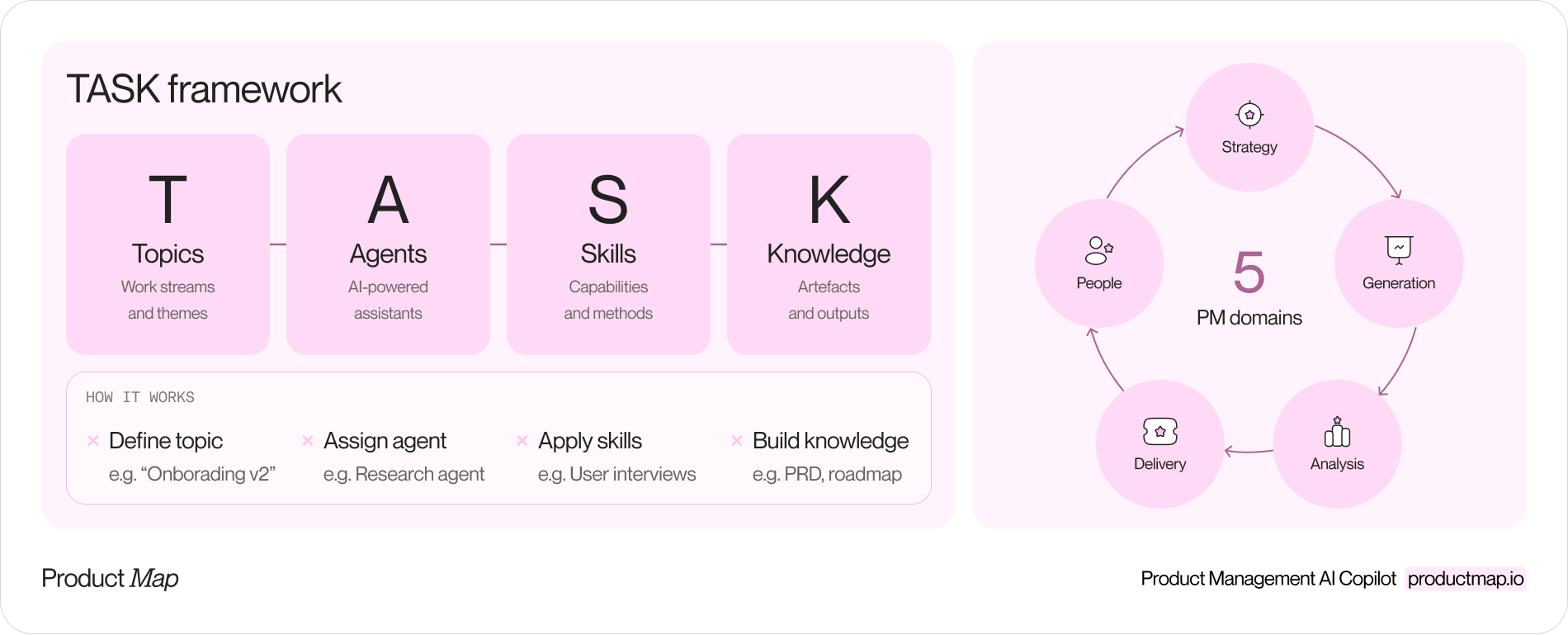
The TASK framework is Product Map's answer to that bottleneck. Every piece of product work runs through one loop: pick a Topic, the PM domain you're in. Assign an Agent scoped to it. Apply your Skills to direct the agent and judge the output. Save the result as Knowledge, a plain-text file the next run reads. Agents do the volume, skills set the bar, and the knowledge base makes each cycle faster.
The loop also answers where AI fits. TASK maps the PM lifecycle to five domains, each with a repeatable process and a named artifact, which is all an agent needs to work without step-by-step instructions.
- Strategy: business model, product-market fit, roadmap, ICP, OKRs. Agents run the competitive analysis and draft the positioning; you make the calls.
- Generation: user research, design, marketing, growth, AI specs. Agents turn raw transcripts and briefs into synthesis and prototypes.
- Analysis: KPIs, analytics, unit economics, finance. Agents produce the evidence: metric definitions, funnel tests, cohort reports.
- Delivery: backlog, process, development, risk. Agents draft requirements and break down epics; you validate scope.
- People: communication, stakeholders, negotiation, talent. Agents draft the plans; you keep the relationships.
A 10x product manager writes no more documents than before. They run the first pass of every domain themselves instead of waiting on two of them. The five practices below are those first passes. Ownership comes with them: when you ran the interviews and built the prototype, the decision is yours to defend, and so is the outcome.
Run synthetic interviews before you book a real one
A synthetic interview is a conversation with an AI persona built from your ideal customer profile, your support tickets, and your past transcripts. Stanford and Google DeepMind built a thousand agents from two-hour interviews and matched human survey answers at 85 percent. The synthetic interviews article goes into what the number hides: the agents reproduce what is already written down about your users and miss what nobody has written yet.
So the practice is a rehearsal, never a substitute. The workflow takes a morning.
- Build three personas from
icp.md, the last quarter of support tickets, and any real transcripts. - Run five synthetic sessions against your draft interview guide. Watch for questions the persona answers in a sentence. Those are leading questions.
- Rewrite the guide. Cut the questions with obvious answers, add probes where the persona got vague.
- Book five real interviews with the revised guide. Log where the humans surprised you.
One rule keeps the practice honest: a synthetic quote never appears in a deck as evidence. It appears in the research plan as a hypothesis.
Build the prototype in an afternoon, write the spec from it
Product Map's position on prototypes is short: the prototype is the first artifact of the Generation domain, and the spec is written from it, never before it. A spec written first describes a guess. A spec written after describes what three users did on Thursday.
Every agent on the Product Map platform started this way. The PRD, ICP, and unit economics agents each ran first as a Claude Code skill against the team's own context repository, and shipped only after the skill had produced a Markdown file somebody acted on in a real planning cycle. The prototype was the spec.
- The user-testable flow: a clickable version of the feature, built in Lovable, v0, or Claude Code from the one-pager and a screenshot of the current screen. Put it in front of three users on Tuesday instead of three stakeholders on Thursday.
- The internal tool: the feedback tagger, the weekly metrics digest, the release note drafter. Each is a backlog item engineering was never going to reach, and each becomes an agent in your catalog.
- The API or agent shape: when the product is an agent, prototype it against the real context files in Claude Code or Cursor and run it on last week's inputs. The flaws show up before any production code exists.
The spec reads differently afterward: what the prototype did, which parts users understood, and which parts engineering should throw away. That kept-or-cut list is the opening section of prd.md, and the PRD agent drafts the rest around it. The ship-the-prototype article covers when the prototype replaces the spec entirely.
A prototype is for learning, never for shipping. Hardening it belongs to engineering, with evals in scope. The PM's job is to arrive with evidence instead of a request.

Challenge the strategy with research and competitor diffs
Strategy documents fail one test more than any other: name a decision the document rules out. Run that test on a schedule, with two instruments from the Strategy domain.
Run a deep research pass on the strategy every quarter
Deep research modes in Claude, ChatGPT, Gemini, and Perplexity produce twenty-minute, multi-source reports with citations. The prompt is adversarial by design: here is product-strategy.md, here is the ICP, find the three assumptions most likely to be wrong by year end and bring sources.
Read every source the report cites before the findings reach a meeting. The output is a one-page memo: three assumptions at risk, with evidence.
Watch competitors every week and ship a diff, not a deck
A competitor analysis starts expiring the moment it's finished. The competitor analysis article sets out the spec, verify, and refresh loop. The builder version runs the refresh as a weekly job: a scheduled agent reads pricing pages, changelogs, app store reviews, G2 ratings, and open roles for five named competitors, then writes what changed since last week into competitor-analysis-matrix.md.
Every entry links to the page where it was read. And the first line answers one question: does anything here change a decision on our roadmap? Most weeks the answer is no, and a no you can show beats a deck nobody opens.
Set up the analytics yourself and read them every morning
In the builder loop the PM writes the tracking plan, runs the queries, and reads the data before the standup. A thin knowledge base shows here first: an agent can't produce evidence from metrics nobody defined.
Three jobs make the practice concrete.
- Write the tracking plan: a CSV with one row per event: name, trigger, properties, and the question it answers. An agent generates the Amplitude or Mixpanel taxonomy and the engineering ticket from it.
- Ask the questions in plain English: Amplitude and Mixpanel both answer "show me week-four retention for users who touched the new onboarding" with a chart. The skill is attaching a decision to the question and writing it down next to the chart.
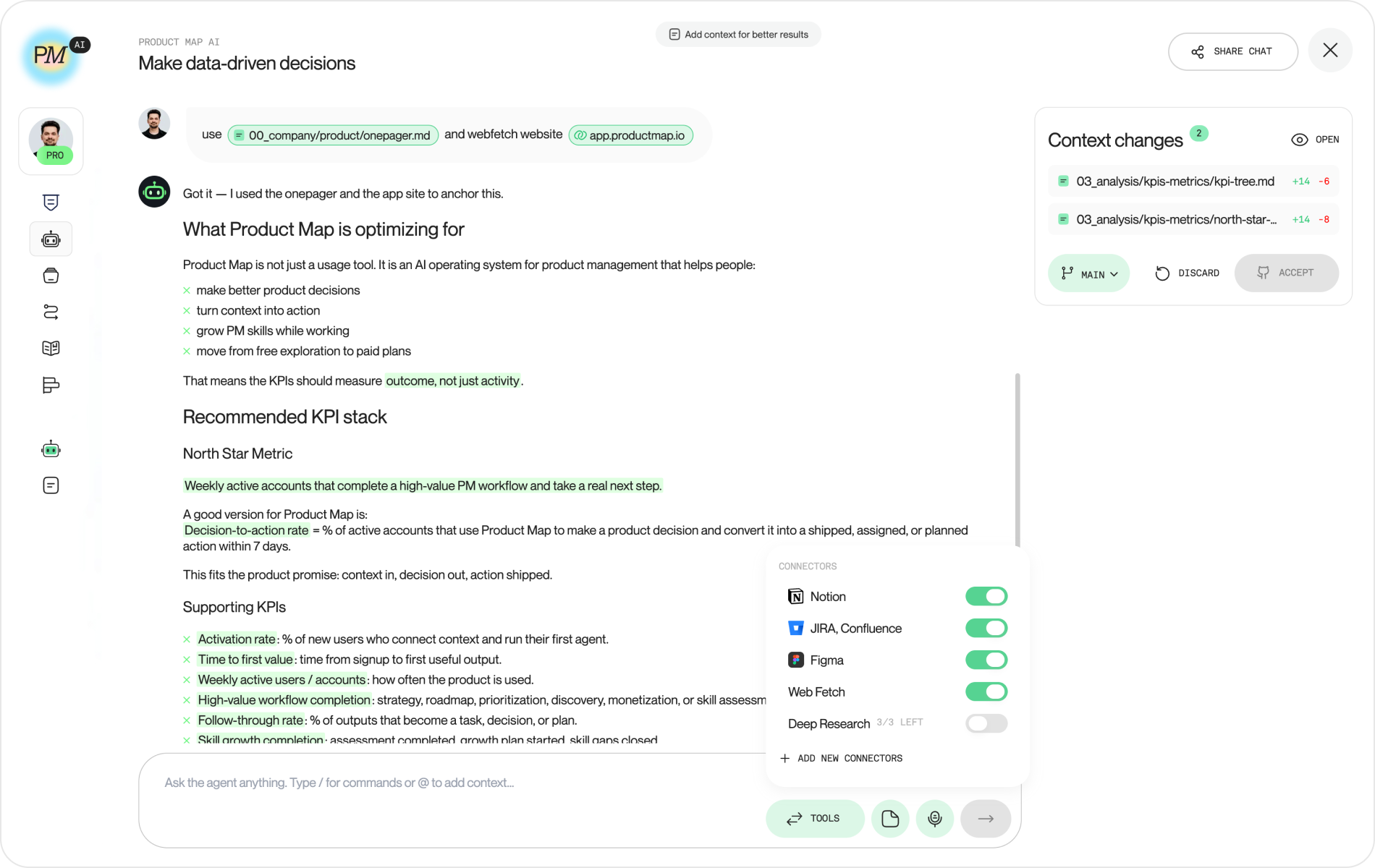
- Run an analytics agent with memory: a scheduled agent reads the metrics file, surfaces outliers, and remembers past runs so each week builds on the last. On Product Map that is Make data-driven product decisions, which returns the decision your metrics support.
For an AI feature, add edit rate, retries, and abandoned answers; the AI product analytics article lists the full set.
The gap heads of product miss: output up, outcomes flat
Product Focus surveyed 677 product people across 40 countries for its 2026 report. Frequent AI use reached 69 percent, up from 49 percent a year earlier. Among those users, 97 percent reported higher personal productivity. Only 64 percent reported better product outcomes.
The cause is structural, and it's the risk in this playbook. A builder PM produces more: more prototypes, research runs, and dashboards. Production is visible and feels like progress, so the deciding gets squeezed. In TASK terms, the team ran Topics, Agents, and Knowledge and skipped Skills. The loop produced artifacts and no decision.
- End every practice in a written decision: the synthetic session ends in a revised guide, the prototype in a kept-or-cut list, the research pass in a three-assumption memo, the competitor diff in a yes or no on the roadmap, the dashboard in a line in
decision-log.md. - Own the outcome of what your agents do: when an agent you built changes a price, a ranking, or a message, the P&L effect is yours. Put a circuit breaker on every agent with write access, and review its log weekly.
The second trap is the mirror image. A PM who builds everything alone becomes the queue they replaced, which is how PMs became the bottleneck once engineering sped up. Run the first pass yourself; hand the repeat to an agent.
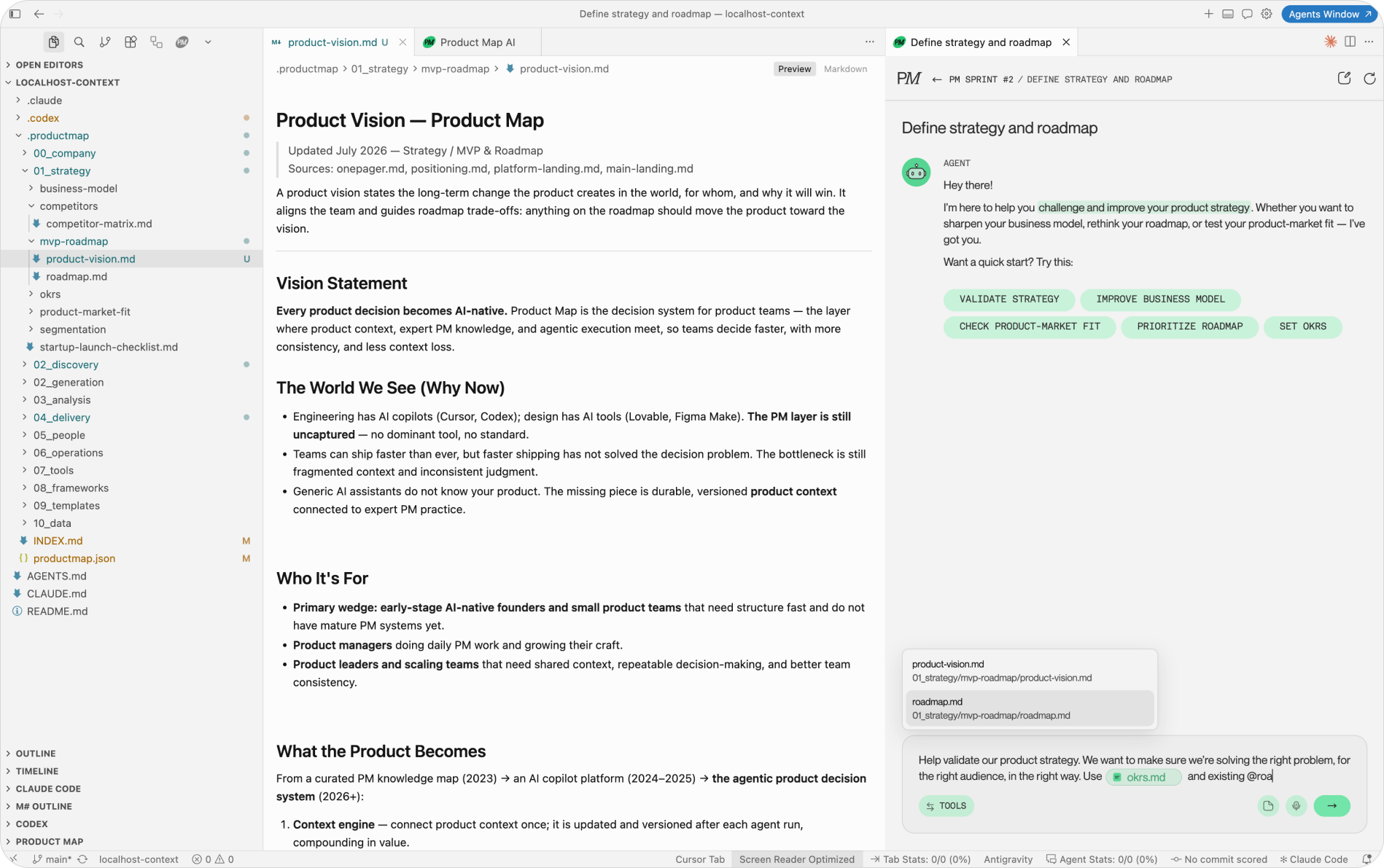
Decisions and agent logs need one home. Keep decision-log.md and the other product files in the repository next to the code, where Cursor, Claude Code, and Codex read them before they build. The Cursor for product managers guide walks through the setup.
The builder PM's week
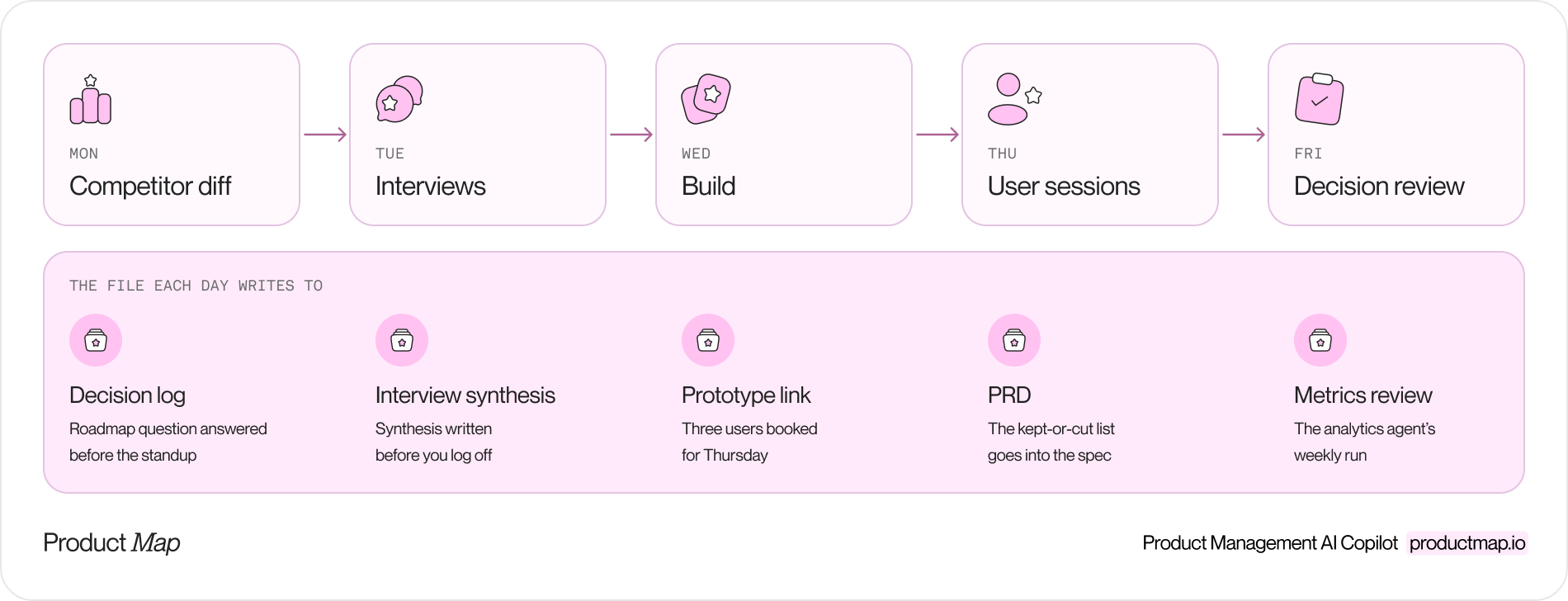
The five practices fit in a week once each has a slot and a file it writes to.
- Monday: read the competitor diff and the weekend's metrics. Answer the roadmap question in the decision log before the standup.
- Tuesday: synthetic rehearsal in the morning, two real interviews in the afternoon, synthesis before you log off.
- Wednesday: build. One prototype, one afternoon, three users booked for Thursday.
- Thursday: user sessions with the prototype, then the kept-or-cut list goes into the spec.
- Friday: decision log review, the analytics agent's weekly run, and one hour turning the task you repeated this week into an agent.
Once a quarter, Thursday becomes the deep research pass, and the memo goes to the review.
None of this needs a new title or a reorg. It needs the PM to run the first pass of work they used to wait for, and to write down what they decided when it came back. The teams closing the 97-to-64 gap are the ones where the second part became a habit.
FAQ
What does AI product management mean in the agentic era?
The PM runs the first pass of work they used to brief out and wait for: interviews, prototypes, strategy checks, competitor tracking, and analytics. Agents do the volume. The PM directs them, judges the output, and owns the decision.
Do product managers need to code to build prototypes?
No. Lovable and v0 turn a one-pager and a screenshot into a clickable flow, and Claude Code and Cursor take instructions in plain language. The skill to practice is reading the result: which parts users understood, and which parts engineering should throw away.
Can synthetic interviews replace real user interviews?
No. A synthetic persona reproduces what's already written down about your users and misses what nobody has recorded yet. Use the sessions to find leading questions and fix the interview guide. Then book real interviews with the revised version.
Why does AI raise PM productivity but not product outcomes?
Output is visible, and the deciding is easy to skip. In the Product Focus 2026 survey, 97 percent of frequent AI users reported higher personal productivity and 64 percent reported better product outcomes. Close the gap by ending every practice in a written decision.
Where should the files from the five practices be stored?
In one Git repository, as Markdown and CSV. Each practice writes to a named file, such as competitor-analysis-matrix.md or prd.md, and the next agent run reads it. PM agents and coding agents then work from the same version. The Git knowledge repository guide covers the setup.