




AI is the least informative word on a product manager resume in 2026. Every candidate has it somewhere. Recruiters stopped reading it as a skill a year ago and now read it as a claim they need evidence for.
That evidence is the whole job of an AI product manager resume. It doesn't have to prove you understand attention heads. What it has to show is a model-backed feature you shipped, measured, and fixed when the model was wrong.
This how-to covers the format, the skills section, a bullet bank for junior and senior candidates, and the ATS keywords that get the file in front of a person.
How an AI PM resume differs from a traditional one
The skeleton is identical: summary, experience, skills, education. What changes is what each section has to prove.
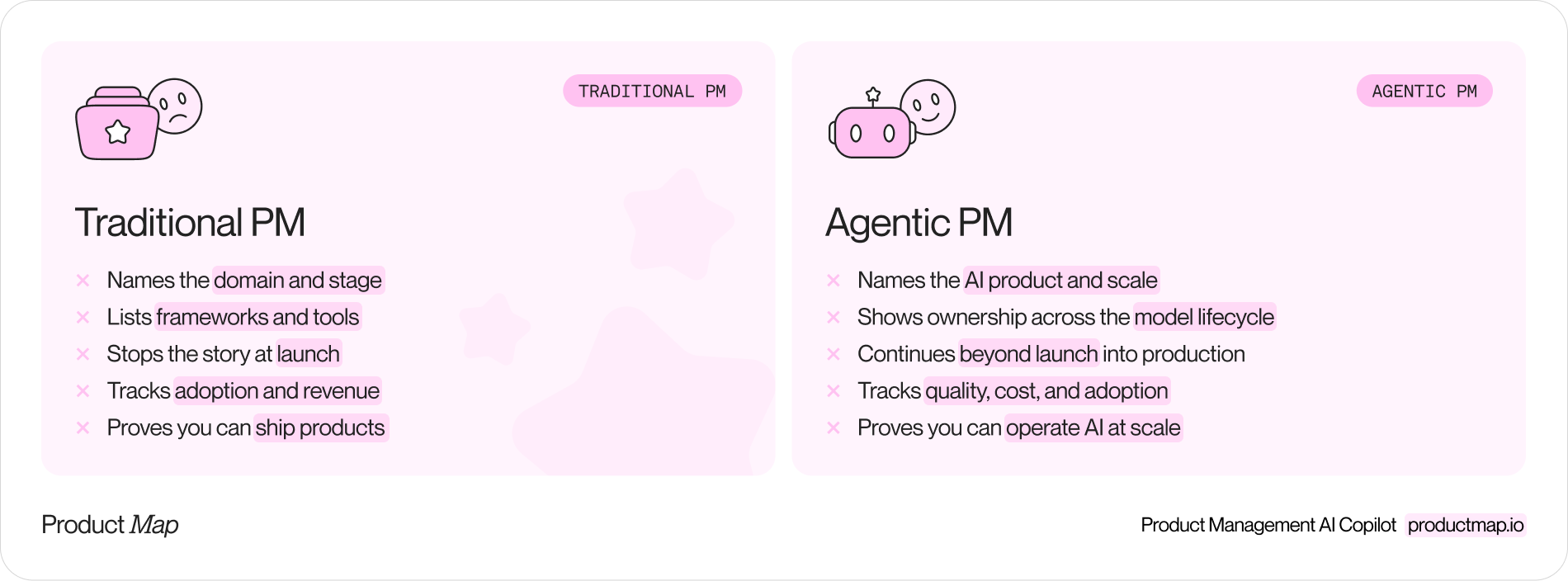
- Summary: a traditional PM summary names the domain and the stage. An AI PM summary names the model-backed product, its scale, and the number it moved.
- Skills: a traditional list covers frameworks and tools. An AI PM list covers the parts of the model lifecycle you've owned: evaluation, prompt design, data readiness, cost and latency, guardrails.
- Bullets: traditional bullets end at "launched." AI PM bullets continue past launch, because a model's behavior keeps changing in production and someone had to watch it.
- Metrics: traditional resumes report adoption and revenue. AI PM resumes add a quality number (accuracy, acceptance rate, edit rate) and a cost number (per query, per resolution).
The AI product manager skills breakdown covers the competency gap. The resume's only job is to show it's closed.
Resume format and structure
Length, section order, and ATS-friendly formatting
One page up to about eight years of experience, two pages beyond. Order the sections: header with LinkedIn, portfolio, and GitHub links; summary; experience; selected AI projects (only if you're transitioning); skills; education. The portfolio link sits in the header because AI PM loops now ask for a prototype, not a case study, and a recruiter who can click through in the first ten seconds will.
Formatting rules are boring on purpose. Single column. Standard section names ("Experience," never "Where I made an impact").
No tables, text boxes, or icons, because Workday, Greenhouse, and Lever parse them into noise. Calibri, Arial, or Georgia at 10.5 to 11 points. File name: Firstname-Lastname-AI-Product-Manager.pdf.
Weak and strong summaries
Weak: "Results-driven product manager passionate about AI and machine learning, with a proven track record of leading cross-functional teams to deliver impactful solutions."
Strong: "Product manager for a support-automation agent handling 38% of inbound tickets at a 200-person SaaS company. Own the eval set, the escalation rules, and the cost-per-resolution target, which fell from $1.90 to $0.60 in two quarters."
For a career switcher, an objective can replace the summary as long as it names an artifact: "Growth PM, four years, moving into AI product roles. Shipped an LLM onboarding assistant as a side project: 500 users, 41% activation lift in an A/B test. Looking for a team where the model is the product."
Technical skills an AI product manager resume needs
AI and ML hard skills to list
List only what you can defend for ten minutes in an interview. That rule halves most skills sections, and the half left over is the one recruiters trust.
- Model evaluation: building eval sets, offline vs online evals, defining task success for non-deterministic output.
- Prompt and context design: system prompts, prompt versioning, retrieval-augmented generation, context files agents read.
- Data readiness: knowing what data the model needs, what you have, and what's missing or unlabeled.
- Cost and latency budgeting: cost per query, token economics, when a smaller model is enough.
- Guardrails and failure modes: escalation rules, fallback behavior, monitoring for drift.
- Tools you've shipped with: the OpenAI or Anthropic API, Braintrust or LangSmith for evals, Lovable or v0 for prototypes.
Product and leadership skills
The AI section adds to the PM half. Discovery, prioritization, roadmap ownership, and stakeholder alignment carry the same weight, with three AI-specific versions worth naming: setting a quality bar with ML engineers, explaining a model failure to an executive without jargon, and writing a PRD with guardrails an agent can be held to.
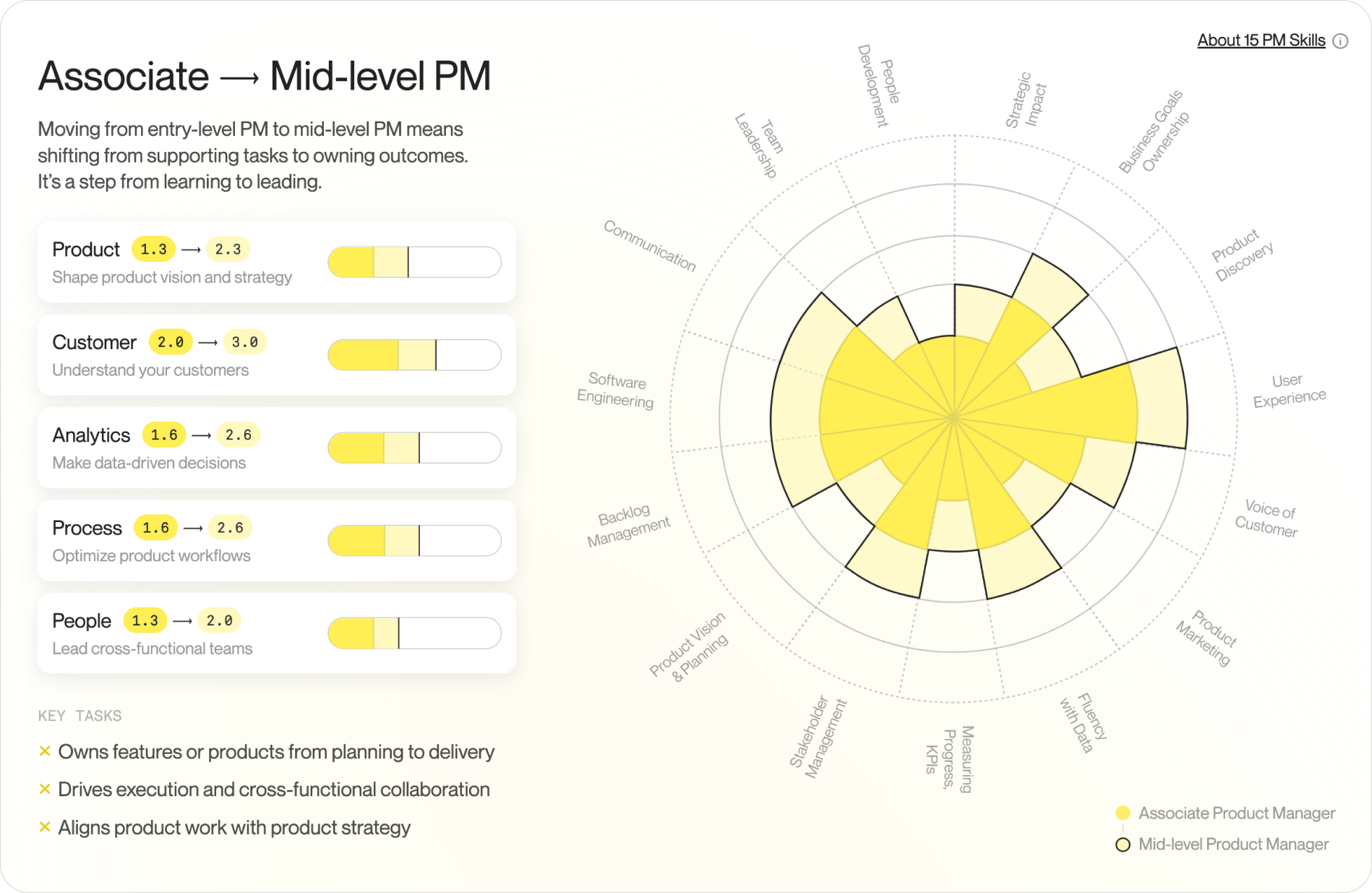
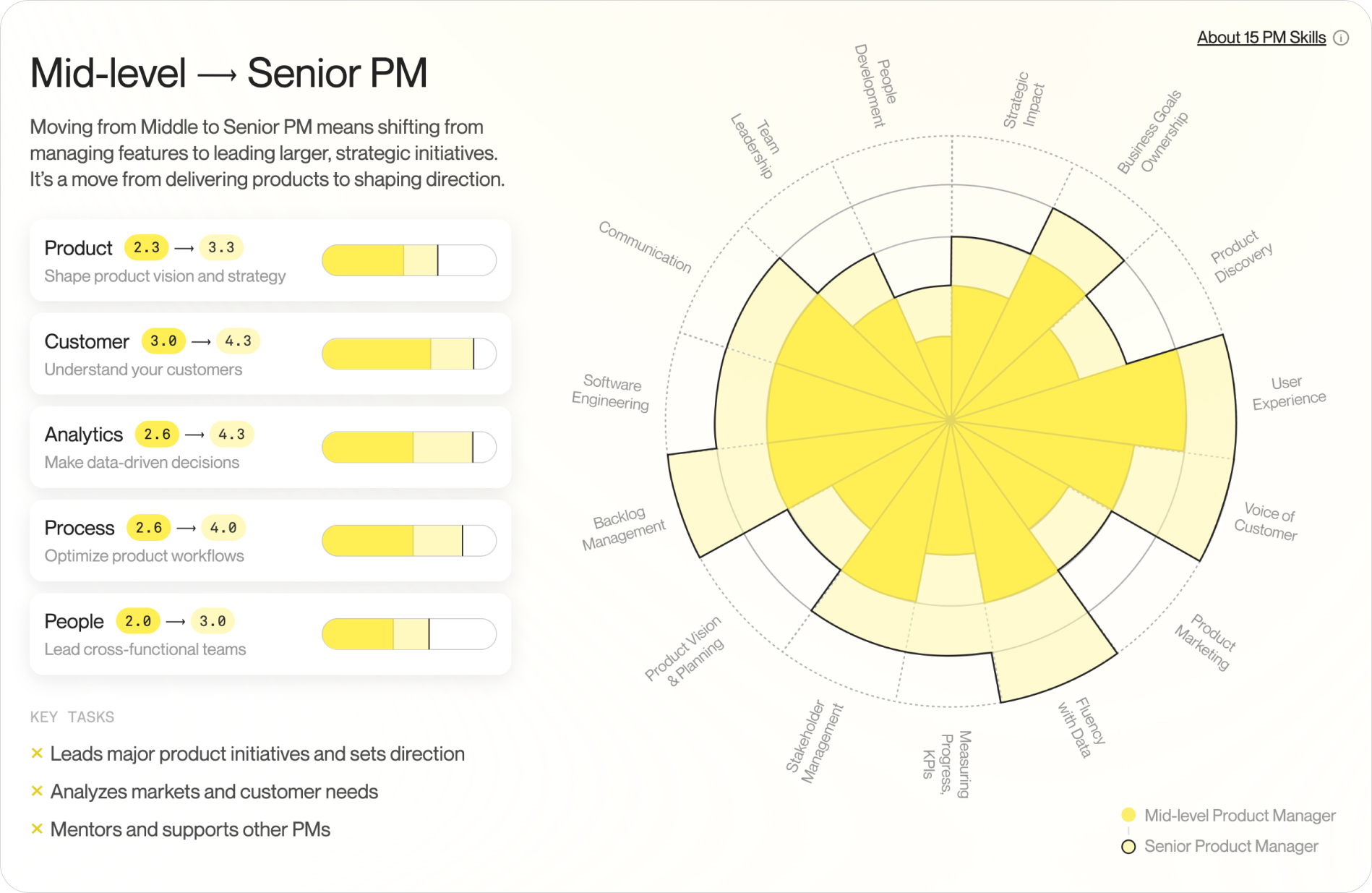
Hiring panels don't score "AI" as its own skill. They score the same 15 product management skills they use for every PM, then look for AI evidence inside those 15.
Five groups, three skills each: Product (Strategic Impact, Business Goals Ownership, Product Discovery), Customer (User Experience, Voice of Customer, Product Marketing), Analytics (Fluency with Data, Measuring Progress and KPIs, Stakeholder Management), Process (Product Vision and Planning, Backlog Management, Software Engineering), and People (Communication, Team Leadership, People Development). If a line in the skills section doesn't map to one of those 15, it's a tool. Tools go on the skills line. The skill goes in the bullet.
.png)
Technical vs non-technical AI product manager resumes
There are two AI PM jobs, and the resume should pick one. The builder PM leads with the model work: the eval set, the architecture choice, the API. The AI-experiences PM leads with the user outcome and keeps model literacy to one skills line and one bullet per role.
Three lines of fine-tuning detail on a non-technical application tells the hiring manager you'll fight the ML lead for their work. Match the depth to the type of AI PM role you're applying for.
Sample bullets you can copy
Every bullet below follows one formula: verb, AI artifact, scale, outcome number, quality or cost number. Swap in your figures and keep the structure.
Bullets for junior AI PMs
A junior bullet has to prove you supported discovery and delivery. Associate PMs turn customer and stakeholder input into clear requirements, coordinate with design and engineering, and share updates on what ships next. The bullets below stay at that level: an eval set you built, interviews you ran, tickets you classified.
- Built a 60-case eval set for a support summarization feature; caught a 22% hallucination rate on refund tickets before launch and cut it to 4% by adding retrieval over policy docs.
- Ran 14 user interviews on an AI search prototype built in Lovable; found users distrusted answers without sources, which became the top requirement in the PRD.
- Classified 1,800 support tickets with a tagging prompt, hand-checked a 200-ticket sample at 91% agreement, and produced the quarter's top five feedback themes for the roadmap review.
- Wrote acceptance criteria and a failure-mode table for an AI draft-reply feature; the edit rate on shipped drafts fell from 48% to 29% across three releases.
Bullets for senior AI PMs
A senior bullet has to prove a different job than a junior one. Senior PMs lead major initiatives, shape strategy, and mentor other PMs. That maps to level 3 on the 15 skills: you lead the initiative, you synthesize user, market, and business inputs, and you hold a measurable bar. If the bullet could sit on a mid-level resume with the title swapped, it isn't senior yet.
- Owned the roadmap for an agent resolving 38% of inbound tickets without a human; cut cost per resolution from $1.90 to $0.60 and held CSAT at 4.5 across 240,000 conversations.
- Set the launch bar at 92% task success on a 500-case eval and held the release twice when the model missed it; post-launch escalation rate landed at 6% against a 10% budget.
- Moved an AI writing feature from per-seat to usage-based pricing after plan margin fell eight points; gross margin recovered to 71% within two quarters.
- Led three PMs and two ML engineers through 11 model releases in a year, with a rollback playbook used twice and a monitoring dashboard the exec team reads weekly.
Quantify AI product impact
Three numbers per feature. An outcome number: activation, revenue, resolution rate. A quality number: accuracy, acceptance rate, edit rate, escalation rate. A cost number: per query, per resolution, margin on the plan. Nearly every candidate has the first. Few show the third, and the third tells a hiring manager you've seen an AI feature lose money and know why. If you have no outcome numbers, scale is still a number: "ran a 300-case eval every release for a year" is evidence.
ATS keywords in two tiers
Must-have and bonus keywords
Must-have keywords appear in the majority of AI PM postings, and a resume missing three of them rarely clears the first filter:
AI product manager, machine learning, large language models (LLM), generative AI, product roadmap, product strategy, cross-functional, data-driven, A/B testing, user research, PRD, KPIs, stakeholder management.
Bonus keywords separate you inside the shortlist:
prompt engineering, retrieval-augmented generation (RAG), model evaluation, evals, fine-tuning, AI agents, guardrails, responsible AI, LLMOps, SQL, Python, vector database, cost per query, latency.
Match keywords to the posting
Paste the posting into a model and ask for the 15 most repeated skill nouns. Put each one into a bullet where it's true, in the posting's exact phrasing. ATS matching is string matching: "LLM" and "large language model" are different tokens, so write both once. Skip the white-text keyword block. Parsers flag it, and a recruiter who spots it stops reading.
Score resume keywords against skills and topic names
Run this prompt on your resume before you send it. Paste the resume, then the posting if you have one. Ask for a coverage assessment and rewritten bullets, not a new keyword dump.
Context: I am applying for AI product manager roles. Attached is my resume. If I also paste a job description, treat its phrasing as the ATS source of truth.

Score against these 15 PM skills:
Product: Strategic Impact, Business Goals Ownership, Product Discovery
Customer: User Experience, Voice of Customer, Product Marketing
Analytics: Fluency with Data, Measuring Progress KPIs, Stakeholder Management
Process: Product Vision and Planning, Backlog Management, Software Engineering
People: Communication, Team Leadership, People Development

Also match these topic names when the resume can defend them:
Product Operations, Unit Economics, Ideal Customer Profile, Minimum Viable Product, Product Roadmaps, Prioritization, Context Engineering, Facilitation, Monetization and Pricing, User Research Methods, Product Analytics, Product Metrics, Prompt Engineering, Market Research, Needfinding Interviews, Competitor Analysis

Task: extract every skill and topic keyword from the resume. Score coverage. Suggest corrections.

Output:
1. Coverage: each of the 15 skills as Present, Weak, or Missing, with the exact phrase from the resume or a dash.
2. Topic hits: which topic names appear, and which AI-PM ones are missing (Context Engineering, Prompt Engineering, Product Analytics, Unit Economics, Prioritization).
3. ATS gaps: posting keywords that are absent. If I pasted a job description, use its exact nouns.
4. Corrections: rewrite up to five bullets so each names a skill or topic, a scale number, and a quality or cost number.

Constraints: quote only text in the resume. Mark inferred claims as INFERRED. Do not add a keyword I cannot defend in an interview. Do not invent metrics.

Quality bar: a hiring manager could use the coverage list as a scoring sheet in under three minutes.
Use the output as a punch list. If the model wants to add "context engineering" and you've never versioned a context file, leave it off. A keyword you can't walk through in the loop is worse than a gap.
Five mistakes that get an AI PM resume screened out
- Listing tools you've used as a consumer. ChatGPT and Copilot in the skills section tell a recruiter you have a browser. Tools belong in a bullet, attached to a shipped result.
- No quality or cost number anywhere. A resume full of adoption numbers and no accuracy or margin figure reads as a marketing resume with AI vocabulary.
- Claiming the engineer's work. "Built a recommendation model" invites one question you can't answer. "Owned the eval set and launch criteria for the recommendation model" survives the follow-up.
- Certificates above projects. Completion badges from three AI courses sit below one shipped project with a user count.
- AI in the title, none in the bullets. Recruiters call this AI-washing, and the loop catches it: hiring managers now ask candidates to walk through an eval case or open a prototype live.
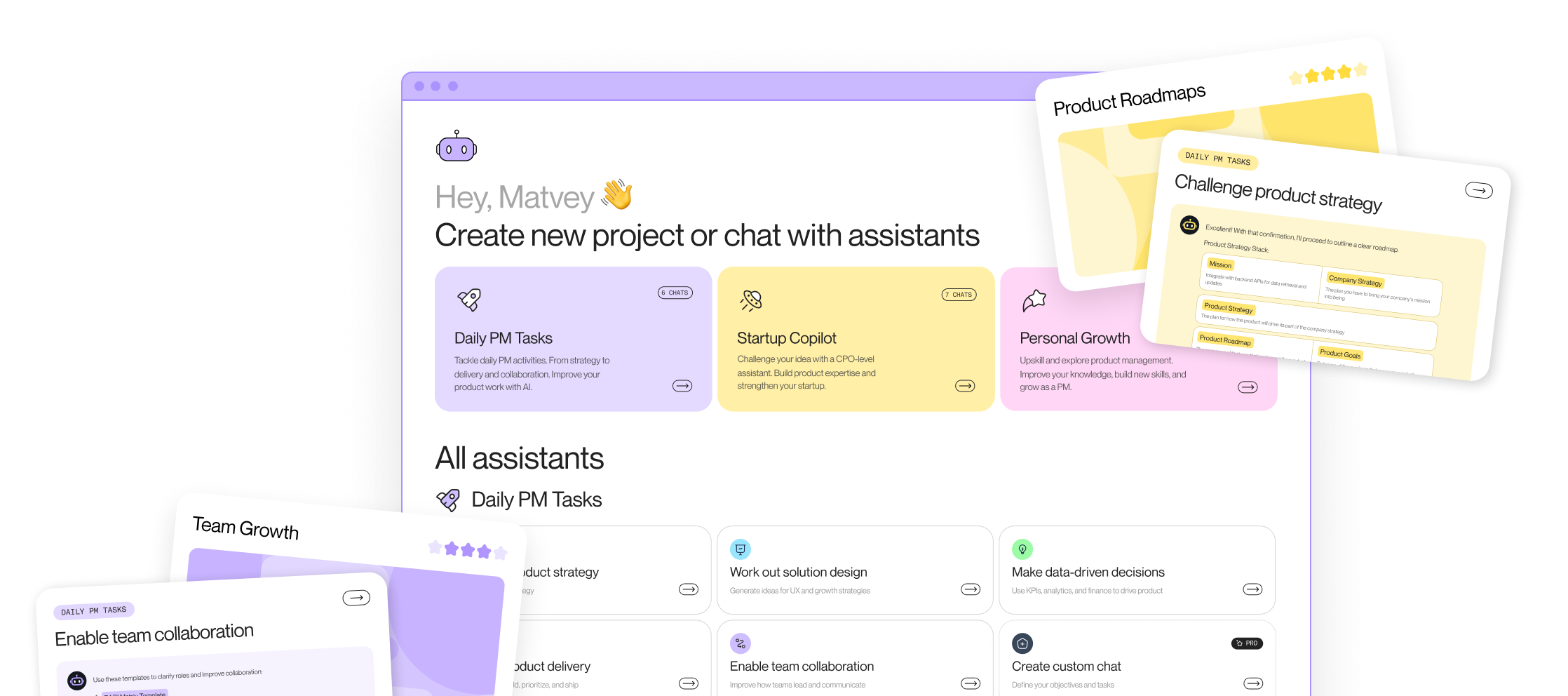
That last check is the one candidates underestimate. The loop asks you to defend a tradeoff the resume only hinted at. Product Map's CV and interview preparation agent scores a resume against the 15 PM skills hiring panels use as their rubric, then runs mock questions against your bullets.
.png)
FAQ
How long should an AI product manager resume be in 2026?
One page below roughly eight years of experience, two above. AI project depth is the usual excuse for a third page. Move the detail to the portfolio and link it from the header.
What are the latest AI PM hiring and skill trends?
Roles naming AI fluency carry a salary premium of about 35% over generalist postings, while roughly three quarters of employers say they can't find candidates with the skills. The PM job market has split into a rising top branch and an eroding middle, and employers screen for a shipped AI project, an eval set for it, and a plain-language view of cost and failure. Product Map's Q3 2026 skills report shows context engineering as the one top-five topic where junior and senior PMs start from the same line, which makes it the fastest skill to add this year.
PDF or DOCX: which file format passes ATS screening?
PDF, unless the portal says otherwise. Check the text is selectable, because a PDF exported as an image parses as blank. Both formats parse fine in a single-column layout.
How do you show AI experience from a non-AI PM role?
Add a "Selected AI projects" section between experience and skills, with one or two projects with real users and a metric. Then rewrite one bullet per current role to show AI in your own workflow: a feedback pipeline you built and checked, a prototype tested before engineering touched it. The path in how to become an AI product manager starts with the shipped project, and so should the resume.
The resume gets the loop, the artifact gets the offer
Rewrite the summary first, because it's the only paragraph a recruiter is guaranteed to read. Replace every bullet ending in "launched" with one ending in a quality or cost number. Then build the eval set or prototype the bullets promise, because the next stage asks you to open it. A resume naming what you measured, and a laptop showing it, is the pair getting hired in 2026.